Task controller
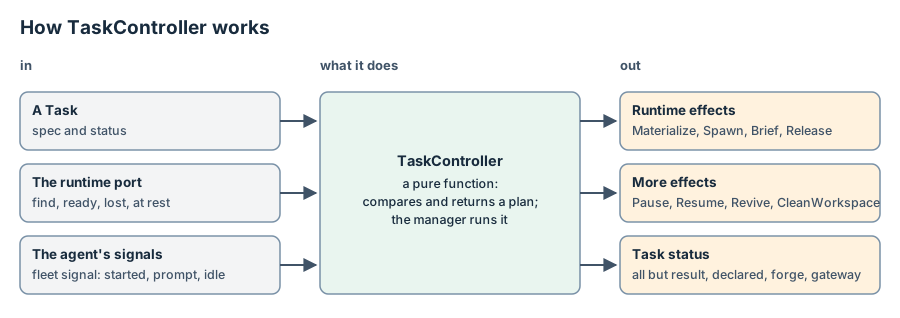
A Task runs one agent session for one brief. Its controller decides the next step from stored Task state and explicit observations. The manager performs that decision through the store and runtime ports.
| Read | Answers |
|---|---|
| Task | What do I apply, inspect and report as a worker? |
| Session | What is the agent a Task runs, and what does sessionState say about it? |
| TaskConfig | How do reusable defaults and frozen launches work? |
| EnvProvider | How do stored/file/command environment sources work? |
| Native config | How do I configure the store, runtime and model variables? |
| State machine | Which transitions, retries and recovery paths are possible? |
| Interface | What are the inputs, outputs, ports and write ordering? |
| Overall architecture | Where does this controller fit in Fleet? |
One run #
- A person applies a Task.
dispatch: falsekeeps it Pending. - A caller runs
fleet reconcile. For a dispatched Task on a reachable place, the controller plans a spawn under a deterministic session key. - The manager persists the intent, runs the effect and persists its receipt. Later passes recover ambiguous effects by their keys.
- A ready session receives its brief in its agent's own inbox. It counts
as delivered once the agent's prompt hook reports it through
fleet signal; a lost answer waits for that report and is never sent again (proven delivery). Messages queued withfleet sendfollow the same way, oldest first, one per pass, each under its own key. A working turn receives them too. - The worker reports through
fleet result. The controller concludes the Task, retaining the session until deletion; messages sent afterwards are still delivered. - With
pauseAfterMsset, the controller pauses an idle session through the runtime.fleet pausepauses it at once, with or withoutpauseAfterMs. The next inbox entry, orfleet attach --wake, resumes it. See pausing an idle session and pausing on request. - Deletion enters Releasing. The finalizer holds the record until the recorded session is released, once proven at rest or gone. The wait for rest has a bound: see releasing a session.
fleet reconcile is a bounded command. It repeats passes while changes are
made, then exits at a fixed point or --max-passes. It does not sleep until a
retry deadline or run a background watch; the caller invokes it again.
fleet up is the resident alternative: it retains the manager lease and
periodically invokes bounded sweeps for all due Tasks, independently of agent
activity, and creates no Task of its own. See
bootstrap and recovery.
A starting Task does not wait for a sweep per step. A starting Task is a dispatched Task that is not briefed yet. A Task with no brief stops starting once its session runs. Each pass reconciles the starting Tasks first. Between two Tasks of a pass, at most every 250 ms, the manager lists the Tasks again and reconciles each starting Task that is new or has a new generation. The manager reconciles a starting Task again after each step that moves it, up to 16 steps in a row. A starting Task that waits for its agent keeps the length of its signal file. The manager reconciles it again when that length changes: between two other Tasks of the pass, or during the wait for the next sweep. The start of a Task thus follows its agent, not the number of Tasks that run.
NeedsAttention is a condition, not a phase: delivery reads and releases can
recover while attention is raised. See the state machine
for the distinction between bounded sends and continuing recovery attempts.
Implementation and evidence #
| Responsibility | Source | Tests |
|---|---|---|
| Pure decisions and requested probes | TaskController | Controller transitions |
| Resource and effect types | Task types, plans | CLI lifecycle |
| Lease, status, intent and receipt ordering | Manager | Store contract, CLI lifecycle |
| Session definition and observed state | Session, TaskController | Session unit tests, Controller transitions, CLI lifecycle |
| Session identity and the runtime protocol | Exec runtime | Exec runtime E2E |
| Workspace trust before the brief | Runtime port, Exec runtime, harness profiles | Workspace trust E2E, Controller transitions |
| Pausing an idle session and resuming it | TaskController, runtime port, Fake runtime | Pause E2E, Controller transitions |
Inbox: fleet send, typed mutations and delivery |
Inbox types, verbs, store | Inbox E2E, Store contract, Controller transitions |
The lifecycle E2E suite drives the built CLI from apply to result and release,
including crashes, failed attempts and Unknown observations. The exec runtime
E2E suite drives runtime-mux and a reference script: start and release,
signals, a revive on the reported conversation, and brief delivery.
Task state machine #
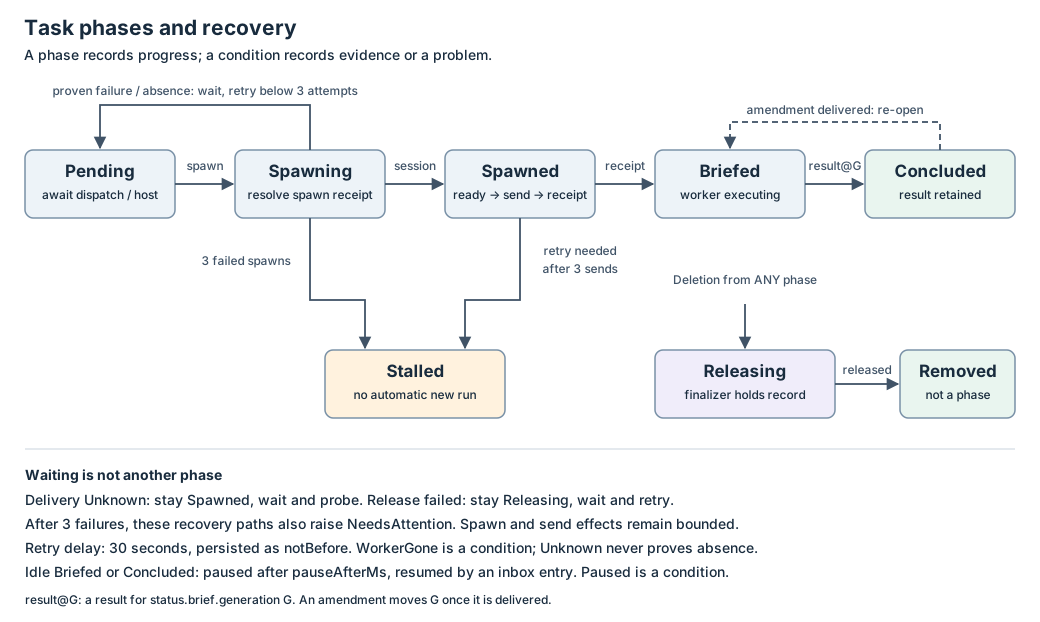
status.phase records execution progress. Conditions describe facts and
problems within that phase; an effect intent or a worker's result is not
proof of an external artifact landing. The
controller interface defines the probes and effects used here.
Transition rules #
The manager only reconciles Tasks whose notBefore is absent or due. It
reconciles a Concluded Task only in these cases:
- Its inbox is nonempty, or it is owed a catch-up note.
- It is being deleted.
- Its session recheck is due:
status.sessionCheckedAtis absent or 5 minutes old. - Its session may be paused: see pausing an idle session. The manager then reconciles it on every sweep, so that its activity is watched.
fleet pauseasked for a pause that is not answered yet, and its session may be paused: see pausing on request. The manager then reconciles it on every sweep until the pause.- It is paused and dispatched, and a
--wakeoffleet attachorfleet shellasked for it at or after the pause (status.wakeRequestedAt). The manager then reconciles it on every sweep until it resumes.
Deletion takes precedence over normal progress, including Stalled and
Concluded. With no deletion, Stalled is terminal. Concluded is terminal
until a delivered amendment re-opens it. A Concluded Task is due again for
delivery and for the session recheck only.
A recorded worker result for status.brief.generation concludes an active
Task before its ordinary phase logic runs. A result for an older generation
concludes nothing.
| Current phase | Observation or input | Next phase | Decision |
|---|---|---|---|
| Pending | dispatch: false |
Pending | Set Spawned=False/AwaitingDispatch; do not spawn. |
| Pending | Dispatched; host false, Unknown or unanswered | Pending | Report host condition; do not spawn. |
| Pending | Dispatched; host reachable; a non-empty URL list and status.workspace is empty; no workspace call in flight |
Pending | Increment materialize attempt; set WorkspaceReady=Unknown/Materializing; persist the intent and plan Materialize, the runtime's workspace call, under the workspace key. |
| Pending | Known Materialized receipt, or a missing/Unknown receipt and the same call again answers it made the workspace |
Spawning | Record status.workspace; set WorkspaceReady=True (Materialized or Adopted); plan Spawn with the workspace as ready. |
| Pending | Known failure, or a missing/Unknown receipt and the same call again answers it made nothing; attempts below 3 | Pending | Set WorkspaceReady=False/MaterializeRetry; wait, then call again under the next key. |
| Pending | Known Unsupported receipt: the runtime does not handle a URL |
Pending | Give the attempt back; set WorkspaceReady=False and raise NeedsAttention, both WorkspaceUnsupported; wait, then call again. Nothing spawns. |
| Pending | Same failure with 3 materialize attempts spent | Stalled | Set WorkspaceReady=False/MaterializeFailed; raise Stalled/MaterializeAttemptsExhausted and NeedsAttention. |
| Pending | Missing/Unknown receipt; the call again is Unknown too | Pending | Set WorkspaceReady=Unknown/WorkspaceUnreadable; spend no attempt. |
| Pending | Dispatched; host reachable | Spawning | Increment spawn attempt; persist spawn intent and plan Spawn. |
| Spawning | Known Spawned receipt | Spawned | Record returned SessionRef. |
| Spawning | Missing/Unknown receipt; session key found | Spawned | Adopt the session and recover its receipt. |
| Spawning | Known failure, or ambiguous outcome with key proven absent; attempts below 3 | Pending | Schedule a wait before another spawn. |
| Spawning | Known TrustUnmapped receipt |
Pending | Give the attempt back; set Spawned=False and NeedsAttention, both TrustUnmapped; schedule a wait, then spawn again under the same key. |
| Spawning | Same failure with 3 spawn attempts spent | Stalled | Raise Stalled/SpawnAttemptsExhausted and NeedsAttention. |
| Spawning | Missing/Unknown receipt; session list unreadable | Spawning | Report Unknown; never infer absence or respawn blindly. |
| Spawned | Readable lookup lacks the recorded session identity | Spawned | Raise WorkerGone and NeedsAttention; do not send. |
| Spawned | spec.brief is empty: an interactive Task |
Spawned | Set Briefed=False/Interactive; send nothing, deliver the inbox, and wait for the user. The Task stays Spawned. |
| Spawned | Known Queued receipt for the brief | Spawned | Set Briefed=False/BriefUndelivered and raise NeedsAttention/BriefUndelivered with the runtime's note. Never send the brief again, and deliver no inbox entry. |
| Spawned | Known Delivered receipt, and the agent's prompt hook reported the brief (or its harness has none); or, with the answer lost, the hook reported it, or for a harness with no prompt hook the journal proves it | Briefed | Record the brief key and the generation of the brief intent; a recovered delivery becomes a receipt. |
| Spawned | The brief was sent, or may have been, and the agent's prompt hook has not reported it, or its report cannot be read | Spawned | Set Briefed=Unknown/AwaitingPrompt. Never send it again; read the hook's report on the next pass. |
| Spawned | Workspace trust Known untrusted | Spawned | Set WorkspaceTrusted=False with the gap as reason, raise NeedsAttention/WorkspaceUntrusted, wait, then probe again. Do not send. |
| Spawned | Workspace trust Unknown | Spawned | Set WorkspaceTrusted=Unknown/TrustUnknown. Do not send and raise no attention. Probe again on the next pass, without a wait. |
| Spawned | Workspace trust unanswered | Spawned | Do not send. Change nothing. |
| Spawned | No brief intent yet, or delivery proven absent; workspace trusted; fresh readiness true; fewer than 3 sends spent | Spawned | Set WorkspaceTrusted=True/Trusted and clear its attention. Persist brief intent and plan Brief, with the brief and every amendment so far as one message, for the current generation. A later pass consumes its receipt. |
| Spawned | Session not ready or readiness Unknown | Spawned | Do not send, including on a retry. Receipt recovery may still proceed. |
| Spawned | Delivery unreadable after an ambiguous send | Spawned | Wait, then probe again; after 3 unreadable probes raise NeedsAttention. |
| Spawned | Another send would exceed the 3-send bound | Stalled | Raise Stalled/BriefAttemptsExhausted and NeedsAttention. |
| Briefed | No result for status.brief.generation; recorded session present or lookup unreadable |
Briefed | Wait for result; Unknown does not mean WorkerGone. |
| Briefed | No result for status.brief.generation; readable lookup lacks recorded identity |
Briefed | Raise WorkerGone and NeedsAttention; never abandon or respawn. |
| Spawned, Briefed, or Concluded with a delivery due | Session lost: the runtime holds the session, but its agent's window is gone | unchanged | Set SessionLost=True/WindowGone. Send nothing. With dispatch: true, persist a revive intent and plan Revive under revive/<n>. A held Task is not revived. |
| Spawned, Briefed, or Concluded with a delivery due | Still lost after a revive | unchanged | Wait 30 seconds from the last revive, then revive again. After three revives have left the session lost, each further revive raises NeedsAttention/ReviveFailed. When each of those three started the agent (a Known Revived receipt) and its window still went away, its agent cannot resume it: set SessionLost=True/CannotResume and NeedsAttention/CannotResume, and revive no more until the window is seen again. fleet attach then exits 3 and opens no view. |
| Spawned, Briefed, or Concluded with a delivery due | Not lost while SessionLost is True |
unchanged | Set SessionLost=False/Revived. When the brief has a receipt and the Task has not concluded, owe a catch-up note under catchup/<n>; a Concluded Task is resumed plainly. In Spawned, the brief protocol continues. |
| Briefed or Concluded | A catch-up note is owed | unchanged | Send the note as an inbox entry is sent, before any inbox entry. In Briefed, the note repeats the brief, the amendments the worker has, and their generation. |
| Briefed, or Concluded and watched | A pause setting; a harness with a resume argv and a reported conversation; the agent's hooks report Idle without a break for pauseAfterMs; the session observed running and not known lost; nothing to deliver or in flight |
unchanged | Persist a pause intent and plan Pause under pause/<n>. See pausing an idle session. |
| Briefed, or Concluded and watched | A pending pauseRequestedAt; a harness with a resume argv and a reported conversation; the session observed running and not known lost; nothing to deliver or in flight |
unchanged | Record the request in pauseRequestAnswered, persist a pause intent and plan Pause under pause/<n>. See pausing on request. |
| Briefed or Concluded | Known Paused receipt, or a missing/Unknown receipt with the session observed stopped | unchanged | Set Paused=True/Requested for a pending pauseRequestedAt, else Paused=True/Idle. Raise no WorkerGone, SessionLost or revive. |
| Briefed or Concluded | Failed pause receipt, or a missing/Unknown receipt with the session observed running | unchanged | Set Paused=False/PauseFailed. The idle time starts again. A request is not tried again. |
| Briefed, or Concluded with a delivery due or watched | Session observed stopped and Fleet did not stop it | unchanged | Set Paused=True/External. |
| Briefed or Concluded | Paused; an inbox entry to deliver, or wakeRequestedAt at or after the Paused=True transition; dispatch: true |
unchanged | Persist a resume intent and plan Resume under resume/<n>. Send nothing. |
| Briefed or Concluded | Known Resumed receipt, a missing/Unknown receipt with the session observed running, or a paused session observed running | unchanged | Set Paused=False/Resumed. Send nothing of Fleet's own: the agent continues its conversation, and only the inbox is delivered. |
| Briefed or Concluded | Failed resume receipt, or a missing/Unknown receipt with the session observed stopped | unchanged | Wait 30 seconds from the last resume, then resume again. After three resumes have left the session stopped, each further resume also raises NeedsAttention/ResumeFailed. |
| Active phase | Accepted worker result for status.brief.generation is stored |
Concluded | Set Concluded=True/ResultRecorded; keep the session. |
| Spawned, Briefed or Concluded | Oldest inbox entry has no receipt; session ready; nothing else sent this pass | unchanged | Persist the entry's intent and plan Brief under its key; one entry per pass. In Spawned the brief goes first: nothing is delivered before the brief was sent, while a brief send is unconfirmed, or while the agent's prompt hook has not reported the brief. |
| Spawned, Briefed or Concluded | Oldest inbox entry; session not ready or Unknown | unchanged | Do not send. Receipt recovery through BriefDelivered may still proceed. |
| Spawned, Briefed or Concluded | Known Delivered receipt and the agent's prompt hook reported the entry (or its harness has none); or, with the answer lost, the hook reported it, or for a harness with no prompt hook the journal proves it | unchanged | Record the receipt in status.deliveries with the runtime's route, and remove the entry, in one write; its intent, receipt and attempt records go with it. Until the hook reports it, the entry waits and is never sent again. Later entries wait behind it. |
| Spawned, Briefed or Concluded | Known Delivered receipt for an entry or a catch-up note; the agent's prompt hook has reported a new prompt since the send was planned, and not this one | unchanged | Raise NeedsAttention/DeliveryUnconfirmed naming it. It stays, marked failed, and is never sent again. Later entries are still delivered. |
| Spawned, Briefed or Concluded | Known Queued receipt for an entry or a catch-up note | unchanged | Mark it failed and raise NeedsAttention/DeliveryQueued with the runtime's note. Never send it again. The entry stays in status.inbox, and later entries are still delivered. |
| Spawned, Briefed or Concluded | Oldest entry is an amendment at or below status.brief.generation, or one never sent with a newer amendment queued behind it |
unchanged | Record its receipt without a send. The worker has it already, or the newer message carries it. |
| Briefed | Amendment entry delivered | Briefed | Set status.brief to the entry's key and generation. |
| Concluded | Amendment entry delivered | Briefed | Set status.brief to the entry's key and generation, and Concluded=False/Amended. Keep the old result. |
| Spawned, Briefed or Concluded | Entry send refused (Known failure) | unchanged | Wait, then send again under the same key to a session observed ready; at most 3 sends. |
| Spawned, Briefed or Concluded | Entry delivery unreadable after an ambiguous send | unchanged | Wait, then read the journal again. After 3 unreadable reads, raise NeedsAttention/DeliveryUnconfirmed naming the entry. The entry stays, marked failed, and is never sent again. Later entries are still delivered. |
| Spawned, Briefed or Concluded | A fourth send of one entry would be needed | unchanged | NeedsAttention/DeliveryFailed naming the entry; the entry stays, marked failed, and later entries are still delivered. |
| Spawned, Briefed or Concluded | More than 20 entries still to deliver, not counting entries given up on | unchanged | NeedsAttention/InboxFull; cleared once the count is back within the bound. |
| Concluded | Empty inbox; session recheck due; lookup answered | Concluded | Record sessionCheckedAt; the next recheck is due 5 minutes later. |
| Concluded | Readable lookup lacks the recorded session | Concluded | WorkerGone and NeedsAttention; never a respawn. |
| Stalled | Any inbox entry | Stalled | Nothing is delivered; Stalled has no session to deliver to. |
| Any phase | Task marked deleting | Releasing | Resolve spawn ambiguity if needed; release once at rest, proven absent, or past RELEASE_GRACE_MS. A deleting Task delivers nothing. |
| Releasing | Busy session or Unknown rest, within RELEASE_GRACE_MS of deletionTimestamp |
Releasing | Keep finalizer; wait for safe evidence. |
| Releasing | Busy session or Unknown rest, RELEASE_GRACE_MS or more after deletionTimestamp |
Releasing | Plan Release, as for a session at rest. |
| Releasing | Unreadable session lookup | Releasing | Keep finalizer; wait for a readable lookup. |
| Releasing | Failed, missing or Unknown release receipt | Releasing | Wait and retry. After 3 attempts raise NeedsAttention with the last failure, and double the wait with each further attempt, up to RETRY_BACKOFF_MAX_MS. |
| Releasing | Known Released receipt, or nothing was spawned and nothing remains to release | Record removed | Remove finalizer; removal is not another phase. |
A Spawned phase without a SessionRef is an invalid internal combination; the controller returns it to Pending instead of sending to nobody. Normal store and controller paths record identity before entering Spawned.
Releasing a session #
A deleted Task waits for its session to be at rest, so that Fleet does not
stop an agent in the middle of a turn. The agent's own hooks say whether it
is at rest. A hook can fail to report the end of a turn, for example when a
person interrupts the agent. Then the last report says working for ever.
The wait has a bound, RELEASE_GRACE_MS (5 minutes), from the Task's
metadata.deletionTimestamp:
- Within the bound, a busy session keeps
Released=False/SessionBusy. An Unknown rest keepsReleased=Unknown/AtRestUnknown. - Past the bound, TaskController plans
Releasefor a busy session or an Unknown rest, as for a session at rest. - The release and its workspace clean run as always.
workspace-gitcommits the work that exists only in the worktree torefs/fleet/preserved/<key>/<name>before it removes the worktree. See Workspace.
The bound does not apply to a session lookup that Fleet cannot read. Unknown is not absence. A release then waits for a readable lookup. A failed release is retried as the retries table says.
Retries and recovery #
MAX_ATTEMPTS=3 bounds spawn effects and brief sends. RETRY_DELAY_MS=30000
is the wait between attempts, persisted as status.notBefore across process
restarts. Releases and workspace cleans have no bound on attempts. After 3
failures their wait doubles with each further failure, up to
RETRY_BACKOFF_MAX_MS=3600000. These are controller constants, not extra
configuration resources.
| Situation | Evidence required before proceeding | Wait and exhaustion behavior |
|---|---|---|
| Spawn failed or was proven absent | A failure receipt, or readable key lookup after an ambiguous spawn | Wait before the next attempt; after the third failed attempt enter Stalled. |
| Workspace not trusted | A Trusted answer on a later pass | Wait before each probe. A held brief is not a send and spends no attempt; the Task never stalls on it. |
| Brief send refused | Known failure before confirmed delivery | Wait before retry; every retry needs fresh readiness; at most 3 sends. |
| Brief send answer missing/Unknown | The agent's prompt hook report of the brief's digest; for a harness with no prompt hook, the session's journal under the original brief key | Reported or Delivered recovers without sending; only a journal can prove it not delivered, which permits a ready-session send; an unreported or Unknown answer waits and reads again, never resends. |
| Delivery journal unreadable | A later readable journal answer | After 3 failures raise NeedsAttention, but keep probing after each wait. Recovery clears BriefUnconfirmed attention. |
| Release answer missing/Unknown or failed | Recorded session at rest, or key proven absent; adapter preserves exact identity | Wait once per failed attempt, then retry. After 3 attempts raise NeedsAttention/ReleaseFailed with the last failure, and back off: each further wait doubles, up to RETRY_BACKOFF_MAX_MS. Success releases the finalizer. A workspace clean retries the same way, with NeedsAttention/CleanFailed. |
| Session lookup unreadable | A later readable lookup | Unknown is not absence and does not by itself trigger WorkerGone or permit a blind spawn. |
| Session lost | A Known lost answer; Unknown revives nothing | Revive at once, then wait before each further revive. After three revives have left the session lost, raise NeedsAttention, and continue: a revive leaves a running session alone. |
| Pause answer missing/Unknown | Whether the session is stopped | Stopped records the pause. Running records a failed pause. Unknown waits; the stop is never repeated blindly. |
| Resume refused, or answer missing/Unknown | Whether the session is stopped | Running records the resume. Stopped resumes again after a wait. Unknown waits. After three resumes have left the session stopped, raise NeedsAttention, and continue: a resume leaves a running session alone. |
| Catch-up note send refused or answer missing/Unknown | As for an inbox entry, under the note's key | At most 3 sends, then DeliveryFailed naming the note. After 3 unreadable reads, DeliveryUnconfirmed naming it. Either way the inbox goes next. |
| Inbox entry send refused or answer missing/Unknown | As for the brief, under the entry's key: a failure receipt, or the journal's answer | Wait before retry; every retry needs fresh readiness; at most 3 sends per entry, then DeliveryFailed and the next entry. Unknown journal reads continue after each wait; the third raises DeliveryUnconfirmed and the next entry goes. |
A single brief key is reused so retrying a proven-undelivered brief does not create a new delivery identity, and each inbox entry's key is reused the same way. A send whose answer is lost is never repeated until a proof says that the text did not arrive. A key reused by a different session is not proof that the original worker is alive and does not transfer at-rest proof to that replacement.
fleet reconcile exits at a fixed point; it does not wait for notBefore.
Invoke it again after the deadline. Stalled Tasks do not retry automatically;
unreadable-delivery and release recovery continue on later due invocations.
A different brief or a fresh run requires a new Task. An addition to the
brief is an amendment, through fleet amend; a Stalled or deleting Task
refuses one. Changing dispatch does not clear attempt counters or revive a
Stalled Task.
Conditions #
Each condition carries status (True, False or Unknown), reason, message,
observedGeneration and lastTransitionTime. The transition timestamp is
retained when its status has not changed against stored state. Conditions
are last recorded observations; absence of a condition is not a True value.
| Type | True means / relevant reason |
|---|---|
| HostReachable | The host answered reachable during the dispatch check. |
| WorkspaceReady | The workspace the runtime makes is whole: Materialized or Adopted. Unknown while Materializing, WorkspaceUnreadable, Cleaning or CleanRetry. False with MaterializeRetry, MaterializeFailed, WorkspaceUnsupported or, after the release, Cleaned. Absent for an empty URL list. |
| Spawned | The spawn returned a session or the controller adopted its key. |
| Briefed | The brief has a ReceiptWritten or ReceiptRecovered record. |
| Stalled | MaterializeAttemptsExhausted, SpawnAttemptsExhausted or BriefAttemptsExhausted. |
| WorkerGone | A readable lookup no longer shows the recorded identity under its key (SessionGone). |
| Concluded | A worker result for status.brief.generation was accepted and observed (ResultRecorded). False with Amended after a delivered amendment re-opened the Task. |
| Released | A known release completed, or there was nothing to release. |
| WorkspaceTrusted | The session's agent trusts its workspace (Trusted). False reasons are Unsupported and Mismatch; Unknown is TrustUnknown. |
| SessionLost | The runtime holds the session, but its agent's window is gone (WindowGone). False after a lost session is back (Revived). |
| Paused | The runtime holds the session with its agent stopped. Idle when Fleet paused it while its agent was idle; Requested when Fleet paused it for fleet pause; External when Fleet found it stopped. False with Resumed once the agent runs again, and with PauseFailed after a pause that did not happen. The phase does not change. |
| NeedsAttention | Reason is Stalled, WorkerGone, BriefUnconfirmed, ReleaseFailed, DeliveryFailed, DeliveryUnconfirmed, DeliveryQueued, BriefUndelivered, InboxFull, WorkspaceUnsupported, TrustUnmapped, WorkspaceUntrusted, ReviveFailed, CannotResume, ResumeFailed or CleanFailed. |
WorkerGone clears when the exact recorded session is seen again.
WorkspaceUnsupported clears when a later workspace call does not answer Unsupported.
TrustUnmapped clears when a later spawn does not answer TrustUnmapped. A successful
delivery recovery clears attention whose reason is BriefUnconfirmed. A
delivery clears attention whose reason is DeliveryUnconfirmed while no
entry is marked failed. An inbox drained back within its bound clears InboxFull.
A Trusted answer clears WorkspaceUntrusted.
BriefUndelivered and DeliveryQueued stay until a person acts on the Task.
ReviveFailed and CannotResume clear when the session is seen not lost.
ResumeFailed clears when the session is seen running.
DeliveryFailed and DeliveryUnconfirmed stay while a failed entry does. A
successful release removes the Task; a worker result alone is not a general
reset of previous conditions. NeedsAttention does not universally stop the
controller: its reason and phase determine what continues. Delivering an
inbox entry changes no phase and no condition other than NeedsAttention
(InboxFull, DeliveryFailed, DeliveryUnconfirmed, DeliveryQueued). A
delivered amendment also re-opens a Concluded Task, with Concluded=False/Amended.
After a host reboot #
A host reboot ends every agent process. The Task keeps its session, brief
record, counters and conversation. Its workspace stays on disk. When the
runtime still holds the session's key with its process exited, lost
answers true. Fleet then resumes the work in the same session:
fleet up starts ──> sweep ──> Lost? ─yes─> Revive (same id, same worktree, conversation resumed)
                                │                │
                                no               v
                                │          next pass: not lost ──> SessionLost=False/Revived
                                v                                    │
                       normal protocol                 Briefed: catch-up note + brief, generation unchanged
                                                       Concluded: plain resume, then the waiting inbox
- Spawned, Briefed and unconcluded Tasks are revived on the first sweep.
- A Concluded Task reads
SessionLost=TrueandsessionState: Loston its next session recheck, with noagentState. It is revived when its inbox has an entry for it, or when a view attaches it:fleet attachasks for the revive and waits for the window. Change requests the worker declared are still followed. Their feedback arrives as inbox entries. - A held Task (
dispatch: false) is never revived. - A revive never creates a second session. The brief key is never sent again. The catch-up note has its own key and journal entry.
- The brief record keeps its generation. A result for another generation is still refused. An amendment that waits is delivered after the catch-up note.
- A deleting Task is released, not revived. A session with no window is at rest.
- A Task whose session row was deleted is
WorkerGone, as before. Fleet does not respawn it.
The manager must run again after the reboot. See
running fleet up.
Pausing an idle session #
An idle session costs a process, its memory and a terminal while its Task waits. Fleet pauses the session through the runtime and resumes it when work arrives. A pause stops the agent's process. The Task, the session's key, its workspace and the agent's conversation stay. A resume starts the harness profile's resume argv on that conversation, under the same key.
A pause ends background work in the agent. A resumed agent does not start its background shells, Monitors or loops again. For this reason, Fleet pauses only on a Known Idle answer from the runtime. Fleet types nothing of its own into a resumed agent: the agent continues its conversation, and only the inbox is delivered.
Briefed/Concluded ──Idle for pauseAfterMs──> Pause ──> Paused=True/Idle
        ^                                                   │
        │                         inbox entry, or fleet attach --wake
        │                                                   v
  the inbox, if any (no note) <── Paused=False/Resumed <── Resume
The controller plans a pause when all of these hold:
pauseAfterMsis set, on the Task or on its TaskConfig.dispatchis true, and the Task is not deleting.- The phase is Briefed, or Concluded.
- The inbox holds no entry to deliver, and no catch-up note is owed.
- No brief, revive or resume waits for its outcome.
- The runtime can pause. The fake runtime can. The exec runtime can when
the runtime's
manifestdeclares thepauseverb (pause), asruntime-muxdoes. - The harness profile has a resume argv, and the agent's hooks reported its conversation. A stop of any other agent ends its conversation, so Fleet never pauses aider or a program.
- The agent's own hooks reported Idle (
fleet signal idle) on every pass forpauseAfterMs, and on the pass that plans the pause.status.idleSincerecords the first Idle answer. Active, Unknown, a pass that sent something, a recorded result or a pass that does not watch the session clears it. - On that pass, the session is observed running and is not known lost.
These rules apply to a paused session:
- An inbox entry plans one resume. Entries that arrive meanwhile wait in the inbox. Delivery then waits for readiness, as before.
fleet attach --wakeandfleet shell --wakeplan one resume too. They setstatus.wakeRequestedAton a paused Task, then wait forPausedto leave True before they ask the runtime for the stream. A request older than the pause resumes nothing. A wake queues no text and types nothing: the agent continues its conversation. Without--wake, both exit 3 and say the Task is paused, so a view that attaches every Task in the background wakes nothing.- A resumed worker is owed no catch-up note. Only a revived worker gets one.
- A session stopped outside Fleet sets
Paused=True/External. The next inbox entry, or a wake, resumes it. - A paused session found running again sets
Paused=False/Resumed. - A pause never raises WorkerGone or SessionLost, and never revives.
- Stalled, held and deleting Tasks are never resumed.
- Deleting a paused Task releases it: a stopped session is at rest.
- A revived Concluded Task owed a catch-up note is not paused again until the note is delivered. The manager reconciles it until then, and the note is sent once the session is ready, with or without an inbox entry.
pauseAfterMs absent means that Fleet never pauses the session. fleet init
writes the TaskConfig default with pauseAfterMs 1800000, 30 minutes,
which a Task with no configRef takes
(TaskConfig).
Activity comes from the agent's hooks, never from the runtime: see signals. A session whose hooks reported nothing, or whose report cannot be read, has Unknown activity, so Fleet never pauses it.
Pausing on request #
fleet pause TASK asks for a pause now. The verb sets
status.pauseRequestedAt to the current time through a typed store
mutation, and prints Task/TASK pause requested. It exits 3 for a Task
that does not exist, and exits 1 for a deleting Task. The pause is
TaskController's, on its next pass.
A request is pending while it was made after all of these:
- the last request the controller planned a pause for
(
status.pauseRequestAnswered); - the last
Pausedtransition: a pause or a resume; - the last wake (
status.wakeRequestedAt).
The controller pauses for a pending request under the rules of pausing an idle session, with these differences:
pauseAfterMsis not necessary.- The agent's activity does not decide. A working agent is paused too, and loses its background work, as a person asked.
The paused session is Paused=True/Requested. An inbox entry,
fleet attach --wake or fleet shell --wake resumes it as any paused
session.
A pending request that the controller cannot honour yet stays pending. It
raises nothing. The controller honours it when the session becomes
pausable, for example after the inbox is delivered. A later wake or resume
supersedes it. The controller acts on a request once: after a refused
pause (Paused=False/PauseFailed) it does not try again.
Signals #
The signal port is how an agent
reports its state. Each spawn gets FLEET_SIGNAL_FILE in its environment:
<data dir>/signals/<session key>.jsonl for a session on this machine. The
agent's harness profile installs hooks that run
fleet signal <state>, which appends one JSON line to that file and does
nothing when the variable is unset:
| State | Claude Code hook | Codex | Means |
|---|---|---|---|
prompt |
UserPromptSubmit |
the turn's input-messages at notify |
the agent was given a text: its digest is recorded |
working |
PreToolUse |
none | a turn runs |
idle |
Stop, SessionStart |
notify (turn complete) |
the turn ended; the agent waits. A Stop whose background_tasks or session_crons is not empty is stored as working: a stop would end that work |
blocked |
none | none | the agent waits for a person: not idle |
The hook's JSON (stdin, or the last argument for Codex's notify) gives
the prompt and the conversation id. The harness profile's [payload]
fields name them (signal contract). The
Activity probe reads the file through the port and answers both the
activity and the whole report. A file never written is a report of nothing;
a file that cannot be read, or that is not a regular file (a FIFO, a
symlink), is Unknown. The read neither blocks on it nor follows it. A
session on another place gets a file on that place, which the runtime port reads through the runtime's
exec (signals on a remote place).
Each spawn also gets FLEET_EVENT_FILE, the session's event outbox beside
its signal file. On each pass, the manager ingests it into the Boards as
TaskController, under the lease, and records the offset in
status.outbox (publishing from a session).
On each pass, the manager also reads the Boards that the Task subscribes
to, as TaskController. When a subscription has new matching events, it
queues one notice in the inbox and moves the cursor in
status.subscriptions, in one write under the lease. The controller then
delivers the notice as any inbox entry
(subscriptions).
A reconcile that changes the phase also queues a fleet.task.phase event in
status.fleetEvents.pending, in the same write. After that write, and at
the start of each Task's turn in a pass, the manager appends the events the
Task is owed to Board fleet, as the controller, under the lease. Then it
writes status.fleetEvents. The events are the pending phase events, one
per new declaration, and one per new result
(Board fleet).
The controller records the last reported conversation in
status.conversation. A revive or a resume names it, so the runtime starts
the harness profile's resume argv.
Proven delivery #
A brief, an inbox entry or a catch-up note counts as delivered only once
the agent's prompt hook reports it, not when the runtime typed it. When the
controller plans the send it records the text's digest in
status.prompts under the send key, in the same write as the intent. For
a profile that names a paste tag, it also records the text's loose digest
in status.loosePrompts. A report of either digest proves the send. Then:
- A Known Delivered receipt waits for the hook:
Briefed=Unknown/AwaitingPromptfor the brief; an entry stays first in line. - No inbox entry goes out while the brief waits for the hook. An entry typed before the agent took the brief joins the brief's prompt, and the hook then proves neither.
- An entry or a catch-up note whose hook has reported a new prompt since
its send was planned, and not this one, is given up on with
NeedsAttention/DeliveryUnconfirmed. It is never sent again. Each linefleet signalappends carriesseq, the file's length before the line, plus one, so that no report is 0. The file only grows, soseqorders the reports and no clock does. The send records instatus.deliveryAttemptsthe latestseqof a report of another prompt. A report of another prompt with a laterseqis the evidence. A report of a text reported before carries a newseq, and a signal file read only in part keeps its newest lines. A line with noseq, as an older Fleet wrote it, is no evidence. An attempt with no boundary, as one planned while the reports could not be read or by an older Fleet, records it on its first pass that reads them. A text the agent took in another form, as when it wraps or reflows it, holds back no later entry. A hook that reports nothing yet, as Codex's until its turn ends, keeps the entry waiting. - A lost answer is settled by the hook's report alone, as a recovered delivery. It is never sent again, whatever the runtime's journal says.
- A proven key's digest is dropped; its receipt stands.
A harness with no prompt hook keeps the runtime's answer, and its journal
for a lost one. A profile has a prompt hook when its authority is full
or partial and its [payload] names a prompt field: every bundled
profile has one.
Harness profiles #
Harness profiles own how each agent is launched, resumed and trusted, so a runtime only runs an argv. A profile is data: one TOML document per harness. Fleet ships these:
| Harness | Launch argv | Resume argv | Trust |
|---|---|---|---|
claude-code, claude |
claude --settings <hooks> and --add-dir per extra directory |
the launch argv, then --resume <conversation> |
its dialog is read from the screen and never answered |
codex |
codex -c notify=… -c projects=<root> and --add-dir per extra directory |
codex resume <conversation> and the launch arguments |
the projects= launch override, for this session only |
pi |
pi -e <Fleet's extension> --approve |
the launch argv, then --session <conversation> |
--approve, for this run only |
opencode |
opencode --standalone, and OPENCODE_CONFIG_CONTENT naming Fleet's plugin |
the launch argv, then --session <conversation> |
none Fleet knows |
kilo |
kilo, with KILO_CONFIG_CONTENT and KILO_TUI_CONFIG naming Fleet's plugins, and KILO_NO_DAEMON=1 |
the launch argv, then --session <conversation> |
none Fleet knows |
omp |
omp -e <Fleet's extension> and --add-dir per extra directory, with OMP_SKIP_SETUP=1 |
the launch argv, then --resume <conversation> |
none Fleet knows |
qwen |
qwen and --add-dir per extra directory, with QWEN_CODE_SYSTEM_DEFAULTS_PATH naming Fleet's settings |
the launch argv, then --resume <conversation> |
none Fleet knows |
copilot |
copilot --plugin-dir <Fleet's plugin> and --add-dir per extra directory |
the launch argv, then --resume <conversation> |
its dialog, which Fleet never answers |
kimi |
kimi and --add-dir per extra directory; its hooks are installed |
the launch argv, then --session <conversation> |
its dialog, which Fleet never answers |
| any other | the harness name | the launch argv: a fresh start | none Fleet knows |
Claude Code's hooks report its start (SessionStart, as idle), each
prompt, each tool use and each turn's end, all in one --settings: Claude
Code keeps the last of several --settings rather than merging them, so a
second one would drop Fleet's hooks or the other's.
Codex has no start hook: its notify runs only once a turn ends. Before
that report, the exec kind reads its screen: the empty composer under its
welcome screen, with Codex in the foreground, is ready and trusted (its
launch override trusts the workspace).
pi, opencode, kilo, omp, qwen and Copilot take their hooks as a file, not an argument. Fleet
ships each file and writes it under its data dir, in harness-assets/, at
each command that starts sessions; the launch names it. Fleet never writes
the agent's config dir, and the agent loads the user's own plugins beside
Fleet's. Each file only runs fleet signal <state> with its JSON on stdin,
and registers nothing where FLEET_SIGNAL_FILE is unset
(signal contract).
| Harness | File | Reports |
|---|---|---|
pi |
fleet-pi.ts, passed with -e |
session_start as idle, before_agent_start as prompt, agent_start as working, agent_settled as idle, each with pi's session id |
opencode |
fleet-opencode/, an OpenCode 2 plugin directory named in OPENCODE_CONFIG_CONTENT |
its terminal UI's start as idle; each user prompt as prompt; working while any session executes; blocked while a permission or a question is open; idle when every session ends |
kilo |
fleet-kilo/: a server plugin named in KILO_CONFIG_CONTENT, and a terminal UI config named in KILO_TUI_CONFIG that names its TUI plugin |
its terminal UI's start as idle; each user prompt as prompt; working while any session is busy; blocked while a permission, a question, a suggestion or a network request is open; idle when every session is idle |
omp |
fleet-omp.ts, passed with -e |
session_start as idle, before_agent_start as prompt, agent_start as working, blocked while a tool waits on its approval, and an agent_end that will not continue as idle, each with omp's session id |
qwen |
fleet-qwen.json, a settings file named in QWEN_CODE_SYSTEM_DEFAULTS_PATH |
SessionStart, Stop and StopFailure as idle, UserPromptSubmit as prompt, PreToolUse, PostToolUse and PostToolUseFailure as working, PermissionRequest as blocked, each with qwen's session id |
copilot |
fleet-copilot/, a plugin directory passed with --plugin-dir |
sessionStart and agentStop as idle, userPromptSubmitted as prompt, preToolUse, postToolUse and postToolUseFailure as working, a notification of a permission prompt or a question as blocked, each with Copilot's session id |
- pi asks a person nothing of its own: its hooks report no
blocked. pi reportsidleatagent_settled, notagent_end: after a run ends, pi may still retry, compact or take a queued message. - pi asks to trust a directory with project resources (
.pi,.agents, in it or a parent) before it loads them.--approvetrusts the project for this run only, as Codex's launch override does. - opencode runs its own server (
--standalone). The shared background service was started with another environment: it would load neither Fleet's plugin nor the session's signal file. - opencode's server loads before its terminal UI takes input, and a brief typed then is lost. So the plugin's TUI part reports the start, not its server part.
- An opencode subagent runs in a session of its own, with a parent. Its prompt is not a prompt to the agent, and its session is not the conversation.
- A Task's own
OPENCODE_CONFIG_CONTENTreplaces Fleet's, as every Task variable replaces the profile's: that session reports nothing. - kilo merges
KILO_CONFIG_CONTENTand the fileKILO_TUI_CONFIGnames with the user's and the project's config. kilo runs its server in its own process (KILO_NO_DAEMON=1): a runningkilo daemonwas started with another environment, and a terminal UI that attaches to it loads neither Fleet's server plugin nor the session's signal file. - kilo's server, as opencode's, loads before its terminal UI takes input. So its TUI plugin reports the start, and a subagent's prompt and session are skipped as opencode's are.
- kilo runs one event's handler without waiting for the one before it. The
plugin sends one signal at a time, in order: two
fleet signalprocesses started together may append in either order. omp's extension does the same. - An omp subagent runs in omp's process and loads the same extensions, in a session of its own and with no UI. Its events are skipped: they are not the agent's.
- omp shows a setup wizard at its first interactive start. Fleet never
answers it, as it never answers pi's trust question:
OMP_SKIP_SETUP=1skips it. - qwen merges the hooks of its system defaults file with the user's, the
project's and the system settings file's hooks.
QWEN_CODE_SYSTEM_DEFAULTS_PATHreplaces the path of the system defaults file (/etc/qwen-code/system-defaults.jsonon Linux): a Fleet session does not read the distribution's defaults. For example, Arch's package turns qwen's auto-update off there, and a Fleet session does not get that setting. - The system settings file (
/etc/qwen-code/settings.jsonon Linux) keeps its path, and an operator's settings there apply. Fleet does not nameQWEN_CODE_SYSTEM_SETTINGS_PATH: qwen derives the defaults path from that file's directory, so the variable would hide both files. - qwen writes a settings file of an older version again, migrated. Fleet's
file has qwen's current version (
$version4). - qwen's
Notificationhook is not used: qwen sendsidle_promptwhile its approval dialog opens, inside a turn. - A turn that qwen cancels, a denied approval included, ends with no hook.
The agent stays
attentionorworkinguntil its next prompt. - Copilot loads a
--plugin-dirplugin beside the user's plugins and the hooks in its ownhooks/directory. - Each Copilot hook has two forms: a POSIX shell command (
bash) and a PowerShell command (powershell), which Copilot runs on Windows. Each form does nothing whereFLEET_SIGNAL_FILEis unset, and exits 0 whenfleetis missing. No Windows run has checked the PowerShell form yet. - Copilot runs
permissionRequestfor every permission check, an allowed one included. So its hooks reportblockedonly from the notification that a person is asked:permission_promptorelicitation_dialog. - Copilot starts its session at its first message, and reports nothing
before it, a resumed session included. Before that report, the
execkind reads its screen: the bare❯between two rules, the cursor after it and the/ commandsfooter under it, with Copilot in the foreground, is ready and trusted. Copilot asks its folder trust before it shows the composer, and that dialog is Untrusted. The brief is Copilot's first message. - Copilot's npm package runs as
node, which leads its process group. Sonodein the foreground counts as Copilot, and the screen tells it apart. - A turn that Copilot cancels, a denied approval included, ends with no
hook. So does a turn that fails, for example on a model that cannot be
reached: Copilot runs only
errorOccurred, once per retry, and marks each one recoverable. The agent staysattentionorworkinguntil its next prompt.
Kimi Code reads hooks from its own config.toml only. Its hooks are a
block that fleet integration install kimi appends to that file
(installed integrations). They report SessionStart,
Stop, StopFailure and Interrupt as idle, UserPromptSubmit as
prompt, PreToolUse and PermissionResult as working, and
PermissionRequest as blocked, each with Kimi's session id.
- Kimi starts its session at its first message, and reports nothing
before it. Before that report, the
execkind reads its screen: the empty composer, the cursor in it and thecontext:footer under it, with Kimi in the foreground, is ready and trusted (Kimi asks its folder trust before it shows the composer). The brief is Kimi's first message. - Kimi's prompt is a list of parts.
fleet signalreads the text of each part as one prompt.
The exec runtime kind and the fake runtime run the profile's argv.
Profile format #
A file <config dir>/harnesses/<any name>.toml replaces the bundled
profile of the same name, or adds a harness. The
bundled profiles are
complete examples.
name = "stub"                  # the harness name a Task gives
program = "stub-agent"         # the program the launch argv starts
aliases = []                   # other names for the same harness
authority = "full"             # full | partial | session | none

[launch]
args = []                      # after the program: the hooks, and more
env = { STUB_HOOKS = "on" }    # under the Task's own environment
add_dir = "--add-dir"          # one per other directory; omit for none

[resume]                       # omit for a fresh start on each revive
args = ["{program}", "--resume", "{conversation}", "{launch_args}"]

[trust]
mode = "unknown"               # launch-override | dialog | unknown
args = []                      # launch-override only; {root} is replaced

[payload]                      # read by `fleet signal`
prompt = ["prompt", "input-messages"]
conversation = ["session_id", "thread-id"]
paste = "pasted_content"       # omit when the agent does not wrap a paste

[screen]
rules = "codex"                # a bundled rule set; omit for the set named as the profile

[telemetry]                    # the agent's own OpenTelemetry; omit for none
env = { STUB_OTEL_ENDPOINT = "{endpoint}", OTEL_RESOURCE_ATTRIBUTES = "{resource}" }
args = []                      # after the launch arguments; never {headers}

[install]                      # only for an agent that takes no hooks at launch
version = 1                    # a greater one makes an installed integration outdated
dir_env = ["STUB_AGENT_HOME"]  # the agent's variables for its config dir; the first set wins
dir = "~/.stub-agent"          # else this; `~/` is the home directory
windows = false                # true only when the hooks are checked on Windows

[[install.files]]              # a file Fleet owns whole
path = "hooks/fleet.json"      # inside the config dir
text = '{"version":{version}}' # `{version}` is install.version

[[install.blocks]]             # a block Fleet appends to a file of the user's
path = "config.toml"
text = "..."
comment = "#"                  # what starts a comment line there
authoritysays what the hooks report:fullreports working, idle and blocked;partialreports some states;sessionreports the conversation only;nonehas no hooks.- In
[launch]and[resume],{asset:<name>}is the path of the file or directory<name>that Fleet ships, underharness-assets/in its data dir, with/separators. A data dir whose path holds a double quote or a control character stops each command that starts sessions: opencode's config names the file inside a JSON string. - In
[resume],{program}is the launched program and{conversation}the reported conversation. The argument{launch_args}, alone, is every launch argument after the program. - In
[trust],{root}is the trust root, escaped for a double-quoted string. A root with a control character fails the spawn. - An omitted
[payload]list is the default one, shown above. [payload] pastenames the tag that the agent puts around a pasted text.fleet signalthen also reports the text inside that wrapper. The runtime types a brief as a bracketed paste. Claude Code 2.1.325 gives its prompt hook that paste inside<pasted_content id="…">tags.- With a paste tag,
fleet signalalso reports the loose digest of a prompt that holds the tag anywhere: the digest of the prompt without those tags and without whitespace. Claude Code 2.1.327 can take the start of a long paste as typed text and wrap only the rest. - An unknown key is an error. Each command that reads the profiles stops, and names the file.
- A harness that no profile names runs its name as a program, with no hooks, trust or resume.
[screen] rulesnames a bundled rule set, which must exist. Omitted, the profile uses the set of its own name, when Fleet ships one.[install]is whatfleet integration installwrites (installed integrations). Each path is inside the config directory, and each is listed once.[telemetry]is used only when Fleet exports its own telemetry, the Task does not setagentTelemetrytofalse, and the Task's environment names no OTLP endpoint of its own (coding agents). Fleet replaces{endpoint}with its collector's base URL,{protocol}withhttp/protobuf,{headers}withOTEL_EXPORTER_OTLP_HEADERS, and{resource}withservice.name=<name>,fleet.task=<Task>,fleet.uid=<uid>. A variable that names{headers}is left out when Fleet has no headers. An argument may not name{headers}: a header can be a secret, and an argument list is visible to each user of the machine. The Task's own environment wins over each variable.
Screen rules #
A screen rule reads an agent's state off its screen: the text and title the
runtime's capture returns. It is the second source of agentState, below
the hooks (agent state). Fleet ships one rule
set per agent whose screens it captured: claude, codex, copilot,
opencode and pi
(bundled rule sets). A
harness that no profile names uses the set of its name.
A harness with no hooks and no rule set, such as a shell, has no agent state
to report: its Task gets no activity, so only an agent can be unknown.
[[rule]]
id = "action-required"         # reported as `<set>/<id>`
state = "blocked"              # working | idle | blocked
priority = 900                 # the highest match wins; the first listed on a tie
region = "osc_title"           # bottom_lines(<n>) | whole | osc_title
contains = ["Action Required"] # every string is in the region
# all = [<matcher>, ...]       # every matcher holds
# any = [<matcher>, ...]       # at least one matcher holds
# not = <matcher>              # the matcher does not hold
bottom_lines(<n>)is the lastnlines of text, after the blank rows under them are dropped.- A matcher is a table of
contains,all,anyandnot, read on the rule's region. A rule gives at least one of them. - An unknown key, region or state is an error.
- Each bundled rule is checked against a real screen of its agent: the
fixtures under
crates/fleet-api/tests/fixtures/screens/, run bycrates/fleet-api/tests/screen_rules.rs. A rule that no fixture shows fails that test.
Deletion protocol #
The store adds fleet.dev/release at
Task creation. fleet delete marks the Task, then reconciliation takes over.
No session ever spawned means nothing needs releasing. If a spawn was
interrupted before its receipt, the controller first looks up its key so it
cannot orphan an unknown session.
fleet attach and fleet shell on a Task being deleted exit 3 and say so,
with or without --wake. They suggest no wake.
For a recorded session, the controller requires Known at-rest or readable absence before planning Release. The finalizer remains while release is failed or ambiguous. It is removed only after Known Released, or when there is no session to release.
After Known Released, the finalizer also waits for the session's event
outbox: the manager's ingest must find no whole line left to read
(outbox_drained). A line still to ingest keeps
Released=False/OutboxDraining with no limit. An outbox that cannot be
read keeps Released=Unknown/OutboxUnread for RELEASE_GRACE_MS (5
minutes) from the first pass that could not read it: the condition's
lastTransitionTime while its reason is OutboxUnread. A pass that reads
the outbox changes the condition, and so starts that time again. Then its unread lines are given up,
and the release ends with Released=True/OutboxGivenUp. See
Board.
When the runtime made the workspace, the release is followed by
CleanWorkspace, the runtime's stop with release:
- The finalizer stays until the clean has a
Deletedreceipt. - A failed or unknown clean is repeated after each wait. Three raise
NeedsAttention/CleanFailed. - A Task deleted before its
workspacecall has a Known receipt releases the workspace key without making anything: a release of nothing is harmless. The session and its conversation/workspace may be deleted by the runtime, so a worker result does not itself authorize release before Task deletion.
See implementation and tests for the fault, lease-loss and identity regressions that exercise these paths.
Task controller interface #
The controller is a pure decision function. The manager owns I/O, persistence and process execution. The state machine defines how the values below change the Task; the resource defines the external JSON fields.
Controller API #
Source: TaskController and plan types.
pub struct TaskInput<'a> {
    pub task: &'a Object,
    pub observations: Observations,
    pub now: Millis,
}

pub fn probes(&self, input: &TaskInput<'_>) -> Result<Vec<Probe>, StoreError>;
pub fn reconcile(&self, input: &TaskInput<'_>) -> Result<Plan, StoreError>;
The two methods belong to TaskController. task is the stored object,
including metadata, spec and status. now is Unix time in milliseconds,
supplied by the manager's Clock. Missing status decodes to the default
Pending state; malformed typed spec or status returns StoreError::Invalid.
Neither method reads the clock, disk, environment or runtime itself.
The manager starts with empty observations, asks probes, performs those
probes through Runtime, then calls reconcile with their answers. It skips
Tasks with a future status.notBefore before asking for any probe. It also
skips a Concluded Task whose inbox is empty, unless one of these holds:
- The Task is being deleted.
- Its session recheck is due:
status.sessionCheckedAtis absent or 5 minutes old. - Its session may be paused, or a pause or resume waits for its outcome.
Requested probes #
| Task state | Probes |
|---|---|
Pending, dispatch: false |
None. |
Pending, dispatch: true |
Host { host }; FindWorkspace { host, key, urls }, the workspace call again, while one has no Known receipt. |
| Spawning | Find { host, key }. |
| Spawned | Find; Lost, WorkspaceTrust and Ready for the recorded session; BriefDelivered when a brief intent exists without a known receipt, else the inbox probes below. |
Briefed, no worker result for status.brief.generation |
Find; Lost; Paused; the delivery probes below; Activity when the session may be paused. |
| Concluded, an inbox entry to deliver | Find; Lost; Paused; the delivery probes below. |
| Concluded, session recheck due | Find. |
| Concluded, session may be paused or a pause or resume in flight | Find when the recheck is due; Lost; Paused; Activity when the session may be paused. |
| Concluded otherwise, or Stalled | None. |
| Deleting, regardless of phase | Find; AtRest when a session is recorded. |
The inbox probes, for the oldest entry not given up on: Ready for the
recorded session, and BriefDelivered under the entry's key when it was
sent without a known receipt. The delivery probes are the same probes for
the catch-up note while one is owed, and the inbox probes otherwise. A
session may be paused when the conditions in
pausing an idle session hold,
apart from its activity.
Observations holds host, find, ready, workspace_trust,
brief_delivered, at_rest, lost, paused, activity, signals and
workspace. The manager answers Activity from the signal port, with the
activity and the whole report (signals); the probe is also asked while a
send waits for its prompt proof.
Each is optional: None means no answer was supplied, not a negative answer.
Each supplied answer is an Observation:
| Value | Meaning | Safe inference |
|---|---|---|
Known(true) / Known(false) |
A probe answered yes / no. | Use that specific answer for that specific probe. |
Known(Some(SessionRef)) |
A readable lookup found a session under the key. | Adopt it while spawning; afterward compare it with recorded identity. |
Known(None) from find |
A readable lookup proved the key absent. | Handle absence; do not confuse it with an unreadable lookup. |
Unknown { why } |
A timeout, unreadable answer or ambiguous outcome. | Retain uncertainty and report why; never infer absence or success. |
Returned plan #
pub struct Plan {
    pub status: Option<serde_json::Value>,
    pub effects: Vec<Effect>,
    pub remove_finalizer: Option<String>,
    pub delete: bool,                 // other controllers; TaskController leaves it false
    pub delivery: Option<DeliveryReceipt>,
    pub appends: Vec<InboxEntry>,     // other controllers; TaskController leaves it empty
    pub creates: Vec<Create>,         // other controllers; TaskController leaves it empty
}
| Field | Contract |
|---|---|
status |
Desired typed Task status serialized as JSON, including every new effect intent; None means unchanged. The worker-owned result and the unowned inbox are passed back as read. |
effects |
Ordered effects, each with a deterministic key and Action. The controller does not execute them. |
remove_finalizer |
Request to remove fleet.dev/release after the status and effects; present only for a deleting Task whose release is established. |
delivery |
An inbox entry proven delivered: {key, at, recovered, deliveredVia, mayHold}. deliveredVia is the runtime's route, when the send named one. mayHold is true when that route can hold the text behind an approval dialog; it raises no attention. The manager writes it with status as one record-and-remove mutation: the receipt into status.deliveries, the entry out of status.inbox. |
TaskController plans the actions Spawn(SpawnSpec), Brief { session, text }, Release { session }, Revive { session }, Pause { session }
and Resume { session }. SpawnSpec carries host, key, harness,
workspace (the Task's dir or repositories), optional model, the
private environment map and environmentFrozen. The
manager injects frozen values and prevents model-variable remapping before
performing a spawn; environment values are not persisted in effect intents.
SessionRef carries id, host and key; a later session
reusing a key does not inherit readiness or at-rest proof for the recorded id.
Manager execution protocol #
Source: Manager.
- Acquire the manager lease and list Tasks. A list that is Unknown is not treated as an empty list.
- For each due Task, renew the lease. For a dispatched Task with reusable configuration/environment, resolve or recover its private launch snapshot and persist its public identity before runtime probes/effects. Request and perform probes, renewing before each probe, then call the pure controller.
- CAS-write planned status against the resourceVersion read, through the record-and-remove mutation when the plan carries a delivery. This persists intents before effects. A conflict drops this plan; no effect runs from it.
- Renew before each effect, perform it, then persist its receipt. On a receipt conflict, reread current status and retry that receipt write so a concurrent worker result is preserved.
- If requested, remove the finalizer with CAS and the current lease. The store removes the deleting record when no finalizers remain.
- Repeat passes while changes or conflicts occur, up to
max_passes, then release the lease when still owned. An idle report means no change in the last pass; it is not proof that every Task concluded.
Manager::run(RunOptions) returns Result<RunReport, StoreError>.
RunOptions holds max_passes and lease_ttl. The report carries counts,
idle, per-Task errors and unknowns. Lease loss ends the run; other
per-Task errors are reported rather than counted as successful progress.
Manager::serve(RunOptions, wait) retains one lease across bounded sweeps.
The edge supplies the wait/shutdown callback; controller scheduling still uses
persisted notBefore. fleet up supplies native signal handling and polling,
prints changed errors/unknowns, and stops on lease loss. A normal stop releases
the lease; a crashed process leaves an expiring lease. Neither stop deletes
Tasks or sessions. Bootstrap Task creation uses the manager's ensure_task
verb, retaining an existing Task's immutable inputs and identity.
The CLI's default lease is at least 30 seconds and twice the longest operation bound of the configured ports (runtime, forge, gateway, plugins). An explicitly supplied lease must exceed that bound. A file-store lease fences store writes and checks before effects; it cannot cancel an external action already started. Recovery relies on stable runtime keys.
Runtime port #
Source: Runtime. Every call acts on
one Session, defined in session:
the agent a Task owns, named by SessionRef. All session operations
return Observation<T>; a refused effect is
Known(EffectOutcome::Failed { why }), distinct from an Unknown outcome.
| Method | Input | Answer |
|---|---|---|
operation_bound |
None | Worst-case duration of one session operation, including timeout and cleanup grace, in milliseconds. |
prepare_execution |
Resolved execution | The execution to freeze, unchanged by default, or Unknown. |
env_source |
Explicit file/command source | Bounded manager-local JSON string map, or redacted Unknown. |
host |
Host name | Whether the runtime can reach it. |
spawn |
SpawnSpec, with ready when the runtime made the workspace |
Spawned { session, adopted }, TrustUnmapped { harness } for a harness it knows no workspace-trust interface for, or Failed/Unknown. |
find |
Host and session key | Optional session under that key, or Unknown. |
ready |
SessionRef |
Whether the session's agent can take a message now. A working turn can take one; a dialog that holds the agent cannot. |
workspace_trust |
SessionRef, the Task's workspace and the ready workspace Fleet made, if any |
Trusted { how }, Untrusted { gap, why } with gap Unsupported or Mismatch, or Unknown. |
brief |
Session, text and intent key | Delivered { already, via, may_hold }, Queued { why }, or Failed/Unknown. via names the runtime's route. may_hold is true when the route can hold the text behind an approval dialog. Queued means the runtime kept the text where its agent does not read it. |
brief_delivered |
Session and intent key | Whether that brief was delivered, or Unknown. |
at_rest |
SessionRef |
Whether it is safe to release that recorded session, or Unknown. |
release |
SessionRef |
Released if deleted or proven absent, or Failed/Unknown. Repeating a completed release is a no-op. |
lost |
SessionRef |
Known true only when the runtime holds the session and proves its agent's window gone, and nobody stopped it. Known false for a running or stopped session. |
revive |
SessionRef and the reported conversation |
Revived after the runtime started the lost session's agent again in its own workspace and conversation, under the same identity, or Failed/Unknown. A running session is left alone, so a repeat is harmless. |
paused |
SessionRef |
Known true when the runtime holds the session with its agent stopped, by Fleet or anyone else. Known false for a running or lost session. Unknown on a runtime that cannot pause, so Fleet never pauses there. |
pause |
SessionRef |
Paused after the runtime stopped the agent and kept its row, workspace and conversation, or Failed/Unknown. A stopped session is left alone. |
resume |
SessionRef and the reported conversation |
Resumed after the runtime started the stopped agent again in its own workspace and conversation, under the same identity, or Failed/Unknown. A running session is left alone, so a repeat is harmless. |
create_dir |
Host and directory | Ok(true) when made, Ok(false) when it existed, Err with why, or Unknown. Used for a conversation Task's thread directory. |
remove_dir |
Host and directory | Ok(()) when removed or absent, Err with why, or Unknown. |
The exec adapter runs each call as one bounded <program> <verb> of the
runtime protocol through
fleet-exec. Its session key and id are <keyPrefix>.<uid>, so a restart
keeps the id. brief is input of the text with a submit, answered as
Delivered with the route input, which may hold the text behind a dialog.
The adapter cannot read a brief back: brief_delivered is Unknown, and the
agent's prompt hook proves the delivery. lost is a key whose process
exited. A key the runtime no longer holds is Unknown, since a stop also
leaves none. revive and resume start the harness profile's resume argv
under the same key. A running agent is at rest once its hooks last
reported idle. A running agent whose hooks last reported working or blocked
is busy. An exited, paused or absent one is at rest. release is
stop with release: true. pause is the runtime's pause verb, and
paused is an inspect that answers paused, when the runtime's
manifest declares the verb. On any other runtime, paused is Unknown and
pause fails.
The fake adapter provides persisted sessions and faults without starting an agent. Explicit provider commands still run through the same bounded executor with either adapter; command resolution requires a lease above 20000 ms and renews it per source. Both implement the same port; neither is called from pure code.
Workspace calls #
Source: the runtime port. The runtime makes every workspace (see the workspace contract, which states the rules).
| Method | Input | Answer |
|---|---|---|
workspace |
Host, workspace key and the Task's URLs | Materialized { workspace, adopted }, Unsupported { url }, or Failed/Unknown. |
find_workspace |
Host, workspace key and the Task's URLs | The same call again, which is idempotent: the whole workspace, Known(None) when the runtime made none, or Unknown. |
release_workspace |
WorkspaceRef |
Deleted, also for a workspace already gone, or Failed/Unknown. |
The controller asks FindWorkspace only while a workspace call has no
Known receipt. The manager performs Materialize and CleanWorkspace as it
performs a spawn: intent first, then the effect, then the receipt.
Workspace trust #
Workspace trust is an agent's own gate on a folder's project settings. It is not a permission policy, and it approves no tool action. The controller sees only the port's answer and knows no harness.
Trustedlets the brief proceed to the readiness check.Untrustedholds the brief and asks a person, with the adapter'swhy.- Unknown holds the brief. It asks nobody, because it proves nothing.
The exec adapter reads the agent's signals, then its screen. The
runtime contract lists what each answer
proves. The fake adapter answers from each session's
trusted flag and its workspaceTrust fault.
Store port and write ownership #
Source: Store and worker verbs.
| Writer | May change | Required fencing |
|---|---|---|
apply |
New served resources, labels and permitted spec changes; request deletion. Never spec.amendments. |
Store validation, exclusive creation or resourceVersion CAS for spec updates. |
worker |
status.result through record_result |
Current resourceVersion, status.brief.generation, no amendment waiting, and the output types declared up to that generation. |
cli |
Appends to status.inbox through send. Appends to spec.amendments and status.inbox together through amend_task. |
Current resourceVersion. No lease: the CLI calls a manager verb. |
plugin/<name> |
Appends to spec.amendments and status.inbox together through a plan's amends[], with amend_task's checks. |
The Task's uid, ifGeneration, the plugin's tasks scope and live manager lease. |
forge-controller |
status.forge; appends to status.inbox, both through record_relay |
Current resourceVersion and live manager lease. |
task-controller |
Other Task status, status.deliveries and the release finalizer; removes delivered inbox entries |
Current resourceVersion and live manager lease. |
The worker's status.declared is written through declare, with the same
fencing as record_result. status.inbox has no owner. It is reached only
through three typed mutations, append_inbox, record_relay and
record_delivery, each named by its caller (kinds::may_append_inbox,
kinds::may_record_relay, kinds::may_record_delivery), with the rules the
store enforces: no duplicate key across inbox and deliveries, no
about.revision at or below the mirror's highest delivered one, no append
while more than 20 entries are still to deliver (entries given up on do not
count) or the Task is deleting, and no
other field of the Task changed by any of them. A plain update_status that
changes inbox is refused whoever writes it.
The amend mutation is the only write to spec.amendments and the only write
that queues an entry with amends. fleet amend reaches it through
amend_task, and a plugin through its plan's amends[] verb. In one CAS
write it appends the amendment, increments metadata.generation to the
amendment's generation and queues the entry under
task/<name>/<uid>/amend/<generation>, with the inbox's checks. It
refuses a deleting or Stalled Task. update_spec, and so apply and a
plugin patch, refuses any change to spec.amendments, and a create refuses a
Task that carries any.
Store supplies get, list, create, update_spec, update_status,
append_inbox, amend_task, record_relay, record_delivery, delete, delete_fenced,
remove_finalizer, validation and lease acquire/renew/release.
Private launch/freeze_launch methods recover or exclusively freeze launch
data under Task UID, separately from resources. Freezing checks Task UID,
resourceVersion and manager lease; final Task deletion removes the snapshot.
Reads return Known/Unknown; writes return values or StoreError. The store
checks ownership, CAS and lease tokens at the write boundary, including when
a holder name is reused with a newer token. Lease-free worker writes do not
permit controller fields to change.
Intent, receipt and recovery keys #
| Item | Stable identity / stored fields |
|---|---|
| Session key | <name>.<uid>; the uid prevents a recreated Task adopting an earlier Task's session. |
| Spawn effect | task/<name>/<uid>/spawn/<attempt>. |
| Brief effect | task/<name>/<uid>/brief, reused for every permitted send of that one brief. |
| Inbox entry | Its own key, reused for every permitted send of it: task/<name>/<uid>/send/<n> for fleet send, n the resourceVersion the append was made against; task/<name>/<uid>/amend/<generation> for fleet amend; task/<name>/<uid>/relay/<change uid>/<revision> for a forge relay; task/<name>/<uid>/plugin/<plugin>/<key> for a plugin's append; task/<name>/<uid>/gateway/<conversation uid>/<revision> for a chat relay; task/<name>/<uid>/gateway/child/<child uid>/<item> for a child's words. |
| Release effect | task/<name>/<uid>/release/<attempt>. |
| Intent | Action name, timestamp and generation, stored under the effect key. The brief's receipt records the generation of its intent. |
| Receipt | Action name, timestamp and Observation<EffectOutcome>, stored under the effect key. |
An intent without a receipt means the action may have happened. Spawn looks
up its session key, brief and inbox delivery read the delivery journal under
their keys, and release confirms absence or retries after the persisted wait.
Once an inbox entry's receipt is recorded in status.deliveries, its
intent, effect receipt and attempt record are removed with it, so a Task's
status stays bounded however many messages it is sent. The
state machine defines each decision.
The second controller over the Task #
The Forge controller extends this interface without changing what exists:
- ForgeController has its own due gate (
ForgeController::due: a declaration without an entry, or a following entry whosenotBeforeis absent or due) and runs after this controller on each sweep, from a fresh read of the Task, owningstatus.forgeand appending tostatus.inbox. Its plan names no other Task field and adds no finalizer; its one effect,MarkReady, carries its intent and receipt on the entry, apart from this controller's. Probe::Object { kind, name }is answered by the manager from the store before any runtime or forge probe, andProbe::Whoami { host }through theForgeport, cached for the sweep, asProbe::Change { change }is for the ChangeRequest controller.AtRestis reused by ForgeController'sworkerIdlepredicate. The plan'sdeletefield, by which that controller retires its own object,creates, the Tasks ConversationController creates, andappends, the inbox entries ForgeController lands with its status, exist.- Field managers
ChangeRequestControllerandForgeControllerexist, andWorkerownsstatus.declaredas it ownsstatus.result.