Task resource
What it is for #
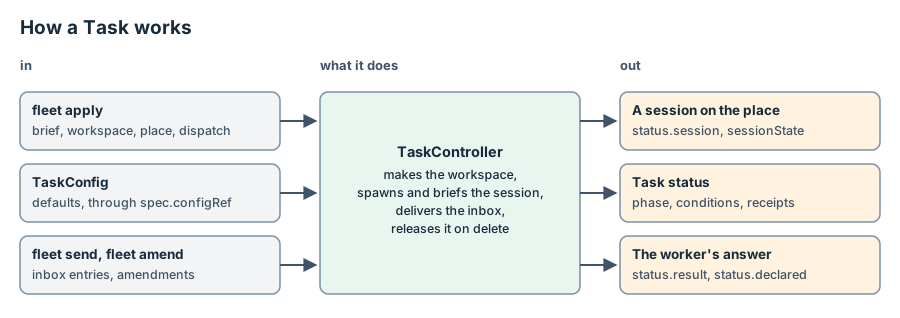
A Task is one agent session doing one brief on one place. TaskController makes the workspace, starts the session, sends the brief, delivers the messages queued for it, records the worker's answer, and releases the session when you delete the Task.
When you write one #
Write a Task for each piece of work you hand to an agent. Write one with an empty brief for an interactive session that waits for its user.
Example #
{
  "apiVersion": "fleet/v1alpha1",
  "kind": "Task",
  "metadata": {"name": "design-305"},
  "spec": {
    "harness": "claude-code",
    "host": "local",
    "brief": "Write the controller design.",
    "workspace": ["git+https://github.com/example/app.git#main"],
    "dispatch": true,
    "outputs": {"prUrl": {"type": "string", "required": true}}
  }
}
Spec #
You write the spec with fleet apply. It is fixed once created, except
dispatch, forge and subscriptions. A change to one of them makes a
new generation. fleet amend appends to amendments; a manifest
cannot change them.
| Field | Type | Required | Meaning |
|---|---|---|---|
harness |
string | unless its TaskConfig, the configRef one or default, gives it |
The agent harness, such as claude-code, passed to the runtime as is. |
host |
string | no | The place the session runs on: <runtime>/<place>, or local, the default runtime's local place. Default local. |
model |
string | no | The model the harness runs. A runtime under [runtimes] passes no model to its harness and refuses a Task that has one. |
configRef |
{name} |
no | A TaskConfig with execution defaults. |
env |
object of strings | no | Environment values. They override inherited ones. |
pauseAfterMs |
integer, at least 1 | no | Pause the session once its agent was idle this long. Overrides the TaskConfig's, including the default TaskConfig's. Absent with no TaskConfig value: never. See pausing an idle session. |
agentTelemetry |
boolean | no | false: the agent exports no telemetry of its own, also when Fleet exports. Overrides the TaskConfig's. Absent with no TaskConfig value: on. See coding agents. |
brief |
string | no | The brief, sent once to the ready session. Empty or absent: an interactive Task, which fleet amend refuses. A blank brief is refused. |
amendments |
array | no | Additions to the brief, oldest first. Only fleet amend appends one. See Amendments. |
workspace |
array of URLs | yes | What the session works in. [] is the runtime's default directory. See Workspace. |
dispatch |
boolean | no | Nothing spawns while it is false, the default. Setting it back to false does not stop a session. |
outputs |
object | no | The structured outputs a result must carry, by name: each {"type": T, "required": bool}, where T is string, integer, number, boolean, object or array. |
forge |
object | no | Overrides of the [forge] defaults for the changes this Task's worker declares: relay.notes, relay.checks, draft.policy (a name under [forge.readyPolicies], or null for no mark-ready). |
subscriptions |
array | no | The Boards whose new events the session hears of, at most 16: each {"board": B, "filter": {...}, "after": SEQ}. See Subscriptions. |
harness, host and model may not be empty, contain NUL or start with
-. Any other field is refused. The store assigns uid, generation,
resourceVersion, the creation time and the fleet.dev/release finalizer.
A manifest with a status, ownerReferences or a label that Fleet alone
writes is refused.
Workspaces #
workspace is a list of absolute URLs. The runtime of the place makes one
directory per URL before the session starts, and the agent starts in the
first. Workspace says who makes it, where it lives, what
happens to it when the Task is deleted, and how to span several
repositories.
Status #
| Field | Writer | Meaning |
|---|---|---|
phase |
TaskController | See Lifecycle. |
conditions |
TaskController | One entry per condition type: status, reason, message, lastTransitionTime, observedGeneration. |
observedGeneration |
TaskController | The spec generation it last acted on. |
execution |
TaskController | The frozen launch: harness, place, model and the identity of each source, without values. Only for a Task with configRef, env or the default TaskConfig. See TaskConfig. |
session |
TaskController | {id, host, key}: the session's runtime id, place and Fleet's key. See Session. |
sessionState |
TaskController | What the runtime last proved: Running, Idle, Paused, Lost or Gone. An Unknown answer keeps the last state. |
agentState, activity |
TaskController | What the agent does (working, attention, idle, unknown) and where that came from: its hooks or a screen rule. See Session. |
conversation |
TaskController | The harness's id of the session's conversation, as its hooks reported it. A revive or a resume names it. |
workspace |
TaskController | The workspace the runtime made: key, host and dirs, one per URL. See Workspace. |
intents, receipts |
TaskController | Each effect's intent, written before it runs, and its outcome, written after. |
prompts |
TaskController | Per send key, the digest of the text sent, until the agent's prompt hook proves delivery. |
loosePrompts |
TaskController | Per send key in prompts, the loose digest of the same text, for a harness profile that names a paste tag. A report of either digest proves delivery. |
brief |
TaskController | {key, generation, recovered}: the newest brief or amendment the worker received. A result names this generation. |
spawnAttempts, briefSends, materializeAttempts, cleanAttempts, releaseAttempts, briefProbeFailures, revivals, reviveAttempts, pauses, resumes, resumeAttempts, catchUps, catchUp |
TaskController | Counters and keys of bounded retries. Three failures raise NeedsAttention. |
idleSince, notBefore, sessionCheckedAt |
TaskController | When the agent became idle, the earliest next reconcile after a failure (30 s later), and the last session lookup of a Concluded Task (repeated every 5 minutes). |
pauseRequestAnswered |
TaskController | The pauseRequestedAt it last planned a pause for. A request is acted on once. |
deliveries, deliveryAttempts |
TaskController | Receipts of delivered inbox entries, and sends and probes per entry in delivery. otherPromptSeq is the latest place in the agent's signal file of a report of another prompt when the entry's send was planned. |
outbox |
TaskController | {offset, generation, skipped, lastSkipped, closed, discarding}: how far the session's event outbox is ingested into the Boards. See Board. |
subscriptions |
TaskController | {notices, cursors}: the count of notices queued, and per subscription its Board, filter, boardUid, cursor (after) and the key of its last notice. See Subscriptions. |
fleetEvents |
TaskController | {started, pending, phases, declared, result, skipped, lastSkipped}: the fleet.task.* events on Board fleet. started is set once the record follows the Task. pending holds the phase events not appended yet. phases counts the phase changes. declared counts the declarations with an event. result is the generation of the last result with an event. See Board. |
result |
the worker, fleet result |
The worker's claim: outcome, generation, summary, artifacts, outputs. See Worker result. |
declared |
the worker, fleet declare |
Facts the worker declared, each a JSON object with a string kind. |
forge |
ForgeController | One entry per declared change, and its conditions. See Following declared changes. |
gateway |
GatewayController | The tie to a chat thread, the relay cursor and the posts. See Talking in a conversation. |
inbox |
nobody; typed appends | Messages queued for the session. See Inbox. |
answered |
nobody; inbox appends | Per Question id, the entry that answered it. First answer wins. |
wakeRequestedAt |
nobody; fleet attach --wake and fleet shell --wake |
When a wake last asked for the session. TaskController resumes a paused session for a request made at or after its pause. See Pausing an idle session. |
pauseRequestedAt |
nobody; fleet pause |
When fleet pause last asked for a pause. TaskController pauses the session for a request made after the last Paused transition and after the last wake. See Pausing on request. |
Lifecycle #
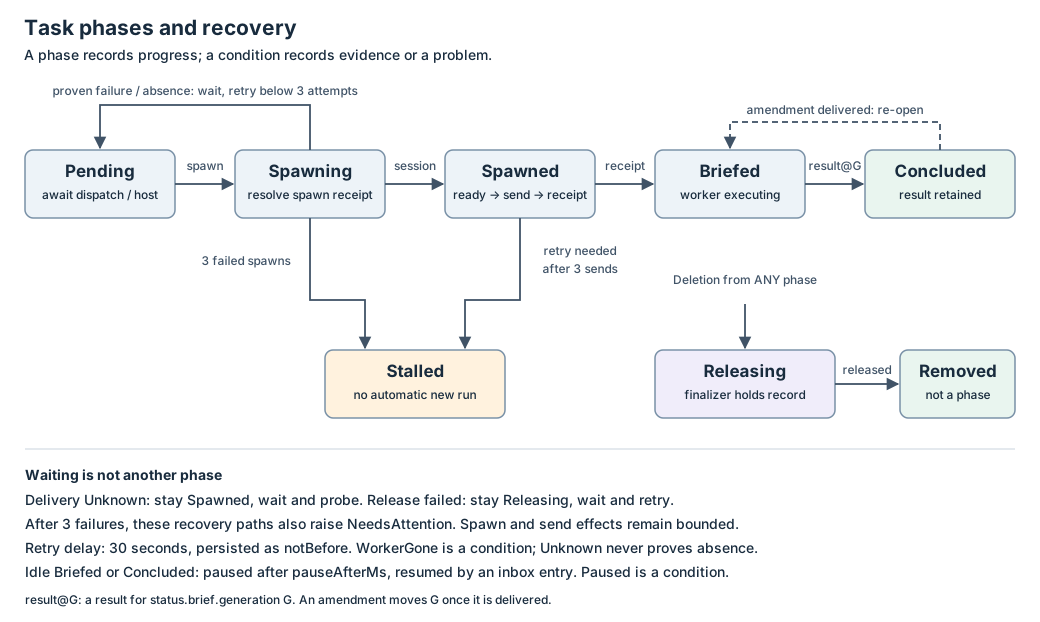
Pending: nothing spawns untildispatchistrue.Spawning,Spawned: the workspace is made and the session starts on the place.Briefed: the agent's prompt hook proved that the brief arrived.Concluded: a result for the current generation arrived. The session stays, and inbox entries still reach it. An amendment re-opens the Task.Stalled: spawn or brief attempts are exhausted.Releasing: the Task is deleting. TaskController releases the session and cleans the workspace. Then the finalizer goes.
NeedsAttention is a condition, not a phase.
The Task state machine has the
transition rules.
Related kinds #
spec.configRefnames a TaskConfig, which names EnvProviders.- A Task owns at most one Session, from spawn to release, and at most one Workspace.
fleet declare --change-request URLmakes the Task follow a ChangeRequest.- A Conversation can create a Task, and ties it to its thread.
- A plugin can create and act on Tasks.
Worker result #
fleet result writes status.result: outcome is shipped, stuck,
failed or not-applicable, and generation must match
status.brief.generation. Optional summary, artifacts (strings) and
outputs carry the answer. The declared outputs are spec.outputs plus the
outputs of each amendment at or below that generation. Required outputs must
be present with their declared JSON types; undeclared outputs and top-level
null output values are refused.
Nested object and
array contents have no additional schema validation.
A result is accepted only after a brief receipt exists and before deletion.
A result is refused while an amendment waits to be delivered, unless its
delivery was given up. Repeating the same result is a no-op. Within one
generation, replacing a result is refused. A result for a newer generation
replaces the result for an older one. shipped is a worker's claim: Fleet
does not verify a forge artifact.
A result for status.brief.generation changes the phase to Concluded on
the next reconcile. It does not release the session until the Task is
deleted.
Amendments #
fleet amend TASK adds to a Task's brief without a new Task. The worker keeps
its session, its conversation, its worktree, its branch and the changes it
declared. An amendment can give more context, add an ask, add a constraint or
ask the worker a question. spec.brief stays exactly as written.
fleet amend design-305 --text "Also cover the migration notes." \
  --reason "the requester asked for migration notes"
# Task/design-305 amended: amendment 1 appended, generation 1 → 2
fleet amend design-305 --file more.md --output notesUrl=string! --if-generation 2
| Option | Meaning |
|---|---|
--text TEXT or --file PATH |
What the amendment adds. --file - reads stdin. Empty text is refused. |
--reason TEXT |
Why, kept in the amendment. |
--output NAME=TYPE[!] |
A new output that a result must carry. A trailing ! makes it required. A name already declared in spec.outputs or an earlier amendment is refused. Repeatable. |
--if-generation N |
A precondition: the amend is refused unless the Task is at generation N. Exit code 5, Task/NAME is at generation M, not N. |
--json |
Prints {task, amendment, previousGeneration, generation, key, from}. |
One compare-and-swap write does three things:
- It appends
{text, reason, outputs, from, at, generation}tospec.amendments.fromiscli/<user>, orplugin/<name>for a plugin's amend. - It increments
metadata.generationto the amendment'sgeneration. - It queues an inbox entry under
task/<name>/<uid>/amend/<generation>withamendsset to that generation.
The caller does not need to know a generation. Without --if-generation,
the verb retries on a conflict, and two concurrent amends both land in order.
Two identical amendments are both kept. A script that retries uses
--if-generation, so that a retry cannot append twice.
An amend is refused for a missing Task, a Stalled Task, a deleting Task and a
full inbox. Nothing would deliver it. A plugin amends a Task through its plan's
amends[], with the same checks and a required ifGeneration. See
Plugin operations. An amend is accepted while WorkerGone
is True; it waits for the session, as fleet send does. Only the store's amend
mutation can queue an entry with amends, or append to spec.amendments. A
manifest that creates a Task with amendments is refused.
The worker's assignment is the brief plus every amendment, in order. TaskController delivers an amendment as an inbox entry:
- An amendment written before the brief goes out is part of the brief's message. The brief is then sent for the newest generation. The amendment's entry is recorded without a send.
- An amendment to a briefed worker goes to the same session's agent inbox when the session is next ready. Its message names the generation that the worker's result must name.
- When a newer amendment is queued behind one that was never sent, the newer message carries both. The older entry is recorded without a send.
- Its receipt sets
status.briefto the entry's key and generation. - A delivered amendment re-opens a Concluded Task: the phase goes back to
BriefedwithConcluded=False/Amended. The old result stays until the worker records a result for the new generation.
fleet send is a conversational message. It changes no contract, leaves no
trace in the spec and does not re-open a Concluded Task. A different
deliverable, repository, harness or host, or a brief that is wrong, needs a
new Task.
Inbox #
fleet send TASK TEXT queues a message for the Task's session. It appends
one entry to status.inbox as cli/<user> under the key
task/<name>/<uid>/send/<n>, where n is the resourceVersion the append
was made against, so a key never repeats for the life of the Task. --json
prints the entry as appended.
| Field | Meaning |
|---|---|
key |
Deterministic and unique across inbox and deliveries; also the runtime intent key the delivery is journaled under. |
from |
cli/<user> for fleet send and fleet amend; forge/<change> for a relay, the ChangeRequest's name; plugin/<name> for a plugin's append or amend; board/<board> for a subscription's notice. |
text |
The message. The runtime can put its own header before it. For an amendment, the amendment's text; TaskController composes the delivered message from the spec. |
about |
For a relay: the mirror's uid, revision and head. Absent for fleet send. |
answers |
The declared Question ids this entry answers: fleet send --answers ID, or a plugin append's answers. Absent when empty. The store refuses an id that names no declared Question. |
amends |
For an amendment: the spec generation it created. Absent otherwise. |
notice |
For an event-notice: board, count, first, last and expiredBefore. See Subscriptions. Absent otherwise. |
queuedAt |
Unix milliseconds. |
An entry is given up on when TaskController stops sending it, as the delivery rules below describe. An entry is still to deliver when it is not given up on.
status.inbox has no owner. The store reaches it through typed mutations,
each named by its caller: append (fleet send, the Forge controller's
relay write, which also replaces status.forge, and TaskController's notice
write, which also replaces status.subscriptions), which refuses a key
already in inbox or deliveries, an about.revision not above the
mirror's highest delivered one, an append while more than 20 entries are
still to deliver, and a deleting Task; and record-and-remove, TaskController's
status write that also moves one entry's receipt into deliveries and the
entry out of inbox. No manager may replace the list.
TaskController delivers inbox entries as it delivers the brief, oldest first,
one per pass: only to a session observed ready on that pass, under the entry's
key as the runtime intent key, at most 3 sends, then a receipt. The entry
counts as delivered once the agent's prompt hook reports it through
fleet signal; a send whose answer was lost is settled by that report, never
repeated. A harness with no prompt hook falls back on the runtime's journal.
An entry that exhausts its sends raises
NeedsAttention/DeliveryFailed naming it and stays queued behind nothing: later
entries are still delivered. An entry whose journal stays unreadable for 3 reads,
or whose prompt hook reported another prompt since the send and not this
one, raises NeedsAttention/DeliveryUnconfirmed naming it. That entry is never sent
again, stays in status.inbox, and holds back no later entry. An entry the
runtime only queued, where the agent does not read it, raises
NeedsAttention/DeliveryQueued naming it, with the same outcome. More than
20 entries still to deliver raise
NeedsAttention/InboxFull. An entry given up on does not count. Such an entry
can never be delivered, so it can never make room. A Concluded Task with a
nonempty inbox is due again for delivery, and at rest for a session recheck
every 5 minutes, as the Task state
machine describes;
a readable lookup that no longer shows its session is WorkerGone and
NeedsAttention, never a respawn. A session that is still there without its
window, as after a host reboot, is revived to read its inbox. See after a host
reboot. A paused
session, stopped by Fleet or by anyone else, is resumed to read its inbox.
See pausing an idle session. A Stalled or
deleting Task delivers nothing: a deleting Task refuses fleet send and
releases its session as before.
Subscriptions #
A Task can subscribe to Boards. Its session then gets one
inbox notice per subscription when new events match. The notice gives the
count, the seq range and the fleet event list command that reads them.
The session reads the events itself.
fleet event subscribe design-305 --board ci --type 'ci.*'
fleet event unsubscribe design-305 --board ci --type 'ci.*'
Each item of spec.subscriptions has these fields:
| Field | Type | Required | Meaning |
|---|---|---|---|
board |
string | yes | The Board. It need not exist yet. |
filter |
object | no | type, subject, source and correlation, as the fleet event list flags take them. A value that ends in * matches a prefix. Absent: every event. |
after |
integer | no | The seq of the last event the Task knows of. Absent: the Board's head when TaskController first reads the subscription. |
Two items with the same board and filter are refused. fleet event unsubscribe removes the item with the same board and filter, and
TaskController then drops its cursor. A notice already in the inbox is
still delivered. Board has the rules for the
cursors and the notices.
Following declared changes #
The Forge controller, a second controller over the Task, reads the changes a worker declared and relays what is new on each into the inbox.
| Field or verb | Owner | Meaning |
|---|---|---|
spec.forge |
apply; mutable like dispatch |
Optional overrides of the [forge] defaults: relay.notes, relay.checks, draft.policy (a name under [forge.readyPolicies], refused at apply when the config does not define it; null disables mark-ready). Field-level: absent fields inherit. |
status.declared |
worker, through fleet declare |
Facts the worker declared, each a JSON object with a required string kind and nothing else validated. --change-request URL writes {kind: "ChangeRequest", url, name} and ensures the named ChangeRequest exists; --json writes any object. Accepted after the brief has a receipt and before deletion; a repeated URL is a no-op; it concludes nothing. |
status.forge |
ForgeController | One entry per declared change, keyed by ChangeRequest name: its uid, state, cursor, gaps, mark-ready record and notBefore; plus this controller's conditions. Absent for a Task that declared nothing. |
The Forge controller appends to status.inbox as forge/<change>, with
about set, in the same write that advances the entry's cursor. The
Forge controller interface
defines every field of status.declared and status.forge, with an example
of a Task following two changes.
Any Task may declare a change, with or without a spec.forge block; the
standing worker policy tells every worker to open its change as a draft, to
declare it, and to end every post on it with
<!-- fleet:worker <task uid> --> on its own line, which is how Fleet tells
the worker's words from a person's on the same account and one worker's from
another's. Those three rules are the worker's to keep: a change opened ready
is never marked ready, a change never declared is never followed, and a post
without the mark comes back to its author as feedback. Nothing forge-related
has to be created in advance, and a second Task may declare a change another
Task opened. No new finalizer and no owner reference: a ChangeRequest
outlives the Tasks that follow it, and deleting a Task deletes nothing else.
The Forge controller interface
lists the resulting writers.
Talking in a conversation #
The Gateway controller ties a Task to a
chat thread and relays the thread into its inbox, as the Forge controller
does for a change. It posts what the Task declares in that thread, and it
opens a thread for a Question. It posts every Task's Drafts, result and
change news in the gateway.logs channel, never in a thread. A tied
thread gets one notice when a followed change is first ready for review.
A worker never posts in a chat and holds no platform credential: it
declares, and Fleet relays.
| Field, label or verb | Owner | Meaning |
|---|---|---|
fleet declare --json '{"kind":"Question","id":"q1","text":"…"}' |
worker |
Ask once. Posted in the tied thread, or, on a Task with no tie and no parent, opens a thread in the questions route's channel and ties the Task to it. Never reposted. |
fleet declare --json '{"kind":"Comment","id":"c1","text":"…"}' |
worker |
Say something in the tied thread. Never opens a thread. The id, unique for the Task, keeps two identical Comments apart. |
fleet declare --json '{"kind":"Draft","id":"d1","title":"…","text":"…"}' |
worker |
Show a draft for review. Logged in the gateway.logs channel, never posted in a thread. |
status.gateway |
GatewayController | conversation, the verified tie; cursor, the Conversation revision relayed through; seen, declared, logged, result, changes, ready, announced, children and posted, what was read, posted or logged; posts, the post, log and reaction effects' intents and receipts; questions, each posted Question; gaps; reactions, how each message of the thread is marked; and its conditions. Absent for a Task that never talks. |
status.answered |
none; inbox appends carrying answers |
Per Question id {key, from, at}, first writer wins. Another channel showing the same Question reads it and stops waiting. |
gateway.fleet.dev/conversation, gateway.fleet.dev/conversation-uid labels |
the Conversation's controller, at creation; apply refuses both |
The Conversation a conversation Task was created for, by name and uid. |
gateway.fleet.dev/parent, gateway.fleet.dev/parent-uid labels |
whoever creates a child and may already append to the parent's inbox (a person, or a plugin whose Task scope covers the parent), at creation only | The parent Task's name and uid. A child never talks in a thread; its parent relays its Questions, Comments, Drafts and results into its own inbox, so naming a parent is writing to it. A verified tie wins over them. |
gateway.fleet.dev/route label |
whoever creates the Task | The route whose channel a Question from this untied Task opens a thread in, instead of gateway.questions. |
fleet send TASK --answers ID TEXT |
cli |
Answer a declared Question from the command line, or as a parent answering a child, recording status.answered. |
Inbox entries from the Gateway come from gateway/<conversation> or
gateway/child/<child>, under keys the
interface defines.
Unknown declaration kinds are ignored, as the Forge controller ignores
them.
Commands #
fleet apply -f task.json             # create, or change dispatch
fleet status task design-305 --json  # phase and conditions
fleet send design-305 "Also update the docs."  # queue a message for the session
fleet pause design-305               # pause the session now; a message or attach --wake resumes it
fleet event subscribe design-305 --type 'ci.*'  # hear of new ci events on Board shared
fleet amend design-305 --text "Also cover the docs." --reason "asked by the requester"  # add to the brief
fleet declare design-305 --change-request https://github.com/OWNER/app/pull/88  # follow the change the worker opened
fleet declare design-305 --json '{"kind": "Note", "text": "docs need a pass"}'   # any fact with a kind
fleet result design-305 --generation 1 --outcome shipped \
  --output prUrl='"https://example.test/pr/1"'
fleet delete task design-305         # release the session, then remove
fleet reconcile                      # run the controller under the lease
Plugin operations #
The Plugin controller lets a registered plugin do to a Task what a person does, through the same manager verbs, never through a status write:
| Verb | On a Task | Carried by |
|---|---|---|
| Create | A full Task manifest, exclusive by name; the store labels it fleet.dev/plugin: <plugin>, a label apply refuses to set |
The plan's creates |
| Patch | dispatch and forge; a patch never changes amendments or subscriptions |
The plan's patches |
| Amend | fleet amend on the Task's behalf: an amendment from plugin/<name>, with that verb's checks. ifGeneration is required; on any other generation the verb is refused and recorded in host.verbs, so a repeated pass appends nothing |
The plan's amends |
| Send | An inbox entry from plugin/<name> under task/<name>/<uid>/plugin/<plugin>/<key>, with the inbox's own checks |
The plan's appends |
| Declare | fleet declare TASK --change-request URL on the Task's behalf, with that verb's preconditions |
The plan's declares |
| Delete | By name and uid; the release finalizer then runs as for any deletion |
The plan's deletes |
status.result stays the worker's: no plugin writes it. Under the config's
tasks = "own", every verb but create requires the Task to carry the
plugin's label; tasks = "any" lifts that. The field owners above are
unchanged; the inbox gains a third named appender beside fleet send and
the Forge controller.