CronTask resource
What it is for #
A CronTask creates a Task at each time of a schedule. It is the Kubernetes CronJob for Fleet: the CronJob makes a Job, and the CronTask makes a Task. The CronTask controller does the work. The Task controller then runs each Task like any other Task.
When you write one #
Write a CronTask when the same brief must run again and again: a nightly
review, a weekly dependency update, a check every hour. To prompt one
long-lived session on a timer instead, use fleet send TASK TEXT from a
cron job or a systemd timer.
Example #
{
  "apiVersion": "fleet/v1alpha1",
  "kind": "CronTask",
  "metadata": {"name": "nightly-review"},
  "spec": {
    "schedule": "0 3 * * 1-5",
    "concurrencyPolicy": "Forbid",
    "startingDeadlineSeconds": 600,
    "historyLimit": 3,
    "template": {
      "metadata": {"labels": {"team": "review"}},
      "spec": {
        "harness": "claude-code",
        "host": "local",
        "brief": "Review what landed today and report what needs attention.",
        "workspace": ["git+https://github.com/example/app.git#main"],
        "dispatch": true
      }
    }
  }
}
At 03:00 UTC on Monday 16 November 2026, this CronTask creates the Task
nightly-review-29913300. Its status then reads:
phase: Scheduled
lastScheduleTime: 1794798000000      nextScheduleTime: 1794884400000
active: [nightly-review-29913300]
effects["create/29913300"]: intent, then receipt {known: {type: created, uid, adopted: false}}
conditions: Scheduled=True (Scheduled), Skipped=False (Created)
Spec #
You write the spec with fleet apply. You can change it at any time. A
change applies from the next reconcile.
| Field | Type | Required | Meaning |
|---|---|---|---|
schedule |
string | yes | Five cron fields (minute, hour, day of month, month, day of week), or @hourly, @daily, @weekly, @monthly, @yearly. Fleet evaluates it in UTC. A seconds field is refused. |
template.spec |
object | yes | The spec of each Task. fleet apply validates it as a Task spec. amendments is refused: fleet amend adds them to one Task. |
template.metadata.labels |
object of strings | no | Labels for each Task. The crontask.fleet.dev/ and gateway.fleet.dev/ labels are refused: only a controller sets them. |
concurrencyPolicy |
Forbid, Allow or Replace |
no | What happens at a scheduled time while an earlier Task of this CronTask is not Concluded. Forbid (the default) skips the time. Allow creates the Task. Replace deletes the earlier Task, and creates the new one only when the earlier one is gone. |
startingDeadlineSeconds |
integer, at least 1 | no | A scheduled time that the controller sees more than this many seconds late is skipped. Without it, a late time is never skipped. |
suspend |
boolean | no | true stops new Tasks. The Tasks that run continue. |
historyLimit |
integer, 0 to 100 | no | How many Concluded Tasks to keep. The default is 3. The controller deletes the older ones. |
concurrencyPolicy defaults to Forbid, not to Allow as in a CronJob.
A Task is an agent session that often works in one directory. Two sessions
at once are seldom what you want, so you ask for them explicitly.
The name of a CronTask is at most 240 characters, so that the name of each Task fits.
Status #
The CronTask controller writes all of the status.
| Field | Meaning |
|---|---|
phase |
Scheduled, or Suspended while spec.suspend is true. |
observedGeneration |
The spec generation of the last reconcile. |
lastScheduleTime |
The scheduled time of the last Task decided on for creation. |
lastConsidered |
The last scheduled time that the controller decided about: created, skipped or forbidden. |
nextScheduleTime |
The next scheduled time. |
notBefore |
When the manager reconciles the CronTask again. |
active |
The names of this CronTask's Tasks that are not Concluded, and of the creates still pending. |
effects |
Each create and each delete by key: its intent, written before the effect, and its receipt, written after. task names the Task, scheduled the time a create is for, unknowns the attempts at a create whose outcome was never known, and running whether a delete may remove a Task that is not Concluded (Replace only). The controller keeps the newest 20 settled records. |
conditions |
Scheduled, Skipped and NeedsAttention. See conditions. |
Lifecycle #
apply ──▶ Scheduled ──(each scheduled time)──▶ create a Task, or skip the time
             ▲  │
  suspend:   │  ▼ suspend: true
  false      Suspended ──▶ no new Task; running Tasks go on
- The first reconcile writes
nextScheduleTime. A CronTask creates no Task for a time before it existed. - When the manager was down for several scheduled times, only the latest one is decided. The earlier ones are dropped.
- A CronTask has no finalizer. A delete removes it at once.
- The Tasks of a deleted CronTask stay. A Task holds a session and maybe
work that is not merged, so Fleet does not delete it for you. Delete the
Tasks with
fleet delete task NAME.
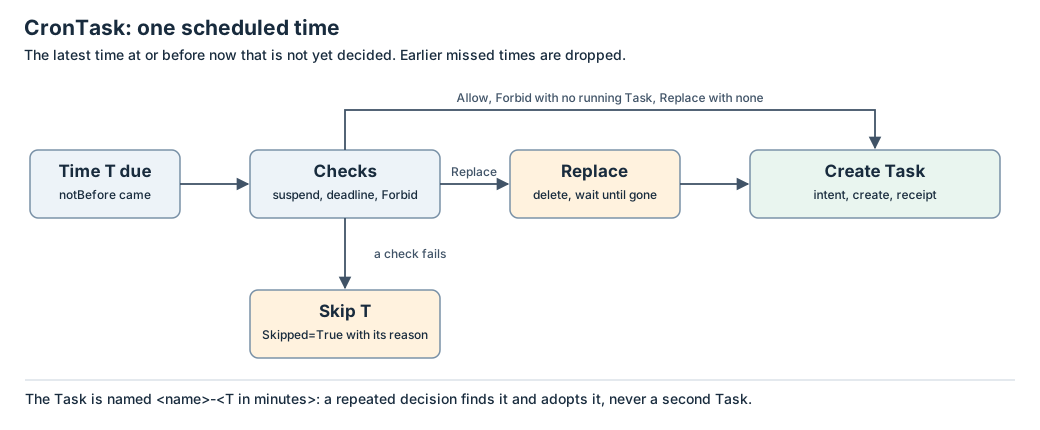
The controller page has the full rules for one scheduled time.
Related kinds #
- Each Task that a CronTask creates is named
<cron-task>-<T / 60000>, for the scheduled timeTin Unix milliseconds. Each sweep computes the same name for the same time, so a repeated decision cannot make a second Task. - Each Task has two labels that only the CronTask controller sets:
crontask.fleet.dev/name(the CronTask's name) andcrontask.fleet.dev/uid(itsuid, which tells this CronTask's Tasks from those of an earlier CronTask with the same name). To list them, filterfleet list tasks --jsononcrontask.fleet.dev/name. - A template can name a TaskConfig in
spec.configRef, as any Task can. - The CronTask controller never writes a Task's status.
Commands #
fleet apply -f nightly-review.json
fleet get crontask nightly-review
fleet list crontasks
fleet status crontask nightly-review
fleet delete crontask nightly-review