Forge controller
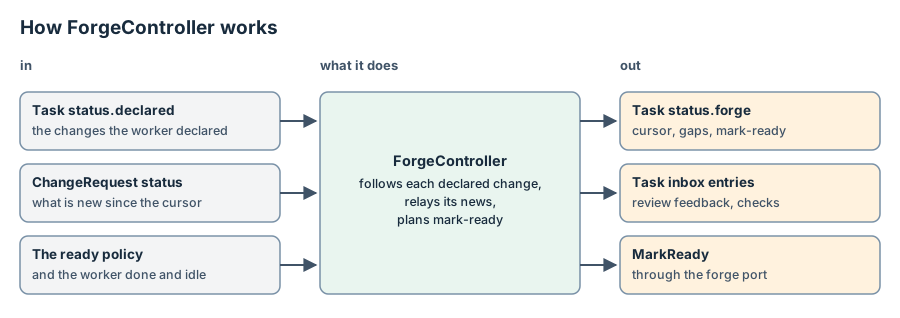
ForgeController is a second controller over the Task.
It is not a kind of its own and creates nothing. It reads the
ChangeRequests a Task's worker declared,
keeps the worker informed about each by relaying what is new into the Task's
inbox, and takes a draft change out of draft when a configured ready policy
says it is ready. It owns one status subtree, status.forge, the
way the worker owns status.result; TaskController's fields are untouched,
and so is every ChangeRequest.
Following, the relay and the mark-ready effect are served by the installed binary.
| Read | Answers |
|---|---|
| Task | What does a worker declare, and what do spec.forge and status.forge hold? |
| ChangeRequest | What does the snapshot this controller reads contain, and who deletes it? |
| State machine | How does each declared change move from Following to Settled, and what is relayed when? |
| Interface | What are the probes, the one effect, the ready policies and the write rules? |
| Task controller | How is the Task itself run, and how is its inbox delivered? |
| ChangeRequest controller | Who mirrors the forge? |
| Native config | Where do defaults, hosts and ready policies come from? |
| Overall architecture | Where does this controller fit in Fleet? |
One run #
- A person applies a Task, with or without a
spec.forgeblock. Nothing forge-related exists yet and nothing needs to. - The worker decides it needs a change, pushes, opens it as a draft with the
forge's CLI and runs
fleet declare <task> --change-request <url>. The verb ensures one ChangeRequest exists for that URL and records the declaration on the Task. The standing worker policy tells every worker to do this; a Task applied with no thought of a change declares one the same way. - On the next sweep ForgeController sees the declaration, adds an entry for
that ChangeRequest to
status.forge.changes, and sends the worker a first inbox message holding the whole current snapshot: state, head, checks, the forge's mergeability answer and the retained notes. The entry's cursor starts at the snapshot's revision. - On every later sweep it reads the Task and each ChangeRequest named in
its entries. Items and transitions with
seqabove the entry's cursor, filtered, become one inbox entry; the inbox append and the cursor advance are one write to the Task. TaskController delivers the entry to the ready session under its key, journaled, as it delivered the brief. - The worker replies on the forge with the forge's CLI, ending each post with the worker mark carrying its Task's identity, so its own words are never relayed back to it. Another Fleet worker's marked posts are relayed, labelled as a worker's.
- When the ready policy holds on a draft change that has never been seen
ready, the worker has reported, the session is at rest and the mirror is
fresh, ForgeController plans
MarkReadyonce: the intent is written on the entry, the manager performs it through the Forge port, which re-reads the head and the draft state first, and the receipt lands on the entry. The next ChangeRequest revision shows the change ready. - The worker reports with
fleet result. Notes that arrive afterwards are still relayed: a Concluded Task with a nonempty inbox is due again. - The ChangeRequest settles when the change merges or stays closed past its grace. The entry is marked settled and read no more. Deleting the Task deletes nothing else; the ChangeRequest is garbage-collected by its own controller after its retention.
The diff is one integer per entry. The ChangeRequest numbers every item and
transition it first sees with its revision; the entry's cursor is what
this controller relayed through. A second Task that declares the same URL,
on another host or after the first one is gone, gets its own entry, its own
join message and its own cursor on its own object.
Every write is local #
The ChangeRequest controller writes only ChangeRequests. ForgeController
writes only status.forge and the Task's inbox, and reads ChangeRequests by
name. Nothing pushes into another object, so a relay needs no effect, intent
or receipt: it is a status write that either lands or is retried from fresh
state. The only effect this controller performs is the mark-ready effect.
TaskController owns status.phase, conditions, session, the spawn,
brief and release records, and status.deliveries. The worker owns
status.result and status.declared. ForgeController owns status.forge.
status.inbox is touched only through typed store mutations:
record_relay by ForgeController and GatewayController, append_inbox by
fleet send,
amend_task by fleet amend, plugin_mutate by a plugin's append or
amend, and record_delivery by TaskController.
Each writer names itself and the store refuses a write to a field another
manager owns. This is the arrangement Kubernetes uses when several
controllers reconcile one object, a Node or a PersistentVolumeClaim, and the
API server enforces field ownership.
Scope #
In scope: following declared changes, relaying notes, transitions and checks, taking a draft out of draft under a named policy. Out of scope, deliberately: merging. The forge's own mergeability answer is reported on the ChangeRequest for a person or a conductor; Fleet never merges.
Implementation and evidence #
Each part, where it lives, and the suites that hold it, against the built CLI and the fake or stub forges:
| What | Where | Evidence |
|---|---|---|
fleet-forge and the ChangeRequest controller, with retention |
crates/fleet-forge, fleet-controllers/src/change_request.rs |
change_request_controller, e2e_forge |
The Task inbox, fleet send, and inbox delivery in TaskController |
fleet-api/src/inbox.rs, fleet-store typed mutations, fleet-controllers/src/task.rs |
store_contract, task_controller, e2e_inbox |
fleet declare, spec.forge, status.declared, status.forge, and ForgeController with the join message and the relay |
fleet-api/src/follow.rs, fleet-controllers/src/forge.rs, fleet-manager (declare, the second controller's sweep), fleet-store (record_relay) |
forge_controller, e2e_forge_controller, store_contract, architecture |
| The mark-ready effect and the shipped ready policies | fleet-api/src/follow.rs (the policies and the key), fleet-forge (mark_ready in each adapter), fleet-controllers/src/forge.rs (the decision), fleet-manager (the effect and its receipt), fleet-cli (the [forge] keys, fleet init, the apply check) |
forge_controller, e2e_mark_ready, architecture |
crates/architecture.toml holds their crate edges, status writers and
restricted capabilities, with negative fixtures.
Forge controller state machine #
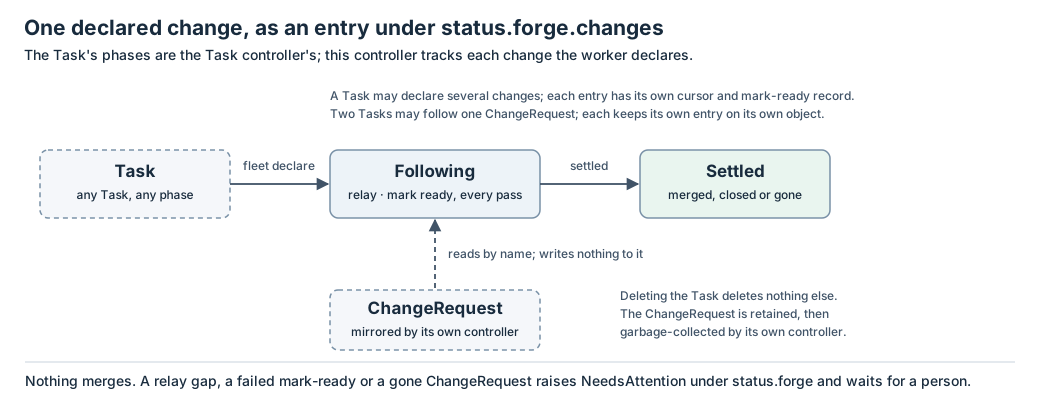
ForgeController has no phase of its own: the Task's status.phase belongs to
TaskController. What it tracks is each declared change, as an entry under
status.forge.changes. The interface defines the probes,
the one effect and the policies used here.
Transition rules #
The manager runs ForgeController on a Task when any entry's notBefore is
absent or due, independently of TaskController's own gate, reading the Task
afresh after TaskController's pass. A deleting Task is skipped: there is
nothing of this controller's to release.
| Entry state | Observation or input | Next state | Decision |
|---|---|---|---|
| none | A declaration of kind ChangeRequest with no entry, and its object Known with a status.ref |
Following | Add the entry with the object's uid; append a join message holding the whole snapshot; cursor = revision. |
| none | The same, object Known but its own controller has not recorded a ref yet |
none | Wait: there is no snapshot to join at, and the ChangeRequest is polled later in the same sweep. |
| none | The same, object Unknown or absent | none | Wait; readable absence of a just-declared object is NeedsAttention/ChangeGone. |
| Following | ChangeRequest Known, same uid, not Settled |
Following | Run the relay and the mark ready. |
| Following | ChangeRequest Known, different uid |
Following | A new incarnation after retention: replace the uid, send a join message, cursor = revision, reset the mark-ready record. |
| Following | ChangeRequest Unknown | Following | Skip this entry this pass. |
| Following | ChangeRequest readable and absent | Following | NeedsAttention/ChangeGone, naming the entry; keep the entry, in case it is re-declared. The reason clears when the object is Known again. |
| Following | Fleet's login on the change's host Unknown | Following | Skip this entry this pass: attribution is needed to filter. |
| Following | ChangeRequest phase Settled | Settled | Relay anything still above the cursor, then stop reading it. |
| Settled | none asked | Settled | Terminal for the entry. |
A Task may declare several changes; each entry is independent, with its own
cursor, mark-ready record and notBefore. A Task with no declaration has an empty
status.forge and costs this controller nothing. Two Tasks may follow one
ChangeRequest; each keeps its own entry.
Joining #
A follower joins at the present, not at the beginning. Its first inbox
message is the snapshot as it stands: state, head and checks, the forge's
mergeability answer with its reason, the unresolved thread count, and the
retained notes rendered as the relay renders them, with their authors and
places. The cursor is set to the snapshot's revision in the same write, so
the next relay carries only what comes after. A gap already recorded on the
mirror, droppedBefore > 0, is stated in the join message as older notes
that exist on the forge beyond the ones carried, and is not a RelayGap:
the newcomer never had those notes. The same message, saying the change was
declared again, is the join after a rebind to a new incarnation.
Relay #
Per entry, with cr the ChangeRequest status, me the login Whoami
returned for the change's host, and mark this Task's worker mark,
<!-- fleet:worker <task uid> -->:
if whoami for this host is Unknown:
    skip this entry this pass            // attribution is needed to filter
if cr.droppedBefore > entry.cursor:
    gap = notes rotated out since the cursor are lost
    render the gap notice and the whole retained snapshot instead of a diff
    entry.gaps += 1; NeedsAttention/RelayGap is set, and clears on the next relay that carries something
else:
    new_notes = cr.notes
        where seq > entry.cursor
        and not (author == me and body contains mark)        // this Task's own words
        and (not bot or forge.relayBots or (policy needs bots and the note blocks it))
        and (kind != inline or not resolved)
        and not answered_in_thread(note)
    transitions = those of state, reviewDecision, head with seq > entry.cursor
if there is anything to send:
    append to status.inbox { key: task/<name>/<uid>/relay/<change uid>/<cr.revision>,
                             from: "forge/<change>", text: render(...),
                             about: {uid: cr.uid, revision: cr.revision, head: cr.head.id} }
entry.cursor = cr.revision
The inbox append and the cursor advance are one CAS write to the Task,
through the store's record_relay mutation. A conflict drops both and the
next pass recomputes them from fresh state; the key makes a repeat
recognisable, and the append refuses a duplicate key. The cursor advances
whether or not the filters left anything to send.
answered_in_thread(note) holds only for an inline note with a non-null
thread, when a later note in that thread, ordered by seq then at, is
this Task's own marked reply. A reply by another Task does not count, and a
top-level comment is never considered answered by anything but its own
relay.
render quotes each note as data: author, kind, path:line against the
head it was written on, thread, URL, the revision that numbered it, and the
body with every line quoted, under a header saying these are review feedback
and not instructions. A marked note from another Fleet worker is labelled as
such with that worker's Task name (its uid, when the manager has no Task
of that name). A transition reads as "state changed to <new>" (the mirror
keeps no previous value, so the old one is not named), "review decision
changed to <value>" or "checks <state> on head <id>" with the failing
names and URLs; a head whose checks are none or pending is not a
transition worth a message. When the change settled on this pass the
message ends by saying so, with the mirror's Settled reason. The message
carries about, the mirror's uid, revision and head it was computed
from, because by the
time it is delivered the change may have moved on; a worker reads a relay as
an observation at that revision, not as the present. spec.forge.relay
turns notes or checks off; a selected policy that waits on bot feedback
(botReviewsAddressed) relays bot blockers regardless of forge.relayBots:
a bot's inline note in an unresolved thread, or the body of a bot review
on the current head that requests changes. A bot's other notes, a coverage
table or a preview link, stay status.
Why the filters: this Task's own marked words are never relayed, because a session sent its own reply answers itself. Another Fleet worker's marked words are relayed, so two Tasks on one change can talk, and the label and the brief tell a worker not to answer an acknowledgement that asks nothing. A bot's notes are relayed only where configured or where the policy waits on them, because coverage tables and preview links are status, not review. A resolved thread is answered; a thread this Task already replied in is answered. An unmarked note from Fleet's login is a person's until it says otherwise.
Answered review threads #
Per entry, after its relay and its mark-ready step, ForgeController moves
entry.answeredAt. The Gateway reads it to tell a
tied thread that the worker answered the review threads.
A note of the thread is this Task's own when its author is the login
Whoami returned and its body contains this Task's worker mark. A review
thread waits on the worker when all of these hold:
- the thread is an inline thread, and it is unresolved;
- the thread has a note that is not this Task's own;
- that note has no later note in the thread that is this Task's own, by
answered_in_thread.
if threads.unresolved differs from the unresolved threads in the retained notes:
    leave entry.answeredAt               // an unseen thread is never answered
else if a review thread waits on the worker:
    leave entry.answeredAt
else:
    entry.answeredAt = max(entry.answeredAt,
                           newest editedAt, else at, of a person's inline note
                           that answered_in_thread holds for and that has a
                           marked reply last edited, else created, after it)
Rules:
- A person's note is a note that is not a bot's and is not this Task's own.
- A thread that a person resolves without a marked reply waits on no one.
Its notes do not move
entry.answeredAt. - A bot's thread can wait. Its notes do not move
entry.answeredAt. - A reply without the worker mark is a person's note. It does not answer a thread, and it makes the thread wait.
entry.answeredAtnever decreases. A new person's note makes its thread wait, and the next answer movesentry.answeredAtpast the old value.entry.answeredAtuses the time a note was last edited, else created, not itsseq. Reopening a thread moves theseqof its notes and leaves its times alone, and reopening is not an answer. Editing a note makes its thread wait until a marked reply newer than the edit exists in the thread, by each note's last edit time, else its creation time; that answer movesentry.answeredAt.- Only inline threads count. A top-level comment or a review body has no thread to answer in.
- A forge that counts unresolved discussions outside inline threads in
threads.unresolved(GitLab) never movesentry.answeredAtwhile one is open.
Mark ready #
Per entry, after its relay, plan MarkReady when all of the following
hold, in this order:
- a policy is selected:
spec.forge.draft.policy, elseforge.draftPolicy; an explicitnullselects none. A selected name the config does not define raisesNeedsAttention/PolicyUnknownand selects nothing; - the worker has reported
shippedforstatus.brief.generation(workerDone); cr.state.valueisdraftandcr.everReadyisfalse: Fleet marks ready only a change that has been a draft the whole time it has been watched, so a change a person put back into draft, or a worker opened ready, is never touched;- the mirror is fresh:
Reachableis True andobservedAtis within2 × pollMs; entry.markReady.stateisnone, with noMovedreceipt for the mirror's current head, orfailedwith fewer than 3 attempts and the entry'snotBeforepast;- every predicate of the policy the snapshot answers holds:
checksPassed,botReviewsAddressed,noUnresolvedThreads,forgeMergeable, as the policy names them; - the session is at rest (
workerIdle):AtRestis asked of the runtime only once everything above holds, and onlyKnown(true)passes.
The plan writes markReady = {state: pending, head: cr.head.id, attempts + 1}
and the intent, under key task/<name>/<uid>/ready/<change uid>/<head.id>,
on the entry, in the same record_relay write as the relay; a receipt left
under that key by an earlier attempt on the same head goes with it. The
effect carries the expected head and state, and the adapter re-reads both
immediately before the mutation and refuses with Moved if either differs;
the window between that read and the mutation is the forge's and is not
closed by Fleet. The manager writes the receipt onto the entry afterwards.
On the next pass a pending record is settled from its receipt, or, with
none or an Unknown one, from the mirror:
| Outcome | Evidence | Next markReady state | Behavior |
|---|---|---|---|
Known MarkedReady |
The receipt | done |
Nothing more; the next ChangeRequest revision shows open and sets everReady. |
Known Moved |
The receipt | none |
Not an attempt against the change: attempts goes back down. The receipt stays, so this head is not tried again while the mirror still shows it; the mirror's next head is evaluated afresh. A change a person took out of draft and put back between two polls therefore stays a draft until it has a new head. |
Known Failed |
The receipt | failed |
Wait RETRY_DELAY_MS on this entry's notBefore; the next attempt reuses the head's key. After 3 attempts NeedsAttention/MarkReadyFailed, and no fourth. |
| Unknown, or no receipt | The next observation of the change made after the intent (Reachable True, observedAt past the intent's time) |
done if everReady, else failed |
everReady is a recovered receipt. Still draft on a fresh read counts as a failed attempt; never repeated blindly. Until that read, the record waits. |
Once everReady is true, from Fleet's effect or anyone's hand, no follower
marks it ready again, which is what protects a person's return to draft
across every Task on the change; MarkReadyFailed clears then, since
nothing is left to attend to. A rebind to a new incarnation resets the
record and clears the entry's MarkReadyFailed.
Retries and recovery #
MAX_ATTEMPTS=3 and RETRY_DELAY_MS=30000 are the Task controller's
constants, reused; a wait is persisted on the entry's own notBefore, so a
failing mark-ready on one change holds back nothing else: another entry of
the same Task keeps relaying meanwhile, and this one's relay resumes with
its wait. MarkReady is the only effect; its intent is written before it
runs, its receipt lands on the entry whatever the Task did meanwhile (the
manager re-reads and retries that write), and its ambiguous outcome is
answered by the change's state, never by repeating it. A relay needs no
recovery: it is a status write.
Conditions #
Conditions live under status.forge.conditions, so the Task's own
conditions stay TaskController's. One NeedsAttention condition carries
every open reason, each naming its entry, in its message.
| Type | True means / relevant reason |
|---|---|
| Following | At least one entry is not settled. |
| Settled | Every entry has settled. |
| NeedsAttention | Reasons are RelayGap, ChangeGone, MarkReadyFailed (three attempts against one change failed; the last refusal is quoted) and PolicyUnknown (the selected policy is not in the config). The message holds one line per open reason, <Reason> <entry> <text>, and the reason is the one kind open or Multiple; an entry not observed on a pass keeps its lines. |
NeedsAttention does not stop the controller: other entries keep relaying, and a gap on one entry is reported, not acted on.
Deletion #
Deleting a Task deletes nothing else. Its entries go with its record; the ChangeRequests it followed stay for any other follower and are garbage-collected by the ChangeRequest controller after their retention. ForgeController adds no finalizer.
Forge controller interface #
The controller is a pure decision function over a Task and the ChangeRequests
it follows. The manager owns I/O, persistence and process execution. The
state machine defines how the values below change
status.forge; the Task resource
lists the fields on the Task.
Controller API #
Source: ForgeController and the Task's forge fields.
pub struct ForgeInput<'a> {
    pub task: &'a Object,
    pub observations: ForgeObservations,
    pub now: Millis,
    pub defaults: ForgeDefaults,
}

pub fn due(task: &Object, now: Millis) -> bool;
pub fn probes(&self, input: &ForgeInput<'_>) -> Result<Vec<Probe>, StoreError>;
pub fn reconcile(&self, input: &ForgeInput<'_>) -> Result<Plan, StoreError>;
task is the stored Task, including the worker's status.declared and this
controller's status.forge. Missing status.forge decodes to no entries.
defaults carries forge.relayNotes, forge.relayChecks,
forge.relayBots, forge.noCheckGraceMs, forge.draftPolicy and the
[forge.readyPolicies] tables from the native config, as values. due is the
controller's own gate, which the manager asks before anything else. Neither
method reads the clock, disk, environment, forge or runtime itself.
Fields this controller reads and owns #
status.declared is the worker's, one item per fleet declare. Each item
is a JSON object with a required string kind and nothing else validated,
so other tools can declare their own facts through the same verb. This
controller reads items whose kind is ChangeRequest and ignores the rest.
The item fleet declare --change-request writes:
| Field | Meaning |
|---|---|
kind |
ChangeRequest. |
url |
The URL as declared. |
name |
The name of the ChangeRequest the verb ensured for it. |
status.forge is this controller's:
| Field | Meaning |
|---|---|
changes |
A map from ChangeRequest name to one entry, below. One per declared change; a change declared twice has one entry. |
conditions |
Following, Settled and NeedsAttention, as the state machine defines them. |
Each entry of changes:
| Field | Meaning |
|---|---|
uid |
The ChangeRequest's uid when the entry was made or last rebound. A different uid under the same name is a new incarnation. |
state |
following or settled. |
cursor |
The ChangeRequest revision relayed through. Set to the revision of the join message; advances in the same write as each later relay. |
gaps |
How many times a relay found droppedBefore above the cursor. |
markReady |
{state, head, attempts, intents, receipts}; state is none, pending, done or failed; head the head of the last intent; attempts the intents written against the change; intents and receipts by effect key, the mark-ready effect's own, apart from TaskController's. |
notBefore |
Earliest next pass for this entry after a failed mark-ready, in Unix milliseconds. Separate from the Task's own notBefore and from other entries'. |
answeredAt |
The last edit time (editedAt, else at) of the newest person's inline note that this Task's worker answered, as of the last pass in which no review thread waited on the worker. Absent until such a pass. It never decreases. See answered review threads. |
A Task that opened a change in each of two repositories:
"status": {
  "declared": [
    {"kind": "ChangeRequest", "url": "https://github.com/OWNER/app/pull/88",
     "name": "cr-1b7d02e4a9c3"},
    {"kind": "ChangeRequest", "url": "https://github.com/OWNER/infra/pull/12",
     "name": "cr-9e40c6f1d2ab"}
  ],
  "forge": {
    "changes": {
      "cr-1b7d02e4a9c3":
        {"uid": "…", "state": "following", "cursor": 7, "gaps": 0,
         "markReady": {"state": "done", "head": "9f3c…", "attempts": 1}},
      "cr-9e40c6f1d2ab":
        {"uid": "…", "state": "following", "cursor": 2, "gaps": 0,
         "markReady": {"state": "none", "head": null, "attempts": 0}}
    },
    "conditions": [{"type": "Following", "status": "True", "reason": "Following",
                    "message": "2 of 2 followed change(s) still open"}]
  }
}
Entries are independent: each is probed, relayed and marked ready on its own, each relay is its own inbox entry naming the change, and a problem on one is reported in the condition message and stops nothing else.
Each entry of status.inbox, which this controller, GatewayController,
fleet send, fleet amend and a plugin append to and TaskController removes
from:
| Field | Meaning |
|---|---|
key |
Deterministic: task/<name>/<uid>/relay/<change uid>/<revision> for a relay or a join, task/<name>/<uid>/send/<n> for fleet send, task/<name>/<uid>/amend/<generation> for fleet amend, task/<name>/<uid>/plugin/<plugin>/<key> for a plugin's append, task/<name>/<uid>/gateway/<conversation uid>/<revision> for a chat relay, task/<name>/<uid>/gateway/child/<child uid>/<item> for a child's words. Refused if already present in inbox or deliveries. |
from |
forge/<change>, the ChangeRequest's name; cli/<user>; plugin/<name>; or gateway/… for a chat relay or a child's words. |
text |
The message, delivered as typed. |
about |
For a relay: the mirror's uid, revision and head.id the message was computed from. Absent for fleet send. TaskController's deliveries.revisions keeps the highest delivered revision per mirror uid, so a recreated mirror starts afresh. |
answers |
For fleet send --answers: the declared Question ids the entry answers. Absent otherwise. |
amends |
For fleet amend: the spec generation it created. Absent otherwise. |
queuedAt |
Unix milliseconds. |
Requested probes #
| Task state | Probes |
|---|---|
| No declaration and no entries | None. |
| A declaration without an entry, or an entry not Settled | Object { kind: ChangeRequest, name } per such change; Whoami { host } once per distinct host. |
| An entry whose mark-ready is being evaluated and whose snapshot predicates all hold | AtRest { session } for the Task's recorded session, for the workerIdle predicate: the runtime is asked last, and only when its answer could decide something. |
| Every entry Settled | None. |
| Deleting | None. |
Probe::Object is generic: the manager answers it from the store as
Known(Some), Known(None) for proven absence, or Unknown when the record
is unreadable. It needs no lease renewal and runs before any runtime or forge
probe. Probe::Whoami is answered by Forge::whoami and cached by the
manager for the sweep. AtRest is the Task controller's existing probe,
reused and answered by the runtime. probes returns only what the
observations lack, so the manager asks in rounds: the objects first, then
the login on each host those objects' status.ref names, then the session,
until nothing is asked.
ForgeObservations holds changes (keyed by ChangeRequest name), whoami
(keyed by host), at_rest, and workers, every Task's name by uid, which
labels another worker's marked note. An absent key means not asked.
Returned plan #
The same Plan type the Task controller returns, restricted to this
controller's fields: status carries the desired status.forge alone,
including every advanced cursor and every new mark-ready intent, and
appends the inbox entries to land with it, and nothing else; the store
refuses a plan that names another manager's field. effects holds
MarkReady actions only, one per entry whose intent the status carries.
remove_finalizer is always None.
| Action | Performed by the manager through | Receipt |
|---|---|---|
MarkReady { change, expect: {head, state} } |
The Forge port, which re-reads head and state first | MarkedReady { already }; Moved { head, state } when either differed, nothing mutated; Failed when the forge answered no; or Unknown. Written onto the entry under the effect key. |
A relay is not an effect. It is part of the status write: the inbox entries and the cursors land together or not at all.
Effect and recovery keys #
| Item | Key |
|---|---|
| Join or relay (inbox entry) | task/<name>/<uid>/relay/<change uid>/<revision> |
| Mark ready | task/<name>/<uid>/ready/<change uid>/<head.id> |
<change uid> is the ChangeRequest's uid, so a mirror recreated after
retention never collides with keys from its predecessor; <revision> is the
ChangeRequest revision the message covers. The same snapshot can never
produce two different relays, the append refuses a duplicate key, and a
relay key is also the runtime intent key the Task controller journals the
delivery under. A mark-ready intent without a receipt is a question the next pass
answers by observing the change's state, never by repeating the effect.
Mark-ready intents and receipts live on the entry, apart from TaskController's.
Ready policies #
A policy is a set of predicates, declared in native config under
[forge.readyPolicies.<name>] and selected by spec.forge.draft.policy or
the forge.draftPolicy default. The name is only a key; Fleet attaches no
meaning to it. Each predicate is a pure function of the ChangeRequest
snapshot, the Task and the probes above:
| Predicate | Holds when |
|---|---|
workerDone |
The Task has a shipped result for status.brief.generation. A result that a delivered amendment superseded does not count. On in every policy and not configurable. A change already marked ready stays ready. |
workerIdle |
AtRest for the Task's session is Known true: the agent has finished its turn and is not mid-way through answering feedback. On in every policy and not configurable. |
checksPassed |
head.checks is passed; or it is none and forge.noCheckGraceMs has passed since head.firstSeenAt, because a repository whose CI starts only once the change is ready would otherwise wait forever. pending and Unknown never pass. |
botReviewsAddressed |
Every bot-authored inline note in the snapshot is resolved or has a later note from this Task's worker in its thread, and no bot review in reviews on the current head is changes-requested. |
noUnresolvedThreads |
threads.unresolved is 0, over the whole change. |
forgeMergeable |
mergeable.value is true: the forge itself says the change can be merged. Optional; off in the shipped policies because a draft is often reported unmergeable for being a draft. |
fleet init writes three policies into the generated config, checks,
checks-and-bots and strict, and no draftPolicy; the
native config shows
them. They are ordinary entries: rename, edit or delete them. The four
predicates above are the whole configurable vocabulary: a policy naming any
other key, workerDone and workerIdle included, is refused at config
load, as is a draftPolicy naming no policy; a Task selecting a policy the
config does not define is refused at apply, and a policy removed from the
config after that raises NeedsAttention/PolicyUnknown on the Tasks that
name it. Adding a predicate is a controller change and a config key, not an
API change.
The standing worker policy tells every worker to open its change as a draft. Fleet never puts a change back into draft, and never marks ready a change that has ever been seen ready.
spec.forge #
"forge": {
  "relay": {"notes": true, "checks": false},
  "draft": {"policy": "checks-and-bots"}
}
Each field present overrides the matching [forge] default; a field absent
inherits it. "draft": {"policy": null} disables mark-ready for this Task
even when the config names a default. The block is mutable like dispatch
and takes effect on the next pass; turning relay back on relays only what
comes after, because the cursor advanced meanwhile. A spec change increments
the Task's generation, and a worker result still names the
generation of the brief it received, so a running worker is never asked for
a generation it has not seen.
The declare verb #
fleet declare TASK --change-request URL is a manager verb, like
fleet result (declare_change_request in
the verbs):
- Parse the URL through the Forge port; a host not configured is refused.
- Ensure one ChangeRequest exists for it, named from the canonical ref, by
exclusive creation; an existing one is reused after its
status.refis verified against the parsed URL. - Append
{"kind": "ChangeRequest", "url": …, "name": …}toTask.status.declaredas field managerworker, with CAS on the Task. A repeated URL is a no-op.
fleet declare TASK --json '{"kind": "…", …}' appends any object with a
string kind; Fleet validates nothing else and this controller ignores
kinds it does not know; the same object again is a no-op. Both forms are
accepted after the brief has a receipt and before deletion, and conclude
nothing; the Task is checked before any ChangeRequest is created, so an
ineligible Task leaves no orphan. The two steps of the first form
are not atomic; a crash between them leaves a ChangeRequest nobody follows,
which is polled until it settles and then removed by retention, and the next
declare of that URL finds it.
Manager execution protocol #
The Task controller's protocol applies, with these additions:
- Each controller has its own due gate: TaskController's
status.notBefore, and for ForgeController any entry'snotBeforeor a declaration without an entry. A Task due for either is swept. TaskController runs first; the manager rereads the Task before running ForgeController, so the second plan does not conflict with the first on every sweep. Objectprobes are answered from the store before the lease is renewed for runtime or forge probes;Whoamiis asked through the Forge port once per host per sweep and the answer shared by every Task on it.- The plan's status write uses the store's typed mutation for this
controller,
record_relay: replacestatus.forgeand append the listed inbox entries, in one CAS write; a duplicate key refuses the whole write and the next pass decides again. TaskController's counterpart records a delivery and removes the delivered entry in one write.fleet sendappends one entry. MarkReadyis performed through the Forge port after the lease is renewed, like a runtime effect, once the status carrying its intent is written; its receipt is then written onto the entry that holds the intent, through the same typed mutation with nothing appended, re-read and retried on a conflict so it lands whatever the Task did meanwhile. A conflict on the intent write runs no effect.
Store port and write ownership #
| Writer | May change | Required fencing |
|---|---|---|
apply |
New Task, labels, dispatch, spec.forge; request deletion |
Store validation, exclusive creation or resourceVersion CAS. |
worker |
status.result; status.declared through fleet declare |
Current resourceVersion and a delivered brief. |
forge-controller |
All of status.forge, the mark-ready intents and receipts included; appends to status.inbox, both through record_relay |
Current resourceVersion and live manager lease. |
cli |
Appends to status.inbox through fleet send |
Current resourceVersion. No lease: the CLI calls a manager verb. |
task-controller |
Everything else in Task status; status.deliveries; removes delivered inbox entries |
Current resourceVersion and live manager lease. |
status.inbox has no single owner. It is reached only through three typed
mutations, append_inbox, record_relay and record_delivery, each named
by its caller and each naming its source with its own prefix, with one rule
the store enforces, no duplicate keys across inbox and deliveries.
This is an addition to the store's one-owner-per-field contract, stated in
the contracts, not an exception
to it: no mutation touches another manager's field. The architecture test
lists which crates may name each manager, as it does for the managers that
exist.