Fleet architecture
Fleet is a Rust command-line program that persists resources and drives their controllers. The Fleet index explains the model, each resource kind and each controller. This page explains the crates and ports that carry them out.
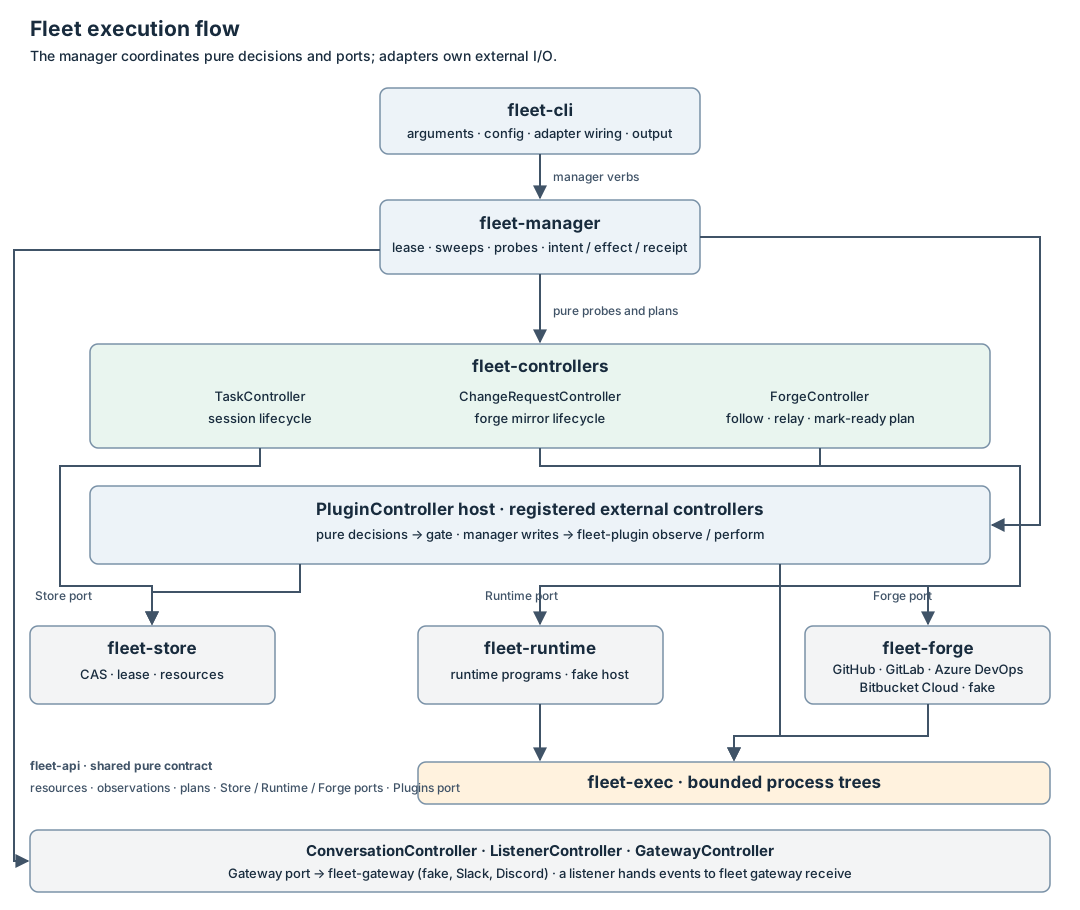
Arrows show calls during execution, not Cargo dependencies. fleet-cli
constructs the adapters; fleet-manager depends on API traits rather than
concrete store, runtime or forge crates. The
ChangeRequest controller runs in the
same sweep as the Task controller, through the Forge port.
Components and boundaries #
| Crate | Owns | Boundary |
|---|---|---|
| fleet-cli | Parse arguments, load config, construct adapters, print results | Calls manager verbs; does not write resources or run controller effects directly. |
| fleet-manager | Reconcile loop, lease renewal, plan execution, apply/delete/send/result/declare verbs | Reads and writes through Store; observes and performs effects through Runtime; reads changes and logins and performs the one forge write, mark-ready, through Forge. |
| fleet-controllers | Pure Task, ChangeRequest, Forge, Gateway, Conversation and Listener decisions, and the plugin admission gate | Receives time and observations as values; returns probes and a plan without I/O. |
| fleet-api | Task, ChangeRequest, plan, observation, result and port types | Pure shared contract; no adapter dependencies. |
| fleet-store | File persistence, CAS, write ownership and lease fencing | A corrupt or unreadable record is Unknown; only proven absence is not-found. |
| fleet-runtime | Session operations through any program speaking the runtime protocol (exec), or the file-backed fake host; the protocol's conformance suite |
Converts external answers to Known/Unknown; retains identity and delivery keys; shares no type with any runtime's code. |
| fleet-forge | Reading one change through gh, glab, az, externally authenticated curl, or the file-backed fake forge, and taking a supported draft out of draft after a fresh read |
One bounded observation is complete or Unknown; a write either preserves the head/state guard or fails closed; the only crate that knows a forge CLI's name. |
| fleet-gateway | Reading and writing one chat thread through Slack's Web API or Discord's REST API by curl, or through the file-backed fake platform |
Every answer is Known or Unknown; a refused write fails closed; the only crate that knows a chat client's name. |
| fleet-plugin | Bounded calls to a registered plugin process through the Plugins port |
The only crate that runs a plugin; every call is one bounded process through fleet-exec. |
| fleet-exec | Bounded process execution; a lease holder's record of the process groups it runs | The only production process spawner; timeout/unwind kills the process tree; the next lease holder stops the groups a holder dead on this boot recorded. |
| otel-env | The OpenTelemetry SDK and its OTLP/HTTP exporter, installed when a config file's [telemetry] table or the OTEL_* variables ask; trace context to a child as TRACEPARENT; shared with the other programs |
The only crate that names the SDK or the exporter; export never changes a command's outcome, and shutdown is bounded. |
The manager and the runtime adapter record spans and metrics through the
opentelemetry API, which does nothing until otel-env installs a
provider. The CLI asks otel-env for each command's root span.
Observability owns the variables, spans and
metrics.
arch-rules and fleet-dev are repository tooling: architecture enforcement,
validation and release packaging. They are not controllers or services in the
installed fleet runtime.
The executable dependency graph is crates/architecture.toml. The architecture suite checks crate edges, purity, restricted process and telemetry APIs, permitted status writers and the holders of the Forge port, including negative fixtures. The CLI may wire adapters, but only manager verbs may perform resource mutations, and only the manager performs the mark-ready effect.
Desired state, observations and effects #
One reconcile shows the loop that every controller follows. One reconcile of a due Task follows this protocol:
read Task + resourceVersion
  -> resolve/freeze referenced execution in private store before first effect
  -> ask pure controller for probes
  -> renew lease before each runtime probe
  -> pass observations + time to pure controller
  -> CAS-write planned status, including effect intent
  -> renew lease before effect -> perform effect -> persist receipt
  -> remove finalizer if requested
Who owns a Task's status lists the
writer of each status field. fleet amend, and a plugin's amends[] verb,
append to spec.amendments and queue the amendment's inbox entry in one
typed store mutation. A status conflict before an
effect drops the plan and retries from fresh state. A receipt conflict
rereads the object and retries the receipt write, preserving concurrent
worker changes. Expired or superseded leases refuse controller writes. An
effect already started cannot be fenced by the file store; deterministic keys
and runtime observation recover that gap.
Resource representation #
fleet-api defines Fleet's resource envelope
and metadata as native Rust types. Manifests use apiVersion, kind,
metadata, spec and status; typed Task views validate spec and status.
Unknown fields are refused. The store assigns identity, generation, resource
version, timestamps and finalizers, and treats incomplete persisted metadata
as Unknown rather than repairing it with defaults.
The file-store format is version 1. Resource versions are store-wide numeric
write counters used for compare-and-swap; timestamps are Unix milliseconds.
The resource API version is separately fleet/v1alpha1. These contracts do
not imply compatibility with Kubernetes metadata or APIs.
The workspace has no kube dependencies. Fleet's current consumers use its own Store and Runtime ports, so resource validation, persistence, lease fencing and effect recovery remain explicit Fleet contracts. A familiar manifest shape does not require a Kubernetes resource library. The bounded manager's scheduling behavior is defined below, independently of the resource representation.
Persistence and execution #
The store uses a fresh versioned data directory with a format marker, resource files, a sequence counter, a lock and the manager lease. Writes use synced temporary files and atomic publication under an OS file lock. Generation tracks spec changes; resourceVersion tracks store writes. A Board's events are the one exception to whole-file writes: the store appends them to the Board's log segments under the same lock. See the store contract for durability and deletion rules.
There is one lease for manager reconciliation. fleet reconcile renews it
before Tasks, probes and effects, and releases it on exit when still owned.
A bounded reconcile run ends when a pass makes no change or reaches its pass
limit. fleet up instead keeps that same manager lease across periodic sweeps,
renewing before each sweep, Task, probe and effect. Retry eligibility remains
persisted as status.notBefore; due Tasks progress without agent activity.
Shutdown releases the lease and retains sessions; crash recovery waits for
lease expiry and observes deterministic session/effect keys. A full disk
pauses fleet up: it keeps manager.lock, runs nothing until a write
succeeds, then renews its own lease with an unchanged token.
The CLI's init writes a local config without Git or network, separate from
resource writes. up runs the ordinary Task controller for every due Task
and creates no Task of its own. The
initialization guide owns
config precedence and startup and recovery instructions.
The runtime is chosen in versioned TOML config, not a separate resource. A runtime program owns host connections and session execution. Fleet calls it through bounded processes; the fake runtime provides persisted fault injection for isolated tests. Runtime operations report their worst-case duration so the CLI can reject a lease too short to outlast them.
The agent's hooks report what it is doing, Active or Idle. The runtime pauses or resumes a session on request: a pause stops the agent's process and keeps its key, and a resume starts it again on its conversation. It decides nothing. TaskController decides when to pause an idle session and when to resume it. A runtime that cannot pause answers Unknown, and Unknown never pauses. See pausing an idle session.
TaskConfig and EnvProvider are passive data; the manager resolves providers through the existing runtime port and bounded executor before freezing a private launch snapshot. TaskController stays pure and owns the lifecycle. See execution configuration.
Sessions and the runtime port #
A Session is one running agent: the unit the runtime port starts,
observes, briefs, sends to and releases. Fleet defines it in
fleet-api's session module and
documents it on the Session page. A
Session is not a stored kind. One Task owns at most one Session, from the
Task's spawn to the Task's release, and names it in status.session.
A Session has two parts:
- an identity,
SessionRef: the runtime'sid, thehostand Fleet'skey. The key is deterministic per Task and carries the Task's uid, so a second spawn finds the first Session and a recreated Task adopts nothing it never owned. - a lifecycle,
SessionState:Running,Idle,Paused,LostorGone, folded from the runtime's Known answers. TaskController records it instatus.sessionStateon every pass that proved something. Unknown never changes it. Nothing decides on it; a view reads it.
The runtime port is the only way Fleet reaches a Session. Fleet owns the Session's identity, its lifecycle record and every decision about it. The runtime owns the agent process, its window and its conversation, and answers what it can prove. Fleet makes the workspace through the workspace port; the runtime runs the session in it.
Fleet owns when workspaces are made and released, the agent's lifecycle hooks
(fleet signal), proven delivery and the harness profiles. Every real
runtime is the exec runtime kind:
[runtimes.<name>] names a program that speaks the
runtime protocol,
a Task names a place of a runtime, <runtime>/<place>, and fleet init
configures runtime-mux alone. The port's calls map onto the protocol's
verbs: spawn is start with the harness profile's launch argv and the
session's FLEET_SIGNAL_FILE, revive is start with its resume argv,
find, lost and at_rest read inspect, release is stop, a brief
is input, create_dir and remove_dir are exec, and the workspace
calls are workspace and stop with release. What only the
agent can prove (readiness, workspace trust, delivery, an idle agent)
comes from the agent's signals. fleet attach asks the runtime's
attach for the command that opens the session's terminal stream.
Workspaces #
A Workspace is the set of files one Session works in. Fleet defines it in fleet-api's workspace module. A Workspace is not a stored kind.
Task ──owns──▶ Workspace {key, host, dirs} ◀──runs in── Session
  spec.workspace      status.workspace               status.session
- A Task names what its Session works in, in
spec.workspace: a list of absolute URLs. - A Task owns at most one Workspace, and its one Session runs in it.
- The Workspace key is the Session key,
<name>.<uid>. - TaskController is the only writer of
status.workspace.
The host's runtime makes every Workspace, through its workspace verb.
Fleet keeps no workspace adapter and no repository map: the URL is the
whole request. The lifecycle follows the Task:
- TaskController plans
Materializeunder the workspace key, before the first start. The manager performs it as the runtime'sworkspacecall. - The spawn gets the ready
{host, dirs}. The Session starts in the first directory and spans the others. The runtime makes nothing at the start. - After the release, TaskController plans
CleanWorkspace, the runtime'sstopwithrelease. The release finalizer goes only after it has a receipt.
An empty list makes no Workspace: the Session starts in the runtime's default directory.
The workspace calls keep the rules of the runtime port:
- Every call answers Known or Unknown. Unknown never concludes.
- The
workspaceverb is idempotent by key. A lost answer is settled by the same call under the same key, which adopts a whole Workspace and never starts a new attempt. - A
workspacecall is whole or nothing. The runtime rolls a partial Workspace back on the next call. - A runtime handles the URL schemes its manifest lists. Fleet refuses any
other URL before anything is made, and the Task waits with
WorkspaceUnsupported.
The host of a Workspace is observed: status.workspace.host is the host
whose runtime made it. Credentials stay with the host and its runtime, and
Fleet sends none.
Forge integration #
ChangeRequest and its
controller mirror one change on a
forge through the Forge port, with adapters in fleet-forge (github via
gh, gitlab via glab, Azure DevOps Services via az, Bitbucket Cloud via
externally authenticated curl, and a fake), and
number every item they see so
consumers diff by one cursor. A ChangeRequest belongs to no Task; it outlives
its followers and is removed by its own controller after a retention period,
by a delete fenced on its uid, its resourceVersion and the lease. The
crate graph has fleet-forge beside fleet-runtime, an adapter depending
on fleet-api and fleet-exec, and the manager a third port. The purity and
process rules above are unchanged: every forge call is one bounded process
through fleet-exec, and no forge-specific name appears above the port.
The Forge controller #
The Forge controller is a second controller
over the Task. When a worker declares the change it opened, fleet declare
ensures the ChangeRequest exists, and the controller follows it: it joins at
the present with one message holding the whole snapshot, then relays what is
new into the Task's inbox by a cursor kept on the Task. It owns
status.forge and appends to the Task's inbox through one typed store
mutation that lands the cursor and the entries together; it writes nothing
else of the Task and no ChangeRequest, and the relay is a status write, not
an effect. The manager runs it after the Task controller on each sweep,
under its own due gate, from a fresh read of the Task, answering its object
probes from the store, its login probe through the Forge port and, last,
its at-rest probe through the runtime. The Task inbox the relay lands in,
status.inbox, is the one field with no single owner: the write-ownership
rule has that typed exception, and every other field keeps one owner.
Its one effect, and Fleet's one forge write, is mark-ready: when a
configured ready policy holds on a draft change that was never seen ready,
the worker has reported, the session is at rest and the mirror is fresh,
the controller writes the intent on the entry with its status and the
manager performs MarkReady through the Forge port, which re-reads the
head and the draft state immediately before the mutation and refuses when
either moved; the receipt lands on the entry, attempts are bounded at three
with the wait on the entry's own notBefore, and an unknown outcome is
answered by the change's next fresh observation, never by repeating the
effect. Policies are named sets of a fixed predicate vocabulary in the
native config, selected per Task or by a default. Fleet never puts a change
back into draft and never merges: the forge's mergeability answer is
reported, not acted on.
The Plugin controller #
The Plugin controller, a host for controllers
written outside this repository as scripts. A plugin registered under
[plugins.<name>] declares its own kinds with a JSON Schema each, which the
store then serves. For each due object of those kinds the manager runs the
plugin's pure probes and reconcile functions as bounded processes
through the Plugins port and a fleet-plugin adapter crate, answers
store probes itself and plugin probes through the plugin's bounded observe
call, and admits the returned plan through a pure gate in
fleet-controllers before writing the plugin's status under field manager
plugin/<name>, performing its Task verbs (create, patch dispatch and
forge, send, declare, delete) and running its keyed effects through the
plugin's perform call with intent before and receipt after. The purity and
process rules above are unchanged: the plugin decides, the manager performs,
and every plugin process is one bounded call through fleet-exec.
The Gateway controller #
The Gateway controller is the Forge
controller's pattern applied to chat. A listener outside the manager holds a
chat platform's connection and hands each raw event to fleet gateway receive, a bounded manager verb that reads it through the adapter and spools
it on a Conversation, the mirror of one thread.
ConversationController numbers its messages, applies the route's admission
rules, creates one Task per thread in the thread's own directory, and retires
an idle thread with its Task and that directory; GatewayController, a third
controller over the Task, owns status.gateway, relays new messages into the
inbox under a cursor through record_relay, and posts what the Task declares
as keyed effects through a Gateway port, with adapters in the
fleet-gateway crate, for Slack and Discord. ListenerController reports
each account's inbound health from the listener's own beats, on a
Listener. The purity and process rules above are
unchanged: the Gateway runs no model, every adapter call is bounded, and no
platform name appears above the port.
Scope #
The Task controller runs sessions and records worker claims. It does not verify that an artifact merged, conduct reviews, manage a forge or dispatch a hierarchy. Registered controller plugins define their own kinds and act through admitted plans. Connection details stay with the runtime; credentials stay with the agent and host.
Views #
thurbox is a Fleet client and reads nothing of Fleet's store directly. The runtime side, the protocol and the terminal stream, is Runtimes.
fleet watch --json: a long-running NDJSON stream, one event per changed Task, resumable by the store's write counter (--since). Its events are in the command line. It feeds thurbox's snapshot behind theSnapshotSourcetrait:FleetWatch(crates/thurbox/src/kernel/snapshot/fleet.rs) publishes each Task as a session row.fleet apply,delete,send: the interface's commands, behind theExecutortrait.crates/thurbox/src/kernel/command/fleet.rsruns them. No interface command maps toamend.fleet attach <task> --json: the command that opens the Task's terminal stream (the terminal stream). It asks the runtime'sattachand wraps attyanswer infleet term-bridge. On a paused Task it exits 3 and says so; with--wakeit first asks TaskController to resume the session, and waits for the resume. thurbox attaches without--wake. thurbox opens the stream it names as a stream pane (crates/thurbox/src/kernel/terminal/fleet.rs), whose backend is the stream itself.fleet shell <task> --json: the same for an interactive shell beside the Task's session, on its place, from the runtime'sshell.- thurbox never starts, restarts or stops
fleet up. When no manager holds the lease, it tells the user the command that starts one.
Fleet is thurbox's only engine: [fleets.<name>] in thurbox's
settings.toml names each Fleet it reaches, on this machine or over ssh or
WSL (thurbox's configuration).
An interactive session is a Task with no brief: it spawns and waits for its
user. It stays Spawned with Briefed=False/Interactive, and its inbox
is delivered as any other.
Workspace URLs #
A Task names its workspace as a list of URLs. Fleet passes the list to the runtime and gets directories back. Everything between, how files come to exist, where they live, what is installed, how they are kept and removed, is the runtime's. Runtimes owns that side.
"workspace": [
  "git+https://github.com/acme/app.git#main",
  "git+https://github.com/acme/lib.git",
  "file:///home/me/notes"
]
- Each entry is an absolute URL. Fleet checks that, and nothing else: the scheme, the reference and any query are the runtime's to read.
- The first entry is where the agent starts; the others are the extra directories it spans.
- An empty list means the agent starts in the runtime's default directory.
Fleet makes two calls, each idempotent by the Task's key:
| When | Call | Answer Fleet records |
|---|---|---|
| before the first start | workspace {key, urls} |
status.workspace.dirs: one directory per URL, as the process sees it |
| after the session is released | stop {key, release: true} |
the workspace is gone |
Fleet builds the harness's argv from dirs (the first is the working
directory, the rest go to additional_dir_args) and starts the session. A
stop, a pause, a resume or a revive leaves the workspace alone.
The answers map to conditions and nothing more:
Unsupported{url}: the runtime does not handle that URL. Fleet answers this itself, before any call, for a scheme the manifest does not list. The Task waits withWorkspaceUnsupported, spends no attempt, and asks again after each wait.Failed{why}: the runtime made nothing. The Task waits withMaterializeRetryand asks again after the wait, at most three times; then it stalls withMaterializeFailed.- Unknown: Fleet asks again with the same key, which adopts a workspace that was made.
A workspace call has its own bound, workspaceTimeoutMs (600000 when
absent), because a first clone can take minutes. Every other call keeps
callTimeoutMs.
The collector #
A deletion releases the session and its workspace once. Whatever that could
not finish (an unreachable host, an Unknown answer, a crash between two
effects) does not keep the Task: its finalizer goes, and the collector takes
over. On each sweep, for each runtime that implements list, every key with
no live Task in the store gets stop {key, release: true}.
The store proves the Task is absent and the runtime proves the leftover exists, both Known; Unknown on either side waits for the next sweep. The key carries the Task's uid, so a recreated Task with the same name is never mistaken for the old one.