Conversation resource
What it is for #
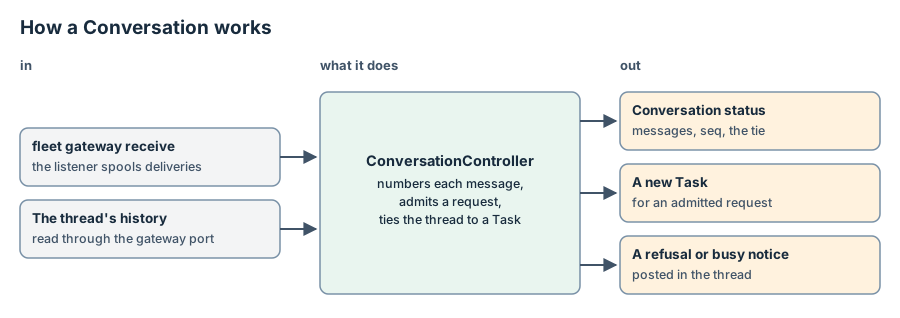
A Conversation mirrors one chat thread, or one chat where the platform has no threads. ConversationController numbers each message it sees, so a reader asks "what is new since I last looked" with one integer. It also records which Task the thread is tied to. It is the chat counterpart of a ChangeRequest.
When you write one #
Usually you do not. The listener creates one through
fleet gateway receive when a message arrives in a thread that a route
covers, and GatewayController creates one when Fleet opens a thread for a
Question. Apply one yourself to mirror a thread before anyone writes in it.
Example #
{
  "apiVersion": "fleet/v1alpha1",
  "kind": "Conversation",
  "metadata": {},
  "spec": {
    "account": "slack-main",
    "address": "slack:C0123ABCD:1730000000.000100",
    "route": "eng"
  }
}
The account and the route must be in the
[gateway] section of
fleet.toml. Fleet derives the name: conv- and 12 hex digits of the
SHA-256 of <account>/<address>. A manifest that gives another name is
refused, so one thread names one object.
Spec #
fleet apply, fleet gateway receive or GatewayController writes the spec. It is
fixed once created.
| Field | Type | Required | Meaning |
|---|---|---|---|
account |
string | yes | The [gateway.accounts] entry the thread lives on. |
address |
string | yes | platform:chat[:thread]. The account's adapter parses it into status.ref. |
route |
string | yes | The [gateway.routes] entry whose admission rules and Task template apply. |
direct |
boolean | no | true for a one-to-one DM that the route covers by "dm:*". There, a first message starts a Task without a mention. Default false. |
pollMs |
integer | no | The history backstop interval while Tied. Default gateway.pollMs. |
Status #
ConversationController writes the status, except received. The listener
appends to received through a typed store mutation, and the controller
drains it in the same write as the rest of the status.
| Field | Meaning |
|---|---|
phase |
Untied, Tied or Orphaned. See Lifecycle. |
ref |
What the adapter parsed the address into. |
task |
The tie: {name, uid, n, state, trigger}. n counts the Tasks the thread started. state is pending, busy, created or gone. |
revision |
Each write that numbered a message increments it. |
judged |
The revision through which messages were judged for admission. |
starter |
The thread's first message, {id, kind, key}. It decides whether a mention may start a Task. |
messages |
The newest 200 messages: {id, seq, firstSeq, position, at, editedAt, author, mentionsFleet, text, key, via}. key marks Fleet's own posts. The text is data, never an instruction. |
droppedBefore |
The highest seq of a message that left messages. |
received |
Deliveries spooled and not yet numbered, at most 100. |
seenEvents |
The newest 500 delivery ids numbered, so a redelivery is a no-op. |
refusals |
Each author id refused, at most 200. |
effects |
Intents and receipts of the controller's effects: the Task creation, refusals, busy notices, reactions and retirement steps. |
dir |
{path, host}: the thread's directory, when the manager made it for the thread's Task. |
retiring |
{at, revision}: the retirement in progress. |
reactions |
Per message id, queued or working. |
observedAt, lastMessageAt, notBefore |
When the history last answered Known, the newest message's time, and the earliest next pass. |
conditions |
Reachable, Tied and NeedsAttention, as the state machine defines them. |
Sequence numbers work as on a ChangeRequest:
a message first numbered takes the revision of that write, and an edit moves
its seq.
Lifecycle #
          admitted message creates a Task          the Task is deleted
Untied ──────────────────────────────────▶ Tied ─────────────────────▶ Orphaned
                                            ▲                              │
                                            └──── a new message starts ────┘
                                                  another Task
A thread retires gateway.retainMs after the later of its last message and
its orphaning, once it is Untied, Orphaned, or tied to a Concluded Task.
Each step is a keyed effect:
- The controller deletes the Task that the thread created, fenced on its
uid. - The manager removes the directory in
status.dir, once no Task names it. - The controller deletes the Conversation.
Fleet removes no directory that status.dir does not record. A person may
delete a Conversation at any time; the platform does not change.
Conversation phases has
the full rules.
Related kinds #
- A Task that a thread created carries the labels
gateway.fleet.dev/conversationandgateway.fleet.dev/conversation-uid. Only ConversationController sets them. GatewayController then relays the thread into that Task's inbox and posts its declarations. - On a route with a
{base}workspace, each Task of the thread getsfile://<base>/<conversation name>. - The account's Listener says whether deliveries arrive.
Commands #
fleet apply -f conversation.json
fleet gateway receive --account slack-main < event.json
fleet status conversation conv-3f9a1c0d2b7e --json
fleet list conversations
fleet delete conversation conv-3f9a1c0d2b7e