Plugin controller
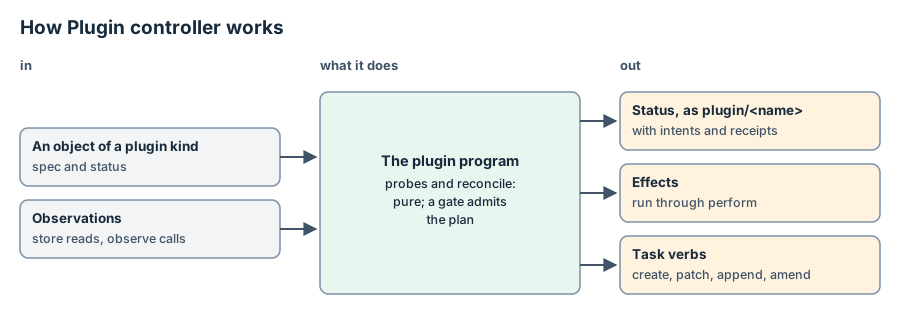
A plugin is a controller written outside this repository, in a language a person can read in one sitting, such as a script. It defines its own resource kinds, decides what to do with each object of those kinds, and may create and steer Tasks. Fleet hosts it the way it hosts its own controllers: the manager owns every read, every write and every process, and the plugin is a function from values to a plan. This page is the reference. Write a plugin builds one step by step.
| Read | Answers |
|---|---|
| Write a plugin | How do I write, register, run and debug my own plugin? |
| Plugin kinds | What does a plugin's resource look like, and who may write what on it? |
| State machine | How does one object of a plugin kind move through a sweep, an effect, and deletion? |
| Interface | What is the protocol, the manifest, the probes, the plan verbs and the write rules? |
| Task | What may a plugin do to a Task? |
| Native config | How is a plugin registered, bounded and given its secrets? |
| Forge controller | The controller this one is modelled on. |
| Overall architecture | Where does this host fit in Fleet? |
One run #
An issues plugin, registered in the native config as github-issues:
fleet upstarts. For each[plugins.<name>]entry the manager runs the program once, bounded, with themanifestcall, and learns the kinds the plugin defines,IssueSourceandIssue, with a JSON Schema for each. The store serves those kinds for the life of the process. A manifest that cannot be read refusesup, like a config that does not parse.- A person applies an
IssueSourcenaming a repository and a label. The store validates its spec against the plugin's schema and refuses what the schema refuses. - On the next sweep the object is due. The manager asks the plugin's pure
probesfunction what it needs; it answers with one plugin probe, "list the open issues with this label". The manager performs that probe through the plugin's ownobservefunction, a second bounded process with the credentials the config names, and gets a Known answer or Unknown. - The manager calls
reconcilewith the object, the answers and the time. The plugin returns a plan: its own status, when to look again, and oneIssueobject to create per issue not yet mirrored, each under a name it derives from the issue number. - A pure gate in the manager admits the plan against the plugin's rights, writes the status by compare-and-swap under the lease, and creates the objects, each exclusive by name and labelled as this plugin's.
- Each
Issueis reconciled the same way. Its plan creates one Task with a brief rendered from the issue, suspended, and records the Task's name anduidin its status. A later pass, after a person or a policy says so, patches the Task'sdispatchto true. The plugin follows the Task by probing it: its phase, its result, the changes it declared. - When the Task concludes, the plan carries one effect, "comment on the
issue with the result", under a key derived from the issue and the result.
The manager writes the intent into the object's status before running the
effect through the plugin's
performfunction, and writes the receipt after. A key with a receipt is never run again. - A closed issue settles its mirror; the plugin's plan asks for its own
object to be deleted after a retention it chooses. Deleting the
IssueSourceis a person's act; its mirrors stay until their own plans retire them, unless the kind declared a finalizer and the plugin cleans up first.
One object costs one plugin process per phase per sweep when due, a few bounded calls when it asked for plugin probes, and one status write. A quiet object whose plan returned the same status writes only its bookkeeping.
Why a host and not a port #
- The decisions are the plugin's. Fleet's three controllers are already pure functions from an object, observations and the time to a plan. Moving that function out of process changes the language, not the architecture: the manager still owns I/O, the store still owns fencing, and a plan is still admitted by Rust before anything is written.
- The I/O is bounded the one way Fleet knows. A plugin process is one
call through
fleet-exec: a timeout, a killed tree, an answer that is Known or Unknown. A plugin that hangs costs one bound and one Unknown. - Nothing is trusted that was not declared. A plugin writes only the status of its own kinds, creates only objects of kinds it may create, touches only Tasks it is allowed to touch, and reaches the world only through probes it asked for and effects it keyed. The gate that enforces this is pure and tested like the controllers.
- A plugin persists nothing. Its memory is the status of its objects, written by the manager with the same compare-and-swap and the same lease as every other status. A crash between two passes loses nothing it could not recompute.
Pure where it decides, bounded where it acts #
A plugin has two halves in one program, selected by the call the manager makes, and they run with different environments:
| Half | Calls | Environment | May |
|---|---|---|---|
| Controller | manifest, probes, reconcile |
PATH and what the OS needs to start a process, nothing the operator set |
Compute. Everything it needs arrives as values; nothing it reads elsewhere is recoverable. |
| Observer | observe, perform |
The variables passEnv and envFrom name, resolved per sweep |
Read and change the world: run gh, call an HTTP API, with the manager machine's logins. Each call is bounded and answers Known or Unknown. |
This is the split Fleet already has between fleet-controllers and
fleet-forge, applied to one script. The controller half's purity is a
contract enforced by starvation, not a sandbox: Fleet withholds credentials,
configuration and the store, and states that a plugin reading outside a
probe gets an answer Fleet cannot recover after a crash. A later host, a
WASM runtime or an embedded engine, could enforce it under the same
protocol; the first host is a process, because fleet-exec already bounds
one.
Every write is the manager's #
The plugin returns a plan; the manager performs it, in the order every
controller's plan is performed: the status carrying each effect's intent is
written first, then the creates, amends, patches, appends, declares and deletes,
each a manager verb under the lease, then the effects, then their receipts.
The plugin's field manager is plugin/<name>. It owns all of the status of
its kinds; the host keeps three reserved fields in it, notBefore,
effects and host, under the same owner. TaskController, the worker and
ForgeController keep every field they own today; a plugin reaches a Task only
through the verbs a person has, never a status write.
Scope #
In scope: plugin-defined kinds with validated specs, a pure controller half
and a bounded observer half, store probes and plugin probes, keyed effects
with intents and receipts, and every Task verb a person has except result:
create, patch the mutable spec fields, amend, delete, send, declare. A plugin
reconciles only kinds it defines; it reads Tasks and ChangeRequests through
probes.
Out of scope, deliberately: a plugin writing status.result, because the
whole system reads a result as the worker's claim; a plugin reconciling a
built-in kind, which would need a plugin-owned status subtree on Task and is
left for a later step; a plugin creating objects of another plugin's kinds;
and a persistent plugin process, which would trade the bounded call for a
service Fleet would have to supervise.
Implementation and evidence #
The protocol types live in fleet-api/src/plugin.rs, pure admission in
fleet-controllers/src/plugin.rs, process hosting in fleet-plugin, and
registration and sweeps in fleet-manager/src/plugins.rs. The file store
validates schemas and rechecks identities, ownership and leases under its
write lock for every plugin verb. The command line loads manifests once per
process and accepts plugin kind names and plurals.
e2e_plugin_controller drives the built CLI and a Rust protocol stub across
process restarts. plugin_gate covers admission rules; store_contract
covers fencing, creator ownership and the amend precondition;
architecture enforces the crate and writer boundaries.
Plugin controller state machine #
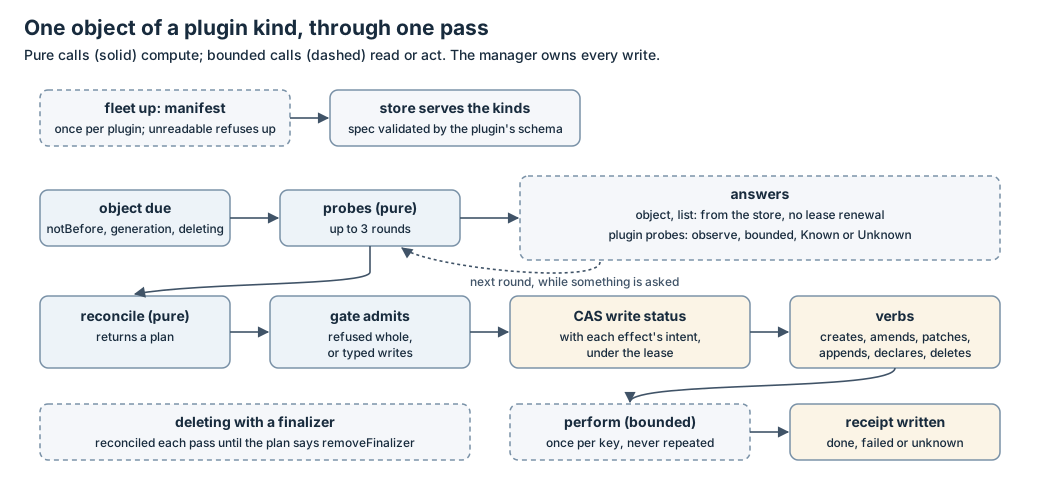
A plugin kind has no phase Fleet defines: the plugin's status is the plugin's, phases included. What Fleet defines is how one object of a plugin kind moves through a sweep, how an effect is carried from intent to receipt, and how an object is deleted. The interface defines the calls, probes and plan verbs used here.
Due #
The manager reconciles an object of a plugin kind when any of these holds:
| Condition | Why |
|---|---|
status.notBefore is absent or past |
The ordinary cadence, as for a Task or a ChangeRequest. |
metadata.generation is above status.observedGeneration |
The spec changed; the plugin sees it at once. |
deletionTimestamp is set and the kind's finalizer is held |
The plugin must finish before the record goes. |
A plan that sets no notBefore gets now + pollMs of its kind, from the
manifest. Nothing is reconciled while its plugin is unavailable; the object
keeps its notBefore and the manager counts it in its report.
One pass #
| Step | Input | Outcome | On failure |
|---|---|---|---|
| Read | The object by name | The object and its resourceVersion |
An unreadable record is Unknown and skipped; nothing is written. |
| Probe rounds | probes is asked with the observations so far, at most three rounds |
Store probes (object, list) answered from the store without renewing the lease; plugin probes answered through observe, the lease renewed before each |
A failed probes call ends the pass with host.error; an Unknown probe answer is handed to the plugin as such. |
| Reconcile | reconcile with the object, the answers, now and the kind's defaults |
A plan | A failed or malformed call ends the pass with host.error and notBefore = now + pollMs; the plugin's status is untouched. |
| Admit | The plan, the plugin's rights, the object | The plan as typed writes | A refused plan ends the pass with host.error naming the verb refused; nothing of it is written. |
| Write | The admitted status, carrying every new effect's intent | One compare-and-swap write under the lease | A conflict drops the whole plan; the next pass rereads. |
| Verbs | creates, amends, patches, appends, declares, deletes, in that order |
Each a manager verb under the lease; each outcome recorded in host.verbs |
A refused verb is recorded and stops nothing after it. |
| Effects | Each effects[] entry with an intent and no receipt |
perform, the lease renewed before each |
The outcome, Known or Unknown, is the receipt. |
| Receipts | Each performed effect | Written into status.effects by compare-and-swap |
A conflict rereads and retries the receipt write, preserving concurrent changes. |
host.error is the host's reserved record of what went wrong on the last
pass; the plugin sees it in its next input and may raise its own condition
from it. The host writes nothing else of the plugin's status.
Effects #
An effect is {key, request}. The key is the plugin's and must be unique for
the life of the object; the host prefixes it with
plugin/<plugin>/<kind>/<name>/<uid>/ for the intent it journals. Rules:
| State of the key | What the host does | What the plugin sees |
|---|---|---|
| No intent | Writes the intent with the status, then performs | Nothing yet |
| Intent, no receipt | Nothing: the process that performed it may have died after acting | effects[key].receipt absent, intent.at set |
Receipt done |
Nothing, ever | The receipt and its result |
Receipt failed |
Nothing, ever, for this key | The receipt and its reason |
Receipt unknown |
Nothing, ever, for this key | The receipt and its reason |
Fleet never repeats an effect under the same key. A plugin that wants to try
again plans a new key, comment/88/2, and decides for itself how many
attempts are enough and after how long, on its own notBefore. Before
retrying an Unknown, it should ask a probe that would show whether the
first attempt acted, the way TaskController observes a session key, because
nothing else can. An intent without a receipt that is older than
callTimeoutMs plus the manager's lease is a receipt unknown with
LostAnswer written by the host on the next pass, so the plugin is not
left waiting on a crash.
A plan may carry at most eight effects. The host keeps the newest 100 keys
under status.effects; a plugin must not plan a key it already rotated out,
and derives keys from facts, an issue number and a result generation, so a
repeat is recognisable.
Creates #
A creates[] entry is a full object of a kind this plugin may create: its
own kinds, and Task. The host sets the label fleet.dev/plugin: <plugin> on
it and creates it exclusively by name:
| Existing object with that name | Outcome |
|---|---|
| None | Created. |
| Created by this plugin | already; nothing changes, the spec is not compared. |
| Anything else | Refused, recorded in host.verbs. |
A plugin derives names from facts, issue-88 or issue-88-review, so a
retried pass creates nothing twice. It learns the uid of what it created by
probing the object on a later pass, and records it in its own status, as
the Forge controller records a ChangeRequest's uid.
Deleting #
A kind without a finalizer is deleted at once by the store, as an
EnvProvider is; the plugin is not consulted, and its next pass finds the
object gone. A kind that declared finalizer: true gets
fleet.dev/plugin/<plugin> on create, and a deleting object stays due until
a plan says removeFinalizer: true. The plugin uses those passes to post a
last comment or retire a Task it created; the host performs the plan as
usual and removes the finalizer last. A plugin removed from the config holds
its finalizers until it is back. Fleet has no forced delete and this design
adds none: retire a plugin's objects before removing its entry.
A plugin retires its own objects with delete: true, performed by uid and
resourceVersion under the lease like a ChangeRequest's retention. It
deletes a Task with a deletes[] entry naming the Task and its uid; the
Task's own controller then releases its session as for any deletion.
Unavailable plugins #
A plugin is unavailable when its manifest call failed at fleet up, which
refuses to start, or when one call type fails three consecutive times to
produce a valid answer (a process that could not start, exited nonzero
without an answer, or timed out). Successful calls of another type do not reset
that failure count. An
unavailable plugin's objects keep their
notBefore and are not reconciled; the manager reports it in run output and
retries a manifest call once per
sweep. fleet list plugins checks registration afresh in its own process. An
Unknown answer from observe is not a failure of the
plugin: it is an answer.
Conditions #
The host writes none. A plugin writes its own status.conditions, in
Fleet's shape, {type, status, reason, message, lastTransitionTime}, and
should keep lastTransitionTime unless the status changes, so a quiet pass
writes nothing. The host's host.error and
host.verbs are facts for the plugin to turn into a condition, typically
NeedsAttention, which fleet status prints for every kind.
Plugin controller interface #
A plugin is one program the manager runs through fleet-exec, with one of
five calls on its argument list and one request on stdin. The controller
calls are pure functions; the observer calls are bounded I/O. The
state machine defines when each call is made and what is
done with its answer; the plugin kinds page
defines the objects the calls are about.
Registration #
A plugin is registered in the native config, operator-owned, under
[plugins.<name>]:
the program, its arguments, its working directory, its call bound, which
Tasks it may touch, and the environment its observer half receives. Nothing
in the store can register a plugin. At fleet up the manager makes the
manifest call once per plugin and refuses to start on a manifest it cannot
read, a kind two plugins claim, a kind a built-in already serves, or a
name in the manifest that differs from the config key.
Protocol #
Protocol 1. One process serves one call. The call is the last argument,
after the configured args; the request is JSON on stdin; the answer is JSON
on stdout; stderr is captured for the manager's report and never parsed.
Exit code zero and one well-formed answer is an answer. Anything else is a
failed call, which is never an answer of unknown and never a plan.
<program> <args...> manifest    stdin: {"protocol":1,"plugin":"github-issues","call":"manifest","id":"m1"}
<program> <args...> probes      stdin: one request per line
<program> <args...> reconcile   stdin: one request per line
<program> <args...> observe     stdin: one request per line
<program> <args...> perform     stdin: one request
Requests and answers use JSON Lines with matching id values. The current
host sends one request per process for every call; batching is reserved for
a later optimization. A missing or unmatched answer fails the call. A
perform request is always alone, so a kill past the bound kills one effect.
Every request carries protocol, plugin, call and id. Every answer
carries id and either ok: true with the call's payload or ok: false
with why. The host treats an ok: false answer as a failed call;
host.error records that the call failed, not why.
manifest #
{"id": "m1", "ok": true, "manifest": {
  "protocol": 1,
  "name": "github-issues",
  "kinds": [
    {"kind": "IssueSource", "pollMs": 60000, "finalizer": false,
     "spec": {"type": "object", "additionalProperties": false,
              "required": ["repo"],
              "properties": {"repo": {"type": "string"},
                             "labels": {"type": "array", "items": {"type": "string"}}}},
     "status": {"type": "object"}},
    {"kind": "Issue", "pollMs": 300000, "finalizer": true,
     "spec": {"type": "object", "additionalProperties": false,
              "required": ["source", "number", "url"],
              "properties": {"source": {"type": "string"},
                             "number": {"type": "integer"},
                             "url": {"type": "string"}}}}
  ]}}
| Field | Meaning |
|---|---|
protocol |
1. A manifest of a protocol this build does not speak is refused. |
name |
Must equal the [plugins.<name>] key. |
kinds[].kind |
A CamelCase kind name, unique across built-ins and plugins. The CLI accepts it lowercased, fleet get issue issue-88. |
kinds[].pollMs |
The cadence when a plan sets no notBefore. At least 1000. |
kinds[].finalizer |
Whether a deleting object is reconciled until the plan removes the finalizer. |
kinds[].immutableSpec |
Default false. True refuses any spec change after creation, as for Task and ChangeRequest. |
kinds[].spec |
A JSON Schema the store validates every applied or created spec against. Required. |
kinds[].status |
A JSON Schema the host validates the plugin's own status against before writing it. Optional. The reserved fields are validated by the host, not this schema. |
probes and reconcile #
Both receive the same input:
{"protocol": 1, "plugin": "github-issues", "call": "reconcile", "id": "r1",
 "object": {"apiVersion": "fleet/v1alpha1", "kind": "Issue",
            "metadata": {"name": "issue-88", "uid": "…", "generation": 1,
                         "resourceVersion": 4410,
                         "labels": {"fleet.dev/plugin": "github-issues"}},
            "spec": {"source": "app", "number": 88,
                     "url": "https://github.com/OWNER/app/issues/88"},
            "status": {"phase": "tasked", "task": {"name": "issue-88-review", "uid": "…"},
                       "observedGeneration": 1, "notBefore": 1730000000000,
                       "effects": {}, "host": {}}},
 "observations": {
   "task": {"known": {"apiVersion": "fleet/v1alpha1", "kind": "Task", "…": "…"}},
   "issue": {"unknown": {"why": "Timeout"}}},
 "now": 1730000300000,
 "defaults": {"pollMs": 300000}}
observations is keyed by the id the plugin gave each probe; a key absent
means not asked. object is the stored object as fleet get prints it,
including the reserved status fields. Neither call receives configuration,
environment or credentials, and neither should need them: the config a
plugin wants is spec.
probes answers with the probes it still lacks. The manager asks in rounds,
at most three, until the answer is empty:
{"id": "p1", "ok": true, "probes": [
  {"id": "task", "type": "object", "kind": "Task", "name": "issue-88-review"},
  {"id": "mine", "type": "list", "kind": "Issue", "labels": {"source": "app"}},
  {"id": "issue", "type": "plugin", "request": {"op": "readIssue", "repo": "OWNER/app", "number": 88}}
]}
| Probe | Answered by | Answer |
|---|---|---|
object {kind, name} |
The store, before any lease renewal | known with the object, known: null for proven absence, unknown for an unreadable record. Any served kind. |
list {kind, labels?} |
The store | known with the objects matching every label, at most 200, else unknown with TooMany; unknown when any record is unreadable. Any served kind. |
plugin {request} |
This plugin's observe, one bounded call per probe |
Whatever observe answered: known with its value, or unknown with why and an optional retryAfterMs. |
reconcile answers with a plan:
{"id": "r1", "ok": true, "plan": {
  "status": {"phase": "reviewed", "task": {"name": "issue-88-review", "uid": "…"},
             "observedGeneration": 1,
             "conditions": [{"type": "Reviewed", "status": "True", "reason": "Shipped",
                             "message": "review posted", "lastTransitionTime": 1730000300000}]},
  "notBefore": 1730003900000,
  "creates": [],
  "patches": [{"kind": "Task", "name": "issue-88-review", "uid": "…", "spec": {"dispatch": true}}],
  "appends": [{"task": "issue-88-review", "uid": "…", "key": "issue/88/comment/3",
               "text": "A maintainer replied on the issue: …"}],
  "amends": [{"task": "issue-88-review", "uid": "…", "text": "The issue changed: …",
              "reason": "new issue body", "ifGeneration": 2}],
  "declares": [],
  "deletes": [],
  "effects": [{"key": "comment/88/1", "request": {"op": "comment", "number": 88, "body": "…"}}],
  "delete": false,
  "removeFinalizer": false}}
| Verb | Meaning | Admitted when |
|---|---|---|
status |
The plugin's whole status, replacing what was stored, minus the reserved fields | It validates against the kind's status schema and names no reserved field. Omitted means unchanged. |
notBefore |
Earliest next pass, Unix milliseconds | Absent means now + pollMs. |
creates[] |
Full objects to create, each exclusive by name, labelled fleet.dev/plugin by the host |
Kind is one of this plugin's, or Task; the spec validates; at most 20 per plan. |
patches[] |
Spec fields to change on an existing object, named with its uid |
Task: dispatch and forge only. Own kinds: nothing; a mirror's identity is its spec. The uid matches, and the Task is this plugin's under tasks = "own". |
appends[] |
Inbox entries for a Task, as plugin/<name> |
Same store checks as fleet send; the key is task/<task>/<uid>/plugin/<plugin>/<key>, unique for the Task; the Task is within tasks. |
amends[] |
{task, uid, text, reason?, outputs?, ifGeneration}, the amend verb on the Task's behalf, from plugin/<name> |
The text is not empty and ifGeneration is present; the uid matches, and the Task is within tasks. At most 8 per plan. |
declares[] |
{task, uid, changeRequest: url}, the declare verb on the Task's behalf |
The verb's own preconditions: a brief receipt, not deleting; the Task is within tasks. |
deletes[] |
Objects to delete, named with their uid |
Own kinds, or a Task within tasks. Fenced on uid; retire the current controller object with delete, after effects. |
effects[] |
{key, request} to perform through perform, with intent before and receipt after |
At most eight; existing keys are retained and never repeated. |
delete |
Retire this object, by uid and resourceVersion under the lease |
Not deleting already. |
removeFinalizer |
Let a deleting object go | The object is deleting and holds this plugin's finalizer. |
A plan with any inadmissible entry is refused whole: nothing of it is
written, and host.error names the entry. The gate that decides this is a
pure function in fleet-controllers, tested like the controllers, and the
only code that names the plugin/<name> field manager.
An admitted verb can still be refused when it runs. host.verbs records the
refusal, and the other verbs of the plan still run. An amends[] entry
follows these rules:
- The store applies the checks of
fleet amend. It refuses a missing, Stalled or deleting Task, a full inbox, and an output name that the Task already declares. - The amendment's
fromisplugin/<name>. Its inbox entry has the keytask/<task>/<uid>/amend/<generation>. ifGenerationmust equal the Task'smetadata.generationwhen the verb runs. Otherwise the store refuses the verb withTask/<task> is at generation M, not N.- Amends run before patches. A patch in the same plan does not move the
generation that
ifGenerationnames.
A plugin reads the Task's generation from a probe and sets ifGeneration to
it. A repeated or recovered pass then appends nothing a second time.
observe and perform #
The observer half receives the probe or the effect the controller half planned, and nothing else of the object:
{"protocol": 1, "plugin": "github-issues", "call": "observe", "id": "o1",
 "probe": {"id": "issue", "request": {"op": "readIssue", "repo": "OWNER/app", "number": 88}}}

{"id": "o1", "ok": true, "known": {"state": "open", "title": "…", "comments": ["…"]}}
{"id": "o1", "ok": true, "unknown": {"why": "Throttled", "retryAfterMs": 60000}}
{"protocol": 1, "plugin": "github-issues", "call": "perform", "id": "e1",
 "effect": {"key": "comment/88/1", "request": {"op": "comment", "number": 88, "body": "…"}},
 "intentKey": "plugin/github-issues/Issue/issue-88/…/comment/88/1"}

{"id": "e1", "ok": true, "outcome": {"done": {"commentUrl": "…"}}}
{"id": "e1", "ok": true, "outcome": {"failed": {"why": "issue is locked"}}}
{"id": "e1", "ok": true, "outcome": {"unknown": {"why": "Timeout"}}}
observe reads and answers Known or Unknown, with the discipline the Forge
adapters follow: an answer is complete or it is Unknown, and Unknown never
means absent, closed or empty. perform acts once under intentKey, which it
may embed in what it writes, a hidden marker in a comment, so a later
observe can tell whether an attempt landed. Fleet never repeats a key, so a perform that acted
and then lost its answer has acted.
Environment #
| Half | Receives |
|---|---|
Controller (manifest, probes, reconcile) |
PATH; on Windows also SYSTEMROOT. Working directory cwd. No other variable, whatever the manager's environment holds. |
Observer (observe, perform) |
The controller half's variables, plus each variable passEnv names, copied from the manager's environment, plus the merged map of the EnvProviders envFrom names, resolved through the manager's existing provider machinery before the plugin's first observer call of the sweep. envFrom wins over passEnv on a collision. |
Values never reach the store, a status, a plan, argv, or the controller half. The host passes them as environment and forgets them with the process. The same rules apply as for EnvProvider command sources: programs run on the manager, with the manager's user, and only trusted programs belong in the config.
Bounds #
| Item | Bound |
|---|---|
| One call | plugins.<name>.callTimeoutMs, default 15000; the tree is killed past it. |
| Requests per process | One. |
| Probe rounds per object per pass | 3. |
| stdout per process | 8 MiB; past it the process is killed and every unanswered request has failed. |
One plan's status |
256 KiB. |
creates per plan |
20; amends per plan, 8; effects per plan, 8. |
| Verbs per plan | 200 patches, appends, amends, declares and deletes together. |
| Probes per round | 200. |
list answer |
200 objects. |
status.effects |
Newest 100 keys. |
operation_bound |
One call's worst case; the lease is sized to outlast it, as for the runtime and forge ports. |
Write ownership #
| Writer | May change | Required fencing |
|---|---|---|
apply |
A plugin kind's spec and labels, except fleet.dev/plugin; request deletion |
Schema validation; immutableSpec when declared. |
plugin/<name> |
All of the status of its kinds, through the manager only; deletion of its own objects; the label fleet.dev/plugin on what it creates |
Current resourceVersion, the live lease, the gate's admission. |
Host, as plugin/<name> |
The reserved fields status.notBefore, status.effects, status.host |
The same write as the plugin's status. |
plugin/<name> on a Task |
spec.dispatch, spec.forge, amendments, inbox appends, declarations, deletion |
The verbs' own checks; tasks = "own" requires the Task's fleet.dev/plugin label to name this plugin. |
fleet.dev/plugin is a label the store sets on objects created through a
plugin's plan and refuses from apply. ownerReferences stay refused on
every kind: a mirror's Task outlives the mirror unless the plugin deletes it.
Architecture #
| Piece | Crate | Role |
|---|---|---|
Plugins port: operation_bound, available, and call (manifest, probes, reconcile, observe, perform) |
fleet-api |
Pure types; the port the manager calls. The plan it returns is untyped JSON until admitted. |
PluginGate: a pure function from an untrusted plan, the plugin's rights and the object to typed writes or a refusal |
fleet-controllers |
The only code that names FieldManager::Plugin. One test per rule. |
| The stdio host: batching, environment scrubbing, JSON Lines, bounds | fleet-plugin, depending on fleet-api and fleet-exec |
The only crate that knows a plugin is a process. |
| Dynamic kinds, schema validation, the creator label, the plugin appender | fleet-store |
Kinds are a value the store is configured with, built from the config and the manifests. |
| The sweep after ForgeController; the verbs on a plugin's behalf | fleet-manager |
Renews the lease before every plugin process. |
[plugins], fleet list plugins, the kinds on the command line |
fleet-cli |
apply of a plugin kind reaches the manifest through the port, cached per process. |
crates/architecture.toml declares the crate, its edges, the
FieldManager::Plugin writer and the forbidden methods for the CLI
(call, admit, plugin_mutate), each with a negative fixture.
The purity rules are unchanged: no plugin process is started outside
fleet-exec, and no plugin's name appears above the port except in the
config.