Gateway controller
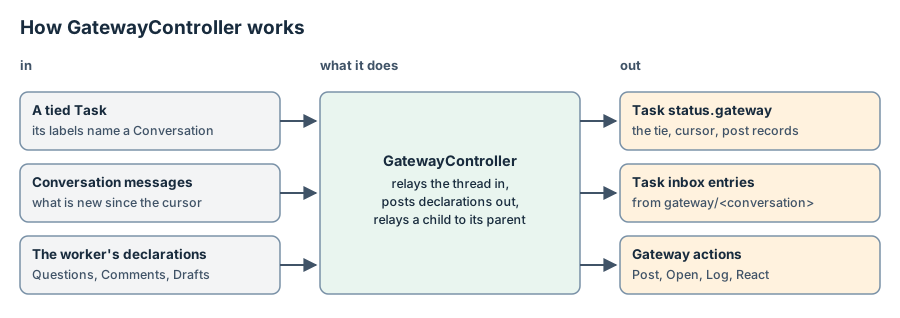
Implemented. The installed binary has steps 1 to 12 below: the [gateway]
key, the Gateway port, the fleet-gateway crate with its fake, Slack and
Discord adapters, the Conversation and Listener kinds,
ConversationController (the mirror, admission, Task creation in each
thread's own directory under the workspace precondition, the busy notice
and the refusal post),
ListenerController, and the fleet gateway receive, account and status
verbs. It has GatewayController's tie, the join and the relay,
status.answered with the answers inbox field, the parent labels and a
child's words reaching its parent's inbox. It posts what a tied Task
declares, opens a thread for an untied Task's Question, and posts every
Task's result and change news in the log channel. It marks an admitted
request with a working reaction when admission starts its Task, or with a
queued reaction while the request waits. It marks each message it relays
with a working reaction, and with a replied reaction once Fleet posted in
the thread. A wildcard route covers every channel that no other route
lists. A DM route covers every one-to-one DM with the bot, where a
top-level message needs no mention. The listener programs stay outside
Fleet.
The Gateway ties chat threads to Tasks:
- A person mentions Fleet's bot in a thread.
- Fleet starts a Task for that thread.
- Every later message in the thread reaches the Task's inbox.
- What the Task declares for the person is posted in the thread.
A thread carries only what is useful to the person in it: the Task's Comments and Questions, one notice when a change it follows is first ready for review, and one notice each time the worker then answers the review threads on that change. A Task's Drafts, its result and the news of its changes are factory logs. They go to one log channel, for every Task, when the config names one.
The Gateway never runs a model. It admits people, keeps the tie between a thread and its Task, and moves messages. The Task does all agentic work.
The Gateway is the Forge controller applied to chat. A Task declares what it wants said. A mirror object follows the thread. Fleet relays new messages into the inbox under a cursor, and recognises its own posts by a marker. One adapter per platform sits behind one port. Slack and Discord have adapters. Telegram and Microsoft Teams are mapped on paper, to check the model.
| Read | Answers |
|---|---|
| Conversation | What does the mirror of one thread hold? Who deletes it? |
| Listener | Is an account's listener running, connected and current? |
| Task gateway status | What does a Task declare to talk? What do status.gateway and status.answered hold? |
| State machine | Which states does a thread and a tie go through? What is relayed or posted, and when? |
| Interface | What are the port, the CLI verbs, the declarations, the inbox entries and the keys? |
| Adapters | Which rules does every adapter keep? How do the platforms compare? |
| Slack adapter | How is a Slack account set up, configured and mapped onto the port? |
| Discord adapter | How is a Discord account set up, configured and mapped onto the port? |
| Native config | Where do accounts, people, routes and admission come from? |
| Overall architecture | Where does this fit in Fleet? |
The parts #
| Part | Role |
|---|---|
| Listener | A small program outside Fleet. It holds the platform connection and hands each event to fleet gateway receive. One per account. |
fleet gateway receive |
A bounded manager verb. It reads one event and adds it to the thread's Conversation. |
| Conversation | The mirror of one thread. It numbers the messages and records which Task the thread is tied to. |
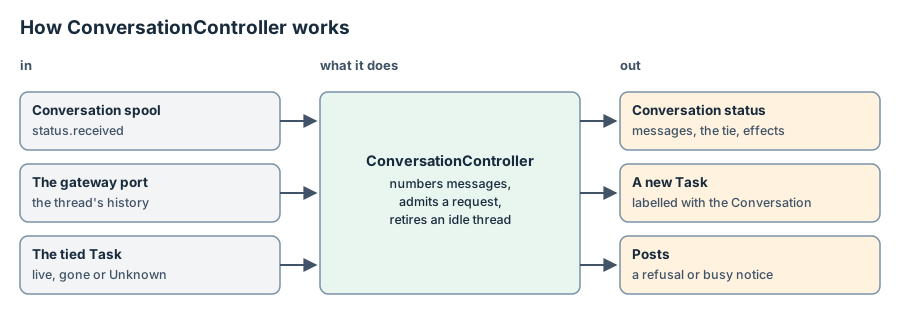
| ConversationController | Keeps each Conversation current, starts a Task for an admitted mention, and retires old Conversations. |
| GatewayController | A second controller over each Task. It relays the thread into the inbox and posts what the Task declares. |
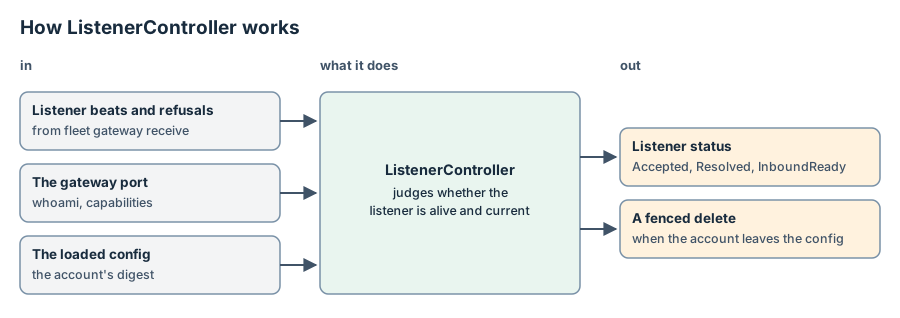
| Listener resource and ListenerController | Show whether an account's listener is running, connected and on the current configuration. |
| Gateway port | The platform API behind one interface: read events, read history, open a thread, post, react. |
Flow: a mention starts a Task #
- A person on a route's allowlist mentions Fleet's bot in a channel that the route covers. The thread can be new or old. See Flow: which route covers a channel.
- The listener receives the event and runs
fleet gateway receive. The verb creates the thread's Conversation and adds the event to it. The listener acknowledges the event only after the verb succeeds. - ConversationController reads the thread's history, so a mention partway through a thread brings everything before it.
- The mention passes the route's admission rules. ConversationController
creates one Task from the route, with the route's TaskConfig and brief
and the thread's own workspace, and records the tie. On a route with a
{base}workspace, the thread's directory is<base>/<conversation name>. The manager creates it when it creates the Task. - GatewayController sends the whole retained thread to the Task as its first inbox entry, after the brief.
- Each later message from an allowlisted person reaches the inbox and is a worker turn. Messages from other people start no turn. They go out with the next allowlisted message, marked as content, never instructions.
- The worker answers with declarations: a
Commentor aQuestion. Fleet posts each one in the thread, in order, and never twice. The worker holds no platform credential and names no destination. - When a
ChangeRequestthe Task follows first leavesdraft(everReadyturns true), Fleet posts one notice in the thread with the change's URL. - After the ready notice, people can write review threads on the change. When the worker's marked reply answers a person's review note, and no review thread waits on the worker any more, Fleet posts one answered notice in the thread with the change's URL. A new note from a person starts a new round, and the next answer posts a new notice. A thread that a person resolves, or a bot's thread, posts no notice of its own. These two notices are the only change news a thread gets. See answered review threads.
- The Task's
Draftdeclarations, its result and all of its change news go to the log channel, never to the thread. - The thread lives as long as people write in it. A Concluded Task still receives the thread, so a later message reaches the same Task.
- If someone deletes the Task, the thread becomes Orphaned. The next admitted message, with or without a mention, starts a new Task with the thread's history, in the same directory.
- A thread with no message for its retention period retires, if its Task is Concluded or it has no live Task. See Flow: a thread's end of life.
Flow: which route covers a channel #
The receive verb finds the route of each event's channel on the event's account:
- A route of the account lists the channel id. That route covers the channel.
- Else, the channel is the
gateway.logschannel. No route covers it. - Else, the adapter says the channel is a one-to-one DM, and the account
has a DM route, with
"dm:*"inchannels. The DM route covers the channel by its DM entry. - Else, the account has a wildcard route, with
"*"inchannels. The wildcard route covers the channel. - Else, no route covers the channel. The verb ignores the event.
Rules:
- An explicit channel id always wins over the wildcard. The order of the routes in the file does not matter.
- An account has at most one wildcard route.
- The wildcard covers only conversations that the account's listener delivers. Each adapter page says which ones.
- Admission applies on a wildcard route as on any route:
allow,allowBots, the mention rule and the refusal. - A wildcard route needs
mention = "required". - A thread that a wildcard route covers keeps that route. A later route that lists its channel id changes the route of new threads only.
Rules for the DM entry:
- An explicit channel id always wins over the DM entry.
- An account has at most one DM route.
- A group DM is no one-to-one DM. The wildcard covers it under the mention rule.
- The Conversation of a thread that the DM entry covers records
spec.direct. In that thread, a message that starts the thread, or mentions Fleet, starts a Task. A stranger's top-level message there earns the refusal. - An edit or a removal that does not say it is in a DM still reaches a
thread whose Conversation records
spec.direct. - A thread keeps its
spec.direct. A later config without"dm:*"changes the rule of new threads only. - On Slack, each top-level DM message starts a new thread, so it starts a new Task. A person continues a Task by replying in its thread.
The cost rule holds on a wildcard route. In a thread that Fleet does not mirror, only a message that can start a Task, earn a refusal, or is Fleet's own keyed post creates a Conversation. Other chatter, in any channel, costs no object.
Flow: reactions show progress #
- Admission accepts a message that starts a Task. The trigger is that message.
- Fleet creates the Task. The create has one of two results:
- The Task is created. Fleet adds the working reaction, 👀 by default, to the trigger.
- The Task waits, because another Task holds the thread's directory. Fleet adds the queued reaction, ⏳ by default, to the trigger.
- While the Task waits, each later admitted message also gets the queued reaction.
- When the Task is created after a wait, each message with the queued reaction gets the working reaction. Fleet removes its queued reaction.
- GatewayController relays admitted messages into the tied Task's inbox: the join, or a later relay. Fleet adds the working reaction to each admitted message in that relay that has no reaction yet.
- The Task works, and declares a
Commentor aQuestion, or a change it follows becomes ready for review. - Fleet posts in the thread for the Task.
- Each message in the thread that still has the working reaction gets the replied reaction, ✅ by default. Fleet removes its working reaction.
Rules:
- Only an
Admittedmessage gets a reaction. AContextmessage and Fleet's own posts get none. - Fleet adds the working reaction to a message once. The join adds no working reaction where admission's working reaction landed.
- Admission tries its working reaction once, when the Task is created. When that reaction fails, or the capabilities are Unknown then, the join adds the working reaction instead. Reason: a late working reaction from admission could land after the Task replied, and stay.
- Only a wait for the thread's directory (
WorkspaceBusy) is queued. A create that is retried after a refusal, or whose outcome Fleet looks for, adds no reaction. - Only the queued reaction shows that a request waits. The busy notice is no reply, so a message with the queued reaction keeps it until its Task is created.
- A wait can end without a Task: the trigger leaves the mirror. Fleet then removes the queued reaction from each message that still has it.
- A message with the queued reaction that leaves the mirror, removed or rotated out, loses the queued reaction.
- Only a thread post counts as a reply: a Question, a Comment or the ready notice. A log post does not count.
- A message that is edited and relayed again keeps the mark it has. Fleet marks it working only when it has no mark yet.
- A message that leaves the mirror, removed or rotated out, gets nothing more.
- Reactions are best effort. A reaction that fails or has an unknown
outcome never holds back a relay or a post, and raises no
NeedsAttention. - Each reaction is a keyed effect: Fleet writes the intent first and the receipt after. A reaction is set, not counted, so a repeat after a crash changes nothing.
gateway.reactions = falseturns reactions off. An adapter whose platform has no reactions answersreactions = falsein its capabilities, and Fleet then adds none.
Flow: a thread's end of life #
A thread retires when both of these conditions are true:
- No message arrived for
gateway.retainMs, seven days by default. The period counts from the later of the last message, the orphaning and the creation of the Conversation. - The thread is Untied or Orphaned, or its Task is Concluded.
A retiring thread goes through these steps, in this order:
- ConversationController deletes the Task that the thread created. The
delete is fenced on the Task's
uid. The Task's finalizer then releases its session, and the thread becomes Orphaned. - The manager removes the thread's directory, if the manager created it. It waits while another Task names the directory.
- ConversationController deletes the Conversation.
Rules:
- A thread whose Task is not Concluded never retires.
- A message that arrives during the retirement stops it. The thread keeps its directory, and the next admitted message starts a new Task there. While the thread's Task is being deleted, Fleet judges no new message. It judges them once the thread is Orphaned, so no message is lost.
- Each step is a keyed effect. After a crash, the retirement continues at the first step that has no settled receipt.
- An Unknown read never counts as absence. The retirement waits.
- Fleet removes only a directory that it created for the thread. It never removes a directory that existed before, a route's base directory or a workspace a runtime made from a route's URL list.
- Nothing on the platform changes. A later message there is treated as a new thread: a new Conversation, the mention rule again, the thread's history, and an empty directory.
Flow: a Question opens a thread #
- A Task that nobody started from chat declares a
Question. For example, a plugin created the Task. - GatewayController opens a new thread in the first channel id of the questions route. The wildcard and the DM entry are no channel id. A route without a channel id cannot take Questions. The first post is the Question, and it carries a marker that names the Task.
- The new thread gets a Conversation, which is tied to that Task by the marker.
- Replies in the thread reach the Task's inbox. The first allowlisted reply
written after the Question records it as answered in
status.answered. - An answer can also arrive another way, for example through a plugin that shows the Question as "Needs input". Whichever answer arrives first wins. Fleet does not repost, nudge or remind.
A Comment, a ready notice or an answered notice never opens a thread.
Fleet posts them only for a Task that is already tied. A Draft, a result or other change news
never goes to a thread.
Flow: the log channel #
- The config names a log destination:
gateway.logs, an account and one channel on it. - A Task declares a
Draft, reports a result, or a ChangeRequest it follows is followed, becomes ready for review, merges or closes. - GatewayController posts one top-level post in the log channel. The post names the Task. For a tied Task, it also names its thread, as a link where the thread's adapter can make one.
- This holds for every Task: a tied Task, an untied Task, a child, and a Task that the CLI, a plugin or another Task started.
Rules:
- A
Draftis logged once perid. A Task's result is logged once per generation. Each change news item is logged once, the change becoming ready for review included. - A log post opens no thread, creates no Conversation and ties nothing.
- Fleet relays no reply written under a log post. The log channel is no route's channel, and a wildcard route never covers it. So the receive verb ignores every event there.
- Without
gateway.logs, Fleet posts Drafts, results and change news nowhere. It marks them read, so a log channel named later does not replay them. The thread's ready and answered notices do not depend ongateway.logs.
Flow: a child speaks through its parent #
A Task can carry parent labels that name another Task. Its Questions,
Comments, Drafts, changes and result then go to the parent's inbox, not to
a thread. The parent answers with fleet send CHILD --answers ID TEXT.
Only the parent speaks in the thread. When the parent is gone, the child
acts as an untied Task.
A child's Drafts, result and change news also go to the log channel, as every Task's do. The parent's inbox entry is the parent's turn of work. The log post is the factory's record, which must show every Task.
Behaviour #
These rules hold across all flows:
- One thread, one mirror, one Task at a time. A thread has one Conversation per account. It is tied to at most one live Task.
- Fleet speaks only through declarations. Every post is a keyed effect: Fleet writes the intent first and the receipt after.
- Fleet never posts twice. A post whose outcome is unknown is looked
for by its marker, never sent again blindly. On a platform with a nonce
marker, Fleet resends it under the same nonce inside the platform's window.
Where a platform cannot find it, Fleet raises
NeedsAttention/PostUnconfirmedand waits for a person. - Posts in one thread go out in declaration order. A post with an unknown outcome holds back the later posts to that thread only.
- A Task's log posts go out in order, apart from its thread posts. A log post with an unknown outcome holds back that Task's later log posts only. It holds back no thread post, and a thread post holds back no log post.
- Fleet never relays its own posts.
- Reactions never hold anything back. A failed or unknown reaction is tried again under its key at most three times in all, and is then given up. It holds back no relay and no post, and raises no condition.
- Unknown never means absent. A platform or store answer that Fleet cannot read makes Fleet wait. It never makes Fleet act as if something is gone.
- Delivery is at least once. A redelivered event changes nothing. In a tied, active thread, an event the listener lost is recovered from history where the platform has it. A mention lost in an untied thread is not recovered.
- A thread Fleet opened belongs to its Question's Task. While that Task exists, a mention there starts no other Task. If Fleet cannot tell which Task opened the thread, the thread ignores mentions rather than guess.
- A route with a base directory gives each thread its own directory.
The route's
{base}is a base directory. Every Task of one thread gets["file://<base>/<conversation name>"], so a later Task finds what an earlier one left. A route with a URL list gives each Task its own workspace, which its runtime makes. - Threads never wait for each other. A thread waits only while another Task already holds its own directory. Examples are the previous Task of an Orphaned thread that is still being deleted, or a Task that someone applied there. The thread then says so once and starts when the directory is free.
- A thread ends once, as a whole. A thread idle for its retention, with a Concluded Task or no live Task, retires: its Task, the directory that Fleet created for it, and its Conversation are deleted. Fleet deletes no other directory.
- Every problem is a visible condition. The Conversation, the Task and
the Listener each report
NeedsAttentionwith a reason. Nothing fails silently.
Why it is shaped this way #
The Forge pattern, applied to chat #
| Forge | Gateway |
|---|---|
| One adapter per forge kind | One adapter per chat platform |
ChangeRequest, the mirror of one change |
Conversation, the mirror of one thread |
revision and per-note seq |
revision and per-message seq |
ForgeController owns status.forge |
GatewayController owns status.gateway |
| Relay under a cursor, in one write | The same |
| The worker mark on forge posts | A platform marker on Fleet's posts |
| Mark-ready, a keyed effect | Open, Post and Log, keyed effects |
Chat differs from a forge in three ways:
- A chat pushes. Fleet polls a forge, but a chat platform delivers events. So Fleet adds an inbound verb and a listener.
- A thread creates its Task. A Task opens a change, but a conversation starts before any Task exists. So ConversationController creates the Task.
- Fleet speaks often. The Forge controller writes one thing. The Gateway posts on every declaration.
A built-in, not a plugin #
The Gateway reads the declarations of every Task, keeps a cursor on each Task in the same write as the inbox append, and must wake when a Task declares something. A plugin can do none of these. A plugin also cannot hold a resident connection, and the platforms need one either way.
A plugin that keeps its own records, works on its own Tasks and polls stays
a plugin. It meets the Gateway only on a Task: in status.declared, in the
inbox and in status.answered.
Inbound transport #
Fleet's rule is bounded calls and no service of its own to supervise. But every platform except Telegram pushes events, over a WebSocket or a public HTTPS endpoint.
| Option | For | Against |
|---|---|---|
| (a) Poll inside bounded calls | Fits Fleet exactly. | Discord and Teams cannot be polled for mentions. Slack's history has rate limits. |
(b) fleet up holds the connection |
One resident process already exists. | The manager gains a network service. A listener stall stalls reconciliation. |
| (c) A separate listener hands events to a manager verb | The manager stays bounded. The listener holds nothing durable. | One more process for the operator to run. |
Recommendation: (c), for every platform.
- The listener is transport only. It holds the connection, authenticates
the platform, and pipes each event into
fleet gateway receive. - Platform parsing stays in Fleet's adapter, with its tests.
- The first listener is for Slack Socket Mode. It is a small program maintained outside the workspace, and the operator's service manager runs it. Any program that runs the verb per event is a listener.
- Fleet supervises no listener but observes each one. A listener reports
heartbeats, and the account's Listener turns
InboundReadyFalse when the listener stops, stalls or runs an old configuration.
Scope #
In scope:
- accounts, people and routes in native config, a wildcard route included,
- admission: the allowlist, the mention rule, and one polite refusal,
- the Conversation mirror, with numbered messages and retention,
- one Task per thread, created from a route,
- relaying a thread into its Task's inbox,
- posting what a Task declares, in order,
- posting every Task's Drafts, result and change news in one log channel,
- opening a thread for a Question from an untied Task, and recording answers,
- routing a child Task's words to its parent,
- the Slack and Discord adapters, the receive verb and the Listener,
- marking an admitted request with a working reaction, or a queued one while it waits for its Task,
- marking a relayed message with a working reaction, and with a replied reaction once Fleet posted in the thread.
The Task controller pauses a conversation Task's idle session when the
Task's TaskConfig sets pauseAfterMs. The next message for the Task resumes
it. See pausing an idle session.
Out of scope, deliberately:
- merging, as for the Forge controller,
- any judgement about the worth of a message: an intake model, a planner or a nudging heartbeat,
- implementing the Telegram or Teams adapters,
- reading people's reactions, files, edits of Fleet's own posts, and interactive components,
- the listener programs themselves.
Implementation and evidence #
Each part, where it lives, and the suites that hold it, against the built
CLI, a fake gateway and a stub curl. crates/architecture.toml holds their
crate edges, field managers and negative fixtures.
| What | Where | Evidence |
|---|---|---|
The Gateway port; fleet-gateway with the fake adapter; the Conversation and Listener kinds; ConversationController with numbering and retention; ListenerController; fleet gateway receive and --beat; fleet gateway account and status; [gateway] config |
fleet-api/src/gateway.rs, crates/fleet-gateway, fleet-controllers/src/conversation.rs, fleet-manager, fleet-cli |
conversation_controller, e2e_gateway, store_contract, architecture |
| Admission; routes; Task creation with the workspace precondition; the refusal post | fleet-controllers/src/conversation.rs, fleet-api/src/gateway.rs |
conversation_controller, e2e_gateway |
GatewayController: the tie, the join and the relay; status.answered and the answers inbox field; the parent labels |
fleet-controllers/src/gateway.rs, fleet-store |
gateway_controller, e2e_gateway_controller, store_contract |
| Posting declarations, results and change news; opening a thread for a Question; children | fleet-controllers/src/gateway.rs, fleet-manager |
gateway_controller, e2e_gateway_post |
The Slack adapter through curl |
crates/fleet-gateway/src/slack.rs |
Truth tables in the adapter's unit tests; recorded Socket Mode payloads; e2e_gateway against the stub curl |
The Discord adapter through curl; inbound = "discord-gateway", messageContent and intents; nonce recovery in ConversationController |
crates/fleet-gateway/src/discord.rs, fleet-api/src/gateway.rs, fleet-controllers/src/conversation.rs |
Truth tables in the adapter's unit tests; synthetic dispatches; conversation_controller; e2e_gateway_discord against the stub curl |
The log channel: gateway.logs; the Log action; a top-level post to a channel address; the port's link; Drafts, results and change news of every Task leave the thread, which keeps one ready notice per change and one answered notice per round of answered review threads |
fleet-api/src/gateway.rs, fleet-api/src/plan.rs, fleet-controllers/src/gateway.rs, fleet-manager, crates/fleet-gateway |
gateway_controller, e2e_gateway_logs, e2e_gateway_post |
One directory per thread, and one end of life: a route's {base} is a base directory; each thread's Tasks get <base>/<conversation name>, which the manager creates through the runtime's create_dir and records; WorkspaceBusy only for a Task that holds the thread's own directory; an idle thread with a Concluded Task or none retires its Task, its recorded directory and its Conversation; gateway.retainMs defaults to seven days |
fleet-api/src/conversation.rs, fleet-api/src/runtime.rs, fleet-api/src/store.rs, fleet-controllers/src/conversation.rs, fleet-manager, fleet-runtime, fleet-store |
conversation_controller, store_contract, e2e_gateway |
Reactions: the port's react and the reactions capability; [gateway] reactions; the React action; a relayed admitted message marked working, and marked replied once a thread post lands; Slack's reactions.add and reactions.remove, Discord's own-reaction endpoints, the fake's record |
fleet-api/src/gateway.rs, fleet-api/src/talk.rs, fleet-controllers/src/gateway.rs, fleet-manager, crates/fleet-gateway |
gateway_controller, e2e_gateway_reactions, e2e_gateway, e2e_gateway_discord |
Reactions at admission: the trigger marked working when its Task is created, or queued while it waits for the thread's directory; a waiting request's later admitted messages marked queued; queued replaced by working when the Task is created; [gateway] reactions queued; the Conversation's status.reactions and its React effects; the join takes those marks without a second reaction |
fleet-api/src/conversation.rs, fleet-api/src/gateway.rs, fleet-api/src/talk.rs, fleet-controllers/src/conversation.rs, fleet-controllers/src/gateway.rs, fleet-manager |
conversation_controller, gateway_controller, e2e_gateway_reactions |
The wildcard route: "*" in channels; an explicit channel id wins; the log channel stays uncovered; one wildcard route per account, with mention = "required"; a questions route needs a channel id |
fleet-api/src/gateway.rs, fleet-controllers/src/gateway.rs |
fleet-api unit tests, gateway_controller, e2e_gateway_wildcard |
The DM route: "dm:*" in channels; the port's direct on a delivery, Slack's channel_type im; the Conversation's spec.direct; a top-level DM starts a Task without a mention, and a stranger's earns the refusal; an explicit channel id wins; one DM route per account; never on Discord |
fleet-api/src/gateway.rs, fleet-api/src/conversation.rs, fleet-controllers/src/conversation.rs, fleet-manager, crates/fleet-gateway |
fleet-api unit tests, Slack truth tables, conversation_controller, e2e_gateway_dm |
Gateway controller state machine #
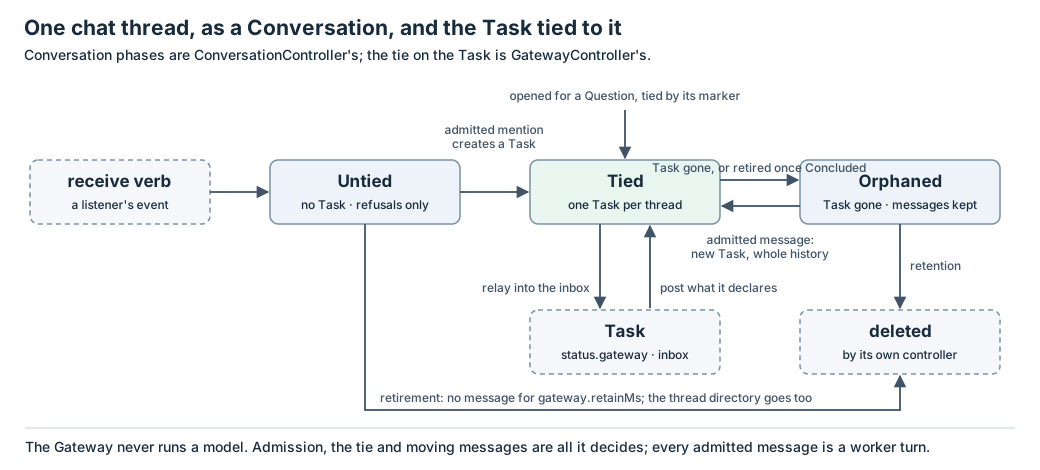
Two things change state: a Conversation,
which ConversationController owns, and the tie on each Task, which
GatewayController keeps under status.gateway. TaskController still owns
the Task's own status.phase. The Conversation phases, the transitions
that create a Task, orphaning and retention are implemented, and so are
every state of the tie on a Task, its ConversationGone, the join, the
relay, posting, logging and reactions.
Conversation phases #
| Phase | Meaning |
|---|---|
| Untied | Fleet mirrors the thread, but no Task is tied to it. |
| Tied | One live Task is tied to the thread. |
| Orphaned | The tied Task is gone. The messages are kept. |
| From | Event | To |
|---|---|---|
| none | An event that could start a Task or earn a refusal, or Fleet's own Question post | Untied |
| Untied | Fleet's Question post, whose marker names a live Task | Tied, to that Task |
| Untied | An admitted message that meets the mention rule | Tied, to a new Task |
| Tied | The Task is readably gone, or another Task holds its name | Orphaned |
| Orphaned | Any admitted message, with or without a mention | Tied, to a new Task with the whole thread |
| Tied | No message for gateway.retainMs, and the Task is Concluded: the retirement deletes the Task |
Orphaned, retiring |
| Untied or Orphaned | No message for gateway.retainMs since the later of the last message and the orphaning, and no Task waiting for the thread's directory; or a retirement in progress |
deleted, after the thread's directory is removed |
Behaviour in every phase:
- A Conversation never leaves Tied because its Task is Unknown. Only a readably absent Task orphans it.
- A message seen twice, from the listener and from history, is one message.
- On a route with a
{base}workspace, every Task of the thread gets the thread's own directory,<base>/<conversation name>. Threads never wait for each other. - When another Task already holds the thread's own directory, the thread stays where it is, says so once, and starts its Task when the directory is free. A waiting thread never retires.
- A thread whose Task is not Concluded never retires.
- A retirement runs its steps in order: the Task, the directory, the
Conversation. Each step is a keyed effect under
conversation/<uid>/retire/<at>/, so a crash between two steps resumes at the first step without a settled receipt. - A message numbered during a retirement stops it. The thread keeps its directory.
- A thread Fleet opened for a Question starts no Task from a mention while the Question's Task exists. The interface gives the limits.
The tie on a Task #
| State | Meaning |
|---|---|
| none | The Task is not tied. It can still open a thread with a Question. |
| opening | Fleet is opening a thread for the Task's Question. |
| opened | The thread is open. Fleet is adding its opening post to the thread's Conversation, through Receive. |
| waiting | The Conversation exists, and Fleet waits for it to name this Task. |
| tied | The Task and the thread are tied. Fleet relays and posts. |
| abandoned | The opened thread never reached its Conversation. The Task acts as untied. |
| child | The Task has a parent. Its words go to the parent's inbox. |
| From | Event | To |
|---|---|---|
| none | The Task carries the conversation label, because a thread created it |
waiting |
| none | The Task declares a Question and has no live parent |
opening |
| none | The Task carries parent labels naming a Task that exists with that uid, or that is Unknown |
child |
| opening | The thread is open | opened |
| opening | Three attempts are refused | none, with PostFailed |
| opening | The outcome is Unknown, and the platform has no history or marker | opening, with PostUnconfirmed, until a person acts |
| opened | Receive succeeded |
waiting |
| opened | The Conversation already names this Task | tied |
| opened | Three Receive attempts failed |
abandoned, with ReceiveFailed |
| waiting | The Conversation names this Task | tied |
| abandoned | The Conversation later names this Task | tied |
| abandoned | A later Question |
opening |
| abandoned | The Conversation is readably gone | none |
| abandoned | The Conversation names another Task | none, with ConversationGone |
| tied or waiting | The Conversation is readably gone, or names another Task | none, with ConversationGone |
| child | The parent is readably gone | none |
child is not a value of status.gateway.conversation.state. Fleet decides
it on each pass from the parent labels and the parent's existence, and a
child's conversation field is absent.
While the tie is opening, opened or waiting, the Task's later
declarations wait. They are posted in order once the tie is verified. A
Comment on an untied Task is skipped and never posted later. The tie does
not change logging: a Task in any state of the tie logs its
Drafts, result and change news.
Joining #
A newly tied Task joins at the beginning of the thread. Its first inbox entry holds the retained messages, so a mention partway through a thread brings its history. If the mirror already dropped older messages, the entry says that they remain on the platform. A Task tied by its own Question has nothing before its own post.
Relay #
GatewayController relays when a tied thread has new admitted messages:
- Everything since the last relay goes out as one inbox entry. The entry, any answers it records and the cursor advance land in one write, or not at all.
- Messages from people not on the allowlist wait. They go out with the next admitted message, under a header that marks them as content.
- Fleet's own posts are never relayed.
- If the mirror dropped messages that were never relayed, because the
thread outgrew the 200 it keeps, the entry says that they remain on the
platform, and the Task raises
NeedsAttention/RelayGap. - Each admitted message in the entry that has no mark gets the working reaction. See reactions.
Posting #
GatewayController posts in a tied thread, in this order:
- every
QuestionandCommentthe Task added since the last pass, in declaration order; - one ready notice per followed change, with its URL, the first time the
change is in a state other than
draft(everReadyis true); - after its ready notice, one answered notice per followed change, with
its URL, each time the entry's
answeredAtmoves past the value the last notice announced. The ready notice records the value it found, so threads answered before it start no round. A change with a ready notice and no value recorded (a Task from beforeannounced) records the current value without a notice.
It posts nothing else in a thread. A Draft, a result and all other change
news go to the log channel. The ready and answered notices are
posted whether or not gateway.logs is set.
- Each post is a keyed effect: intent, then the platform call, then the receipt.
- Posts to one thread go out one at a time. A post with an unknown outcome holds back later posts to that thread, and no other thread.
- A full inbox does not hold back posting.
- A post that lands marks every message still marked working as replied. See reactions.
Logging #
GatewayController logs, for every Task, its Draft declarations, its
result and the news of each followed change, in this order. A Task needs no
tie and no route to log.
- A
Draftis logged once perid. A result is logged once per generation. A change is logged each time its state moves: followed, draft, open (ready for review), merged or closed. - Each log post is a keyed effect, as a thread post is. It is one
top-level post in the
gateway.logschannel. - A Task's log posts go out one at a time. A log post with an unknown outcome holds back that Task's later log posts. It holds back no thread post, and no thread post holds it back.
- An unknown outcome is recovered from the log channel's history, with the
thread posts' rules: a split is found only when every part is found, and
three reads that cannot complete raise
RecoveryIncomplete. - Without
gateway.logs, a Draft, a result or change news is marked read and posted nowhere. A log post whose outcome is not settled whengateway.logsleaves the config is dropped, never posted elsewhere.
Reactions #
Each message of a thread has one mark. Two controllers keep the marks:
- ConversationController keeps the marks that admission makes, before the
Task has the message, under the Conversation's
status.reactions. - GatewayController keeps the marks from the join on, under the Task's
status.gateway.reactions.
Reactions are on unless gateway.reactions is false, and only where the
account's capabilities say reactions.
| Mark | Meaning |
|---|---|
| none | Fleet added no reaction. |
| queued | Admission accepted the message, and the message waits for its Task. Fleet added the queued reaction. |
| working | The Task has the message, or admission just created the Task for it. Fleet added the working reaction, and removed the queued reaction. |
| replied | Fleet posted in the thread since. It added the replied reaction and removed the working reaction. |
| From | Event | To |
|---|---|---|
| none | Admission starts a Task for the message, and the create answers Created |
working |
| none | Admission starts a Task for the message, and the create answers WorkspaceBusy |
queued |
| none | The thread's create waits for its directory, and the message is Admitted and later than the trigger |
queued |
| queued | The create answers Created, and the capabilities are known on that pass |
working |
| queued | The create answered Created on an earlier pass, whose capabilities were Unknown |
none, and Fleet removes the queued reaction. The join marks the message working. |
| queued | The wait is withdrawn: the trigger left the mirror | none, and Fleet removes the queued reaction |
| none | A relay or the join delivers the message, and it is Admitted |
working |
| working | A Question, a Comment, a ready notice or an answered notice lands in the thread for the Task | replied |
| queued | The message leaves the mirror, removed or rotated out | none, and Fleet removes the queued reaction |
| working or replied | The message leaves the mirror, removed or rotated out | none, and Fleet changes no reaction |
| queued, working or replied | gateway.reactions turns false |
none, and Fleet changes no reaction |
| working or replied | The tie ends: the Conversation is readably gone, or names another Task | none, and Fleet changes no reaction |
Rules:
- Fleet adds the working reaction to a message once. The join marks a message that admission marked working, and adds no reaction where admission's working reaction landed. Otherwise the join adds it.
- Admission tries its working reaction once. Reason: a retry could land after the Task replied, and the working reaction would then stay.
- A message marked queued keeps the queued reaction when a thread post lands. Reason: nothing worked on it yet.
- A message that is edited and relayed again keeps its mark.
- A thread post counts as a reply only to the messages marked working before it landed.
- A log post, a refusal and a busy notice are no reply.
- A reaction of ConversationController is a keyed effect on the
Conversation, under
conversation/<uid>/react/. It is best effort, as a reaction of GatewayController is. - The capabilities of the account are read before the relay. When they are
Unknown, or say no
reactions, the relay goes on and marks nothing. - A mark changes when Fleet plans its reactions, not when they land. A reaction that fails changes no mark.
Children #
A child's Questions, Comments, Drafts, changes and result each become one
entry in its parent's inbox, from gateway/child/<child>. A child logs its
Drafts, result and change news as every Task does. The parent
answers with fleet send CHILD --answers ID TEXT, which records the child's
status.answered. A summary or declaration text over 4 000 bytes is not
quoted. The entry gives its size and fleet get task CHILD to read it, so
that the entry stays short enough to type. Only the parent speaks in the
thread. A child whose
parent is gone acts as an untied Task, and its earlier declarations are not
replayed.
Conditions #
On a Conversation:
| Type | True means |
|---|---|
Reachable |
The platform's history answered. |
Tied |
A live Task is tied. |
NeedsAttention |
One of TaskCreateFailed, RouteUnknown (the route left the config), MentionsOnly (the platform delivers only mentions, so only mentions are relayed), WorkspaceBusy (another Task holds the thread's own directory), PostFailed (three attempts at a refusal or busy notice were refused), PostUnconfirmed (a refusal or busy notice has an unknown outcome on a platform where Fleet cannot find it again), RetireFailed (three attempts at one step of the thread's retirement were refused). |
On a Task, under status.gateway.conditions:
| Type | True means |
|---|---|
Tied |
The Task is tied to a thread it verified. |
NeedsAttention |
One of RelayGap, ConversationGone, PostFailed, PostUnconfirmed, DeclarationInvalid, TooManyChildren (over 200), RecoveryIncomplete (Fleet cannot finish reading history to find a post), ReceiveFailed, RouteUnknown. With TooManyChildren, no child is relayed. |
An account's identity and its listener are conditions on its Listener, not on any Conversation.
NeedsAttention stops nothing else. Relay goes on while a post waits, and a
held post in one thread holds back no other thread. A reaction raises no
condition.
Deletion #
Deleting a conversation Task deletes nothing else. Its Conversation becomes
Orphaned and is kept. Deleting a Conversation changes nothing on the
platform. Its Task, if any, raises ConversationGone and keeps running.
Neither controller adds a finalizer.
A retirement deletes the thread's Task, its directory and its Conversation, in that order. A person who deletes a Task or a Conversation by hand deletes only that object. The thread's directory then stays until the thread retires. A Conversation that a person deletes takes its record of the directory with it, so Fleet does not remove that directory.
Gateway controller interface #
This page defines the Gateway's APIs: the port that adapters implement, the
CLI verbs that listeners and people run, what a Task declares and receives,
and who may write what. The port, the addresses and admission are
implemented in fleet_api::gateway; the three verbs, the Conversation and
Listener kinds, ConversationController, ListenerController,
GatewayController's tie, join, relay, posting, logging and reactions, its
Open, Receive, Post, Log and React actions, answers, the parent
labels and Probe::List are implemented. It follows the shape of the
Forge controller interface. The
state machine defines when each thing happens.
Addresses #
One address format names a conversation everywhere above the port:
<platform>:<chat>[:<thread>]
slack:C0123ABCD:1730000000.000100      a Slack thread: channel, parent ts
slack:C0123ABCD                        a channel, where a thread is opened
telegram:-1001234567890:42             a forum topic: chat id, message_thread_id
discord:1300000000000000000:1300000000000000001   a Discord thread: parent channel, thread
Only the adapter reads the parts of an address. A Conversation is named
conv-<12 hex of sha256(<account>/<address>)>, so one thread names one
object per account. The account, not the address, carries the platform
workspace, such as a Slack team.
Gateway port #
The port is fleet_api::gateway::Gateway. Every answer is Known or
Unknown. A refused write is Known(EffectOutcome::Failed { why }).
| Method | Input | Answer |
|---|---|---|
operation_bound |
None | The worst-case duration of one call. |
parse |
An account and an address | The normalised ConversationRef. Unknown for an address the adapter cannot read. |
event |
An account's configuration and a delivery envelope | A Delivery, None for a payload the Gateway ignores (a reaction, a presence change), or Unknown. Pure, so the receive verb runs it without the lease. |
whoami |
An account | Fleet's bot identity, as the platform reports it. |
capabilities |
An account | What the platform offers there: history, marker (metadata, nonce or none), unmentioned (whether messages without a mention are delivered), threads and reactions (whether Fleet can add and remove its own reactions). |
history |
A conversation, and an after message id or a since time |
The messages after that point, oldest first, and the thread's first message as starter. Unknown, with retryAfter where the platform gives one, when the read fails. Unsupported where bots cannot read history. |
open |
A channel, text and an intent key | Opened { conversation, message, at }: a new thread whose first post is the text, carrying the key as its marker. |
post |
A conversation, text and an intent key | Posted { message, at }: a post carrying the key as its marker. To a thread address, a reply in the thread. To a channel address, a top-level post in the channel. |
react |
A conversation, a message id, a reaction name and on |
Reacted { already }: Fleet's own reaction is added (on) or removed. already is true when it was already there, or already absent. |
link |
An account and a thread address | A URL that opens the thread, or none where the adapter cannot make one without a platform call. Pure: it calls no platform. |
What an adapter must guarantee:
atis the platform's own time for the post, such as Slack'stsor Telegram'sdate. Fleet orders answers on it.- A Known
sinceread is complete. Recovery readssincethe intent and treats a missing key as an absent post. A read that cannot page through everything answers Unknown (Incomplete), never a partial list. - An
afterread returns at mostlimitmessages, the newest ones, with a count of those left out. The first read of a thread takes the newest 200. starterisremovedwhen the platform reports the thread's first message deleted.- An open that takes two platform calls keys both from the one intent key, and finishes a half-done open on retry.
- With
marker = nonce { windowMs }, a retry within the window resends the same nonce, and the platform returns the existing post. - A reaction is set, not counted. A repeated add leaves one reaction, and removing an absent one changes nothing. Both are Known successes.
- A reaction name is the platform's emoji name, as
gateway.reactionsgives it. The adapter maps the name to what its platform takes. An adapter whose platform has no reactions answersreactions = false, and Fleet then calls noreact. gateway.reactionsnames three reactions.queueddefaults tohourglass_flowing_sand(⏳),workingtoeyes(👀) andrepliedtowhite_check_mark(✅).reactions = falseturns all three off. The config is refused when a name is empty or holds whitespace, when two names give the same emoji, and when it has another key.- A
postto a channel address opens no thread. Every part of a split text is a top-level post in the channel. Asinceread of the channel address finds them.
Text is Fleet's Markdown subset: paragraphs, emphasis, code, links, lists
and quotes. The adapter converts it to the platform's format, and splits a
long text into consecutive posts under derived keys that name the part and
the count (<key>/1/3, <key>/2/3, <key>/3/3).
There is no edit, delete or merge method. Fleet never changes a post that
it made. react changes only Fleet's own reaction on a message. The
adapters say why each
capability exists.
Events #
| Event | Fields |
|---|---|
Message |
id (unique per conversation), conversation, author (id, name, kind: person, bot or fleet), mentionsFleet, at, text, key (the marker on a Fleet post), startsThread (true when the payload says the message starts its thread, as a Discord thread's starter or a Telegram topic's first message) |
Edited |
id, conversation, text, editedAt |
Removed |
id, conversation |
A mention is a Message with mentionsFleet, not an event of its own. A
newer edit replaces the text. An older edit delivered late changes nothing.
Deliveries #
event answers a Delivery:
| Field | Meaning |
|---|---|
id |
The delivery id. It is the same on every redelivery of one event, and different for an edit or removal of the same message. It is the platform's event id where one exists, such as Slack's event_id. Otherwise the adapter derives it. |
verified |
How the delivery was authenticated: connection (an authenticated socket), signature (a verified webhook), fleet (Fleet's own opening post) or history (read by the backstop). |
receivedAt |
When the listener received it. |
event |
The Message, Edited or Removed. |
direct |
true when the payload says the chat is a one-to-one DM between Fleet's bot and one other user. Absent means false: a channel, a group DM, or a payload that does not say. |
A listener writes one envelope per delivery to the verb's stdin:
{"verified": "connection", "receivedAt": 1730000300100, "payload": {"…": "the platform's raw event"}}
The account's inbound setting names the one method its listener may
claim. The verb refuses any other. Each mirrored message records how it
arrived, as via.
The receive verb #
fleet gateway receive --account NAME reads one envelope from stdin and adds
the event to its thread's Conversation. It is a manager verb, like
fleet send, and takes no lease.
- An event in a channel that no route covers is ignored. A route covers a
channel id that it lists. For a delivery with
direct, the account's DM route, with"dm:*"inchannels, covers every other chat. The account's wildcard route, with"*"inchannels, covers every other channel. Neither covers thegateway.logschannel. - A Conversation that the DM entry covers is created with
spec.direct. AnEditedorRemovedevent withoutdirectis read asdirectwhen the thread's Conversation recordsspec.direct. Reason: a platform can leave the chat's type out of an edit. - An event in a thread Fleet does not mirror yet creates the Conversation only when it could start a Task, earn a refusal, or is Fleet's own keyed post. Other chatter is ignored, so a busy channel costs no objects. This holds in every channel that a wildcard route covers, and in every DM.
- A redelivered event changes nothing.
| Exit | Meaning | The listener |
|---|---|---|
| 0 | Written, a duplicate, or ignored | Acknowledges. |
| 1 | Refused: the thread already holds 100 unread events, the Conversation is being deleted, verified is not the account's inbound, or the account is not configured |
Does not acknowledge. |
| 4 | Unknown: an unreadable envelope, payload or record | Does not acknowledge. The platform redelivers. |
| 5 | A write conflict that the verb's retries did not resolve | Does not acknowledge. The platform redelivers. |
A refused event that the platform stops redelivering is recovered by the history backstop, for a tied, active thread on an account with history.
Listener heartbeats #
fleet gateway receive --account NAME --beat reads one heartbeat instead of
an envelope:
{"instance": "a1", "state": "connected", "digest": "sha256:…", "sentAt": 1730000419990, "lastDeliveryAt": 1730000300100}
instancenames one listener process, so two processes on one account never overwrite each other.stateisconnecting,connectedorclosing.digestis the account configuration the listener started from.- A listener beats on every state change and at least every
gateway.beatMs. - The verb stamps each beat with its own clock, so a listener's wrong clock cannot make it look alive.
--beat uses the same exit codes. It creates the account's
Listener if the manager has not yet. The verb
also records on the Listener every envelope it refuses or cannot read (exit
1 or 4), counted by reason. An envelope for an account the config lacks is
refused without a record, since there is no Listener; fleet gateway status shows that the account is missing.
Other verbs #
fleet gateway account NAME --json   # what a listener needs to connect, with the digest
fleet gateway status                # per account: accepted, resolved, inbound, last delivery
Controllers #
All three controllers are pure: they read what the manager observes and
return a plan. The manager owns I/O, persistence and process execution, and
performs every effect and every write. Each controller has the shape of the
Forge controller: due, probes and reconcile.
ConversationController #
pub struct ConversationInput<'a> {
    pub object: &'a Object,
    pub observations: ConversationObservations,
    pub now: Millis,
    pub defaults: GatewayDefaults,
}

pub fn due(object: &Object, now: Millis) -> bool;
pub fn probes(&self, input: &ConversationInput<'_>) -> Result<Vec<Probe>, StoreError>;
pub fn reconcile(&self, input: &ConversationInput<'_>) -> Result<Plan, StoreError>;
defaultscarries the route the spec names, its admission rules, the people table, the route's brief text andgateway.retainMs, as values. The manager reads the brief when it loads the config, so the controller reads no file.dueholds when the thread has unread events, whennotBeforepassed, or when an effect awaits its receipt and a recovery read is due.probesasksHistoryfor the first read, the backstop and recovery;Objectfor the tied Task, or the Task a Question marker names; andCapabilitiesfor the account, at most once per account per sweep. While reactions are on, it also asksCapabilitieswhen a create is pending or waits, when a message is marked queued, and when a reaction record is left.reconcilereturns:status: the whole Conversation status. The same write drains the events it numbered.creates: at most one Task, from the route, with its intent in the same status.effects: at most one refusalPostper author, one busy notice per tie number, theReactactions of the marks below, and the retirement's oneDeleteTaskorRemoveDirstep.delete: true: deletes the object as the last step of its retirement, fenced onuidandresourceVersion.
It works over each Conversation:
- numbers new messages into the mirror, from the receive verb and from a
historybackstop while the thread is active, - starts a Task for an admitted message that meets the route's mention rule, unless the thread belongs to a Task already,
- ties a thread Fleet opened to its Question's Task, through the marker on the opening post,
- marks the thread Orphaned when its Task is readably gone, or when another Task now holds that name,
- sends one polite refusal per author who is not on the allowlist and mentions Fleet,
- marks the trigger of a created Task working, and the messages of a
waiting request queued, then working when its Task is created, under
status.reactions, - retires the thread after its retention: its Concluded Task, the directory the manager made for it, then the Conversation.
A thread that Fleet opened belongs to the Question's Task. While that Task exists, a mention there starts no other Task. If the opening post's marker never arrives, the thread ignores mentions, and the person asks again in a new thread. Fleet does not guess which Task a thread belongs to.
Two limits apply. Once the Question's Task is readably gone, or the opening
post was deleted, a mention may start a Task. On a platform with neither
history nor a marker, a mention that arrives before Fleet records its own
opening post may start a Task; the Question's Task then raises
ConversationGone.
The Task it creates:
{
  "apiVersion": "fleet/v1alpha1",
  "kind": "Task",
  "metadata": {
    "name": "conv-3f9a1c0d2b7e-1",
    "labels": {"gateway.fleet.dev/conversation": "conv-3f9a1c0d2b7e",
               "gateway.fleet.dev/conversation-uid": "<conversation uid>",
               "gateway.fleet.dev/route": "eng"}
  },
  "spec": {
    "configRef": {"name": "conversation"},
    "brief": "<the route's brief file, as read when the Task is created>",
    "workspace": ["file:///work/conversations/conv-3f9a1c0d2b7e"],
    "dispatch": true
  }
}
The name is the Conversation's name with a number that grows each time the
thread starts a new Task. Only this create sets the two conversation
labels; apply refuses them.
Workspaces #
A route with a {base} workspace names a base directory. Each thread gets
its own directory below it: <base>/<conversation name>, for example
/work/conversations/conv-3f9a1c0d2b7e, which its Tasks name as
["file:///work/conversations/conv-3f9a1c0d2b7e"]. These rules apply:
- Every Task of one thread gets the thread's directory. After an orphaning, the next Task gets the same directory, so it finds what the earlier Task left.
- ConversationController computes the directory from the route and the Conversation's name. It reads no file.
- The create carries an
exclusive: {workspace}precondition that names the thread's directory. - The manager checks the precondition. Then it creates the directory, with its missing parents, on the Task's host. Then it creates the Task.
- A directory that the manager cannot create is a failed create. A directory creation with an unknown outcome is an Unknown create. Both follow the create receipts in effect and recovery keys. No Task names a missing directory.
- The directory is created on the Task's host: the Task's
host, else its TaskConfig'shost, elselocal. A TaskConfig that is absent makes the create fail, because the directory's host is not known. The exec runtime creates the directory through theexecverb of the runtime that serves the host.
Threads never wait for each other. The manager refuses the create with
WorkspaceBusy only while another Task already has the thread's own
directory. Examples are the previous Task of an Orphaned thread that is
still being deleted, or a Task that someone applied there. The thread
then:
- raises
NeedsAttention/WorkspaceBusy, - tells the person once that the request is queued,
- starts the Task, with the whole thread, once the directory is free,
- starts nothing if the message that asked is removed meanwhile.
A route with a URL list has no shared directory. Its create carries no
exclusive precondition, and each Task gets the list as it is: its runtime
makes the workspace for it, a worktree of its own for a git+ URL.
The manager records the thread's directory on the Conversation, as
status.dir, when it created the directory. A directory that existed
before is not recorded. Fleet removes a thread's directory only when the
thread retires, and only a recorded one:
- The thread retires after
gateway.retainMswith no message, once it is Untied, Orphaned, or tied to a Concluded Task. - The manager removes the directory only while no Task names it.
- Fleet never removes a directory that existed before, a route's base directory, or a workspace a runtime made from a route's URL list.
The state machine gives the order of the retirement's steps.
The config is refused when one route's base directory equals, contains or lies inside another's. The check does not stop a Task applied or created by a plugin into a thread's directory later, so no other Task should name a directory below a route's base directory.
ListenerController #
pub struct ListenerInput<'a> {
    pub object: &'a Object,
    pub observations: ListenerObservations,
    pub now: Millis,
    pub defaults: GatewayDefaults,
}

pub fn due(object: &Object, now: Millis) -> bool;
pub fn probes(&self, input: &ListenerInput<'_>) -> Result<Vec<Probe>, StoreError>;
pub fn reconcile(&self, input: &ListenerInput<'_>) -> Result<Plan, StoreError>;
defaultscarries the account's configuration and its digest, the onefleet gateway accountprints.dueholds whennotBeforepassed, or when a heartbeat or refusal was recorded since the last pass.probesasksCapabilitiesandGatewayWhoamifor the account, everygateway.pollMs, from the sweep's per-account cache.reconcilereturns status alone: the three conditions below, anddelete: truefor a Listener whose account left the config.
It works over each account's Listener. Fleet's calls are outbound, so reaching the platform's API proves nothing about inbound delivery. ListenerController judges the listener's heartbeats against the configuration Fleet runs:
| Condition | True when | False reasons |
|---|---|---|
Accepted |
The account is valid and some route uses it. | NoRoute |
Resolved |
The platform's whoami is the configured bot, and capabilities answered. |
IdentityMismatch; Unknown with Unreachable when whoami or capabilities is Unknown |
InboundReady |
Some instance beat connected, on the current digest, within three gateway.beatMs, and in that time the account had no envelope refused for the listener's own fault: one unreadable as an envelope, or one whose verified is not the account's inbound. A full queue or an unreadable payload is one thread's trouble and does not count. |
NoListener, Connecting, Closing, ListenerStale, ListenerConfigOld, DeliveriesRefused |
A connected listener whose platform app is not subscribed to messages
delivers nothing. Fleet cannot see that setting, so it shows each instance's
lastDeliveryAt instead of guessing.
GatewayController #
pub struct GatewayInput<'a> {
    pub task: &'a Object,
    pub observations: GatewayObservations,
    pub now: Millis,
    pub defaults: GatewayDefaults,
}

pub fn due(task: &Object, now: Millis) -> bool;
pub fn probes(&self, input: &GatewayInput<'_>) -> Result<Vec<Probe>, StoreError>;
pub fn reconcile(&self, input: &GatewayInput<'_>) -> Result<Plan, StoreError>;
dueholds when the tied Conversation moved, when the Task declared or reported something not yet read, when a child changed, while the tie is being set up, or when a post's recovery read is due. A quiet tied Task costs nothing.probesasksObjectfor the Conversation, each followed ChangeRequest and the parent;Listfor the children, by the parent labels;Capabilitiesper account, also before a relay while reactions are on; andHistoryto recover a post or an open in the thread, or a log post in the log channel. The manager answersListfrom one Task listing per sweep.reconcilereturns:status:status.gateway.appends: the inbox entries, throughrecord_relay, so the entry and the cursor land in one write.effects: theOpen,Receive,Post,LogandReactactions whose intents the status carries. One pass plans at most one thread effect and one log effect, and the reactions of its relay and of one reply.remove_finalizer: alwaysNone.
It is a second controller over each Task. It
owns status.gateway and:
- joins a newly tied Task with the whole retained thread,
- relays new messages into the inbox, under a cursor,
- posts each
QuestionandCommentin the thread, one ready notice per followed change, and one answered notice per round of answered review threads on it, - logs every Task's Drafts, result and change news in the log channel,
- opens a thread for a Question from an untied Task,
- records answers to Questions,
- routes a child Task's words into its parent's inbox,
- marks each relayed admitted message working, and replied once Fleet posted in the thread. Where admission's working reaction on the message landed, the join adds no second one.
Fields this controller owns #
| Field | Meaning |
|---|---|
conversation |
{name, uid, state} of the tied Conversation. state is opening, opened, waiting, tied or abandoned, as the state machine defines. |
seen |
The Conversation revision last read. |
cursor |
The Conversation revision relayed through. It starts at 0, so the first relay is the whole retained thread. |
declared |
How many items of status.declared were read. |
result |
The result generation logged, or read while no log channel is configured. |
changes |
Per ChangeRequest name, the state.seq logged through, or read while no log channel is configured. |
children |
Per child Task name, {uid, seen, declared, result}. |
posts |
Per intent key, {intent, receipt, attempts, recovery}, for thread posts, log posts and reactions alike. intent.action tells them apart: post, open, receive, log or react. The newest 100 settled, and every unsettled. A react record is dropped once it is settled or given up. |
posted |
Every Question and Comment id posted, and every Draft id logged, for the life of the Task. |
logged |
How many items of status.declared the log lane read for Drafts. |
ready |
The uid of each followed ChangeRequest whose ready notice was posted in the thread. |
announced |
Per followed ChangeRequest uid, the forge entry's answeredAt that the last ready or answered notice found. |
questions |
Per Question id, where and when it was posted. |
gaps |
How many relays found messages dropped from the mirror. |
reactions |
marks: per message id in the thread, working or replied, for the messages the mirror still holds. replies: the keys of the thread posts already counted against the working marks. |
conditions |
Tied, NeedsAttention. |
ConversationController owns status.reactions on a Conversation:
marks, per message id, queued or working, for the messages the mirror
still holds. A working mark there lasts while the tie lasts. Its reaction
records are in the Conversation's status.effects, with intent.action
react.
status.answered has no single owner. It maps a Question id to
{key, from, at}, and only an inbox append that carries answers writes
it.
Actions #
| Action | Performed through | Receipt |
|---|---|---|
Open { account, route, channel, text, key } |
Gateway::open |
Opened { conversation, message, at }, Failed, or Unknown |
Receive { account, address, route, delivery }, under <question key>/receive |
The store, never a platform: it creates the opened thread's Conversation and adds Fleet's opening post, as the receive verb would | Received (written or a duplicate), Failed, or Unknown |
Post { conversation, text, key } |
Gateway::post |
Posted { message, at }, Failed, or Unknown |
React { account, conversation, message, reaction, on, key } |
Gateway::react |
Reacted { already }, Failed, or Unknown |
Log { account, channel, text, thread, key } |
Gateway::post to the channel address, a top-level post. The manager adds a line that names thread, the tied thread with its account, as Gateway::link gives it, else by its address. |
Posted { message, at }, Failed, or Unknown |
Receive is the one way a plan reaches a Conversation, and it changes
nothing outside the store. Log has no Receive: a log post creates no
Conversation.
Plan and Probe #
What the Gateway's controllers use of Plan and Probe in
fleet_api::plan, each with its architecture rule:
Plan.creates, also in the plugin protocol, is carried by ConversationController's plans. The manager's create verb performs it.Plan.appendsis ForgeController's and GatewayController's.Plan.deleteis ChangeRequestController's and ConversationController's.- A create may carry an
exclusive: {workspace}precondition. See workspaces. - Runtime calls,
Runtime::create_dir(host, dir), which says whether it made the directory, andRuntime::remove_dir(host, dir). The manager calls the first before a conversation Task's create, after the precondition, and the second as a thread retires. See workspaces. - Actions
DeleteTask { name, uid }andRemoveDir { host, path }. Only ConversationController plans them, as steps of a thread's retirement. The manager performsDeleteTaskthrough the store'sretire_conversation_task, which refuses a Task that is not Concluded or not this thread's. It performsRemoveDirthrough the runtime, after it checks thatpathis the directorystatus.dirrecords and that no Task names it. - Probes:
Probe::List { kind, labels }, answered by the store;Probe::History,Probe::CapabilitiesandProbe::GatewayWhoami { account }, answered by the Gateway port.Whoami { host }is the Forge port's. - Actions
Open,PostandReceive, above. - The action
React, above. Only GatewayController plans it. The manager performs it throughGateway::react, after the intent and under the lease. - The action
Log, above. Only GatewayController plans it. The architecture rule that keeps the Gateway port in the manager covers it: the manager performs it throughGateway::post, after the intent and under the lease, and no controller holds the port.
The kind names Conversation and Listener are reserved: a plugin manifest
that claims either kind is refused.
Declarations the Gateway reads #
A Task talks by declaring items in status.declared with
fleet declare. The Gateway reads these kinds and ignores the rest:
| Kind | Fields | Tied Task | Untied Task | Child |
|---|---|---|---|---|
Question |
id, text |
Posted once. | Opens a thread, then is tied to it. | Sent to the parent's inbox. |
Comment |
id, text |
Posted once. | Skipped. | Sent to the parent's inbox. |
Draft |
id, title, text or url |
Logged once, as awaiting review. Never posted in the thread. | Logged the same way. | Sent to the parent's inbox, and logged. |
ChangeRequest |
url, name |
Logged when followed, and each time its state moves. The thread gets one ready notice with the URL, the first time everReady is true, then one answered notice with the URL each time the forge entry's answeredAt moves, and no other news. |
Logged the same way. | Sent to the parent's inbox, and logged. |
status.result |
The worker's result | Logged once per generation. Never posted in the thread. | Logged the same way. | Sent to the parent's inbox, and logged. |
"Logged" means a top-level post in the gateway.logs channel. Without
gateway.logs, nothing is logged.
id is a string unique for the Task. An id already posted is never posted
again. An item without an id is skipped and named in
NeedsAttention/DeclarationInvalid.
Inbox entries #
| Entry | Key | From | Holds |
|---|---|---|---|
| A relay, or the join | task/<name>/<uid>/gateway/<conversation uid>/<revision> |
gateway/<conversation> |
The new messages, each with its author, the author's platform id, its time and its text. about is {uid, revision} of the Conversation. |
| A child's item | task/<name>/<uid>/gateway/child/<child uid>/<index or result/generation> |
gateway/child/<child> |
One declaration or result of the child. |
- Messages from people not on the allowlist come first, under a header that marks them as content, never instructions.
- An edited message is relayed again, marked as an edit.
- An entry holds at most 64 KiB of messages. It keeps the newest and says how many older ones remain on the platform.
- While the inbox holds more than 20 entries still to deliver, new messages wait. An entry given up on does not count. Posting goes on meanwhile.
- One pass appends no more entries than the store accepts. The relay comes first, then each child's items in order.
- A child's items past that bound wait for the next pass after a delivery. The items that went out are not sent again.
Answers #
An inbox append may carry answers, a list of Question ids. In the same
write the store records each id in the Task's status.answered, as
{key, from, at}. The first answer wins.
- A relay carries
answerswhen an allowlisted message was written after an open Question was posted in that thread. - A plugin's append and
fleet send --answers IDcan carry it too. - The store refuses an id that names no declared Question.
Admission #
Admission sorts each message by the route and the people table:
| Author | Class | Effect |
|---|---|---|
| Fleet | Own |
Never relayed. |
A person under route.allow |
Admitted |
A turn. |
A bot under route.allowBots |
Admitted |
A turn. |
| Anyone else | Context |
Relayed with the next Admitted message. Starts no turn. |
An Admitted message starts a Task in an untied thread only when it meets
the thread's start rule:
route.mention = "required", the default: the message mentions Fleet.route.mention = "top-level": the message starts a thread. This suits a channel where every top-level post is a request, such as an alert channel.- The Conversation records
spec.direct: the message starts the thread or mentions Fleet. This rule replacesroute.mentionin a DM thread.
In a tied thread, every Admitted message is a turn, with or without a
mention.
A person who is not on the allowlist gets one refusal per author and thread. These messages earn it:
- A message that mentions Fleet.
- In a thread with
spec.direct, a message that starts the thread.
Past 200 refused authors in a thread, no further refusal is sent. An unlisted bot gets none.
Effect and recovery keys #
Every post and Task creation is a keyed effect. Fleet writes the intent
before it acts and the receipt after. Fleet never repeats a key blindly. It
recovers an unknown outcome by looking for the key on the platform or in the
store. On a platform with marker = nonce { windowMs }, it resends the post
under the same key, so with the same nonce, inside the window. The
adapters define the rule.
| Item | Key |
|---|---|
| Question | task/<name>/<uid>/gateway/question/<id> |
| Comment | task/<name>/<uid>/gateway/comment/<id> |
| Draft, in the log channel | task/<name>/<uid>/gateway/draft/<id> |
| Ready notice, in the thread | task/<name>/<uid>/gateway/ready/<cr uid> |
| Answered notice, in the thread | task/<name>/<uid>/gateway/answered/<cr uid>/<answeredAt> |
| Change news, in the log channel | task/<name>/<uid>/gateway/change/<cr uid>/<state.seq> |
| Result, in the log channel | task/<name>/<uid>/gateway/result/<generation> |
| Working reaction, added | task/<name>/<uid>/gateway/react/<message id>/working/on |
| Replied reaction, added | task/<name>/<uid>/gateway/react/<message id>/replied/on |
| Working reaction, removed on the reply | task/<name>/<uid>/gateway/react/<message id>/working/off |
| Queued reaction, added at admission | conversation/<conv uid>/react/<message id>/queued/on |
| Working reaction, added at admission | conversation/<conv uid>/react/<message id>/working/on |
| Queued reaction, removed when the Task is created or the wait is withdrawn | conversation/<conv uid>/react/<message id>/queued/off |
| Refusal | conversation/<conv uid>/refuse/<author id> |
| Task creation | conversation/<conv uid>/task/<n> |
| Busy notice | conversation/<conv uid>/busy/<n> |
| Retirement: the Task's delete | conversation/<conv uid>/retire/<at>/task |
| Retirement: the directory's removal | conversation/<conv uid>/retire/<at>/dir |
A failed post is retried under the same key at most three times, then raises
NeedsAttention/PostFailed. A post whose outcome stays unknown, on a
platform where Fleet cannot find it again, raises
NeedsAttention/PostUnconfirmed and waits for a person. A split post is
found only when every part is found. A split that landed in part is never
repeated where markers read back: it raises NeedsAttention/PostUnconfirmed.
Where the platform honours a nonce, a resend inside the window finishes it.
Three recovery reads that cannot complete raise
NeedsAttention/RecoveryIncomplete, until one does.
A retirement step follows these rules:
- A refused step is tried again under the same key after the delay, at
most three times. Then
NeedsAttention/RetireFailedholds the thread for a person. - A step with an unknown outcome is performed again under the same key,
one
pollMslater. A deleted Task and a removed directory stay so, so the repeat is harmless. - A
RemoveDirthat finds another Task naming the directory waits onepollMsand raisesNeedsAttention/WorkspaceBusy. The wait does not count as an attempt. - A crash after the manager created a directory and before it recorded it leaves the directory unrecorded. Fleet then keeps that directory.
A reaction follows its own rules:
- A reaction is never looked for. Reason: a reaction is set, not counted, so performing it again under the same key changes nothing.
- A refused reaction, one with an unknown outcome, and one whose intent has no receipt are performed again under the same key after the delay.
- After three attempts in all, the reaction is given up.
- A reaction raises no condition and holds back nothing.
- A working reaction not yet settled when its message is marked replied is dropped. Reason: adding it then would undo the removal.
- A queued reaction not yet settled when its message is marked working is dropped, for the same reason.
- ConversationController's working reaction is tried once and never again. Its record stays while the mark stands, so the join can read whether it landed. Reason: a retry could land after the Task replied.
- These rules hold for the reactions of ConversationController and of GatewayController alike.
A log post follows the same rules. Its recovery read is a since read of
the log channel's address on the gateway.logs account. A log post that
waits holds back only the Task's later log posts. A thread post that waits
holds back no log post.
Write ownership #
| Writer | May change |
|---|---|
listener/<account>, through fleet gateway receive |
Creates a Conversation and adds events to it. Records heartbeats and refusals on a Listener. |
conversation-controller |
The rest of Conversation status. Creates conversation Tasks. Deletes its own objects. |
listener-controller |
The rest of Listener status. Deletes a Listener whose account left the config. |
gateway-controller |
status.gateway. Appends to the inbox, recording answers. Creates a thread's Conversation when Fleet opens it, and adds Fleet's opening post. |
apply |
Creates a Conversation by manifest, only under the name derived from its account and address. Requests deletion. |
| The manager, loading the config | Creates one Listener per account. |
apply, cli, plugin/<name> |
Inbox appends with answers. The parent labels on a Task they create. |
Every controller write needs the live lease. The receive verb needs none.
The parent label #
gateway.fleet.dev/parent and gateway.fleet.dev/parent-uid tie a child to
its parent. Naming a parent sends words into its inbox, so the label is
authority:
- The store accepts the labels only when the child is created, and never lets them change.
- Only a writer that may already append to the parent's inbox may set them:
a person, a
tasks = "any"plugin, or atasks = "own"plugin that owns the parent. - The parent must exist with that
uid. A parent the store cannot read refuses the create as Unknown, to be retried.
A tie to a thread, once verified, wins over a parent label.
The route label #
gateway.fleet.dev/route chooses the route whose first channel id a Task's
Question opens in. It is an ordinary label. A route with no channel id, such
as a route with only "*" or "dm:*", raises NeedsAttention/RouteUnknown.