Plugin kinds
What it is for #
A plugin kind is a resource kind that a registered plugin defines and reconciles. The store serves it beside the built-in kinds while the plugin is registered. It has Fleet's envelope, a spec that the plugin's JSON Schema validates, and a status that the plugin owns.
When you write one #
Write objects of a plugin kind when a plugin you registered serves it. To make a new kind, write a plugin: Write a plugin is the step-by-step guide.
Example #
An object of the File kind of the example plugin, which
keeps one file's content:
{
  "apiVersion": "fleet/v1alpha1",
  "kind": "File",
  "metadata": {"name": "hello"},
  "spec": {"name": "hello.txt", "content": "Hello from Fleet.\n"}
}
Spec #
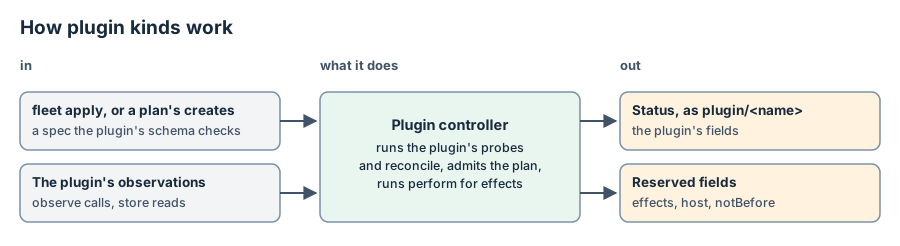
You write the spec with fleet apply, or the plugin writes it through the
creates of its plan. The store validates it against the kind's spec
schema on each write.
| Field | Type | Required | Meaning |
|---|---|---|---|
| any | as the schema says | as the schema says | The plugin's manifest defines the fields. For File: name, a file name, and content, a string. |
The spec can change, and each change increments metadata.generation. A
kind with immutableSpec: true refuses changes after creation.
Status #
The plugin writes the status, through the manager, as field manager
plugin/<name>. If the manifest gives a status schema, the manager checks
the plugin's fields against it. Three fields are reserved: the manager writes
them, and a plan that names one is refused.
| Field | Writer | Meaning |
|---|---|---|
| the plugin's fields | the plugin | Anything the schema allows. fleet status shows phase, conditions and observedGeneration when present. |
notBefore |
the manager | The earliest next pass: the plan's notBefore, else now + pollMs. |
effects |
the manager | Per effect key, intent {at, generation} written before the effect and receipt {at, outcome} after it. outcome is done, failed or unknown. The newest 100 keys. |
host |
the manager | observedAt, the last pass; generation, the spec generation it read; error, why the last pass failed; verbs, the result of each creates, amends, patches, appends, declares and deletes entry. |
Lifecycle #
The plugin defines the phases. The manager makes an object due when its
notBefore passes, when its spec has a new generation, and while it is
deleting.
fleet apply ──▶ due ──▶ probes / observe ──▶ reconcile ──▶ status, intents
                 ▲                                           │
                 └─── notBefore passes, or spec changes ◀── effects, receipts
Deletion:
- A kind without a finalizer is deleted at once.
- A kind with
finalizer: truegets the finalizerfleet.dev/plugin/<name>. The plugin reconciles the deleting object until its plan saysremoveFinalizer: true. - A plan with
delete: truedeletes the object itself.
An object of a kind whose plugin left the config stays readable. The manager reports it and never reconciles it.
Related kinds #
A plugin can act on Tasks through its plan, as a person does:
create one, set dispatch and forge, amend it, send it a message, declare
a change for it, or delete it. With tasks = "own" it acts only on the
Tasks it created, which carry the label fleet.dev/plugin: <name>.
Plugin operations lists each verb.
Commands #
fleet list plugins --json
fleet apply -f hello.json
fleet get file hello
fleet status file hello --json
fleet delete file hello
The command line takes a plugin kind lowercased, as it takes task.