Listener resource
What it is for #
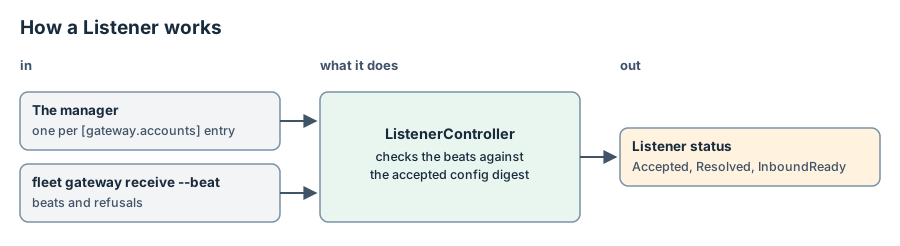
A Listener records the inbound health of one chat account. Fleet makes no
inbound call itself: a separate listener program holds the platform's
connection and hands each delivery to fleet gateway receive. The program
reports here whether it runs, is connected and uses the current
configuration. ListenerController judges that report.
When you write one #
Never. The manager creates one Listener per [gateway.accounts] entry, and
fleet gateway receive creates it when a listener beats first. fleet apply
refuses a Listener.
Example #
The Listener that the manager creates for the account slack-main:
{
  "apiVersion": "fleet/v1alpha1",
  "kind": "Listener",
  "metadata": {"name": "listener-slack-main"},
  "spec": {"account": "slack-main"}
}
fleet apply refuses this manifest: the config is the only source. Read it
with fleet status listener listener-slack-main --json.
Spec #
The manager writes the spec, by exclusive creation. It is fixed once created.
| Field | Type | Required | Meaning |
|---|---|---|---|
account |
string | yes | The [gateway.accounts] entry. The name is listener-<account>. |
Status #
| Field | Writer | Meaning |
|---|---|---|
accepted |
ListenerController | {digest, at}: the account's digest in the loaded config, the one fleet gateway account NAME --json prints, and when it was loaded. |
beats |
the listener, fleet gateway receive --beat |
Per listener instance, its last beat: {state, digest, at, sentAt, lastDeliveryAt}. state is connecting, connected or closing. At most 8 instances. |
refused |
the listener, fleet gateway receive |
{counts, lastFaultAt}: envelopes the verb refused, counted by reason, and the last one that was the listener's own fault. |
beatRevision |
the listener | Each beat and each refusal increments it. |
seen |
ListenerController | The beatRevision it last judged. A Listener is due when something new arrived. |
observedAt, notBefore |
ListenerController | When the platform last answered Known, and the earliest next pass. |
conditions |
ListenerController | Accepted, Resolved and InboundReady, as the interface defines them. |
The listener writes beats, refused and beatRevision through typed
store mutations that change nothing else. ListenerController owns the other
fields.
Lifecycle #
A Listener has no phases. Its condition InboundReady is the state to read:
- True while one instance's last beat is
connected, carries the accepted digest, is younger than threegateway.beatMs, and no envelope was refused for the listener's own fault in that time. - False within one sweep when the listener stops, stalls, runs an older configuration or sends envelopes that the verb refuses.
ListenerController deletes the Listener when its account leaves the config. The manager creates it again if the account returns. A Listener deleted by hand comes back at the next config load.
Related kinds #
- Each Conversation of an account gets its deliveries from that account's listener.
- The Gateway controller page describes the listener program and the receive verb.
Commands #
fleet gateway account slack-main --json
fleet gateway receive --account slack-main --beat < beat.json
fleet gateway status
fleet status listener listener-slack-main --json