TaskConfig resource
What it is for #
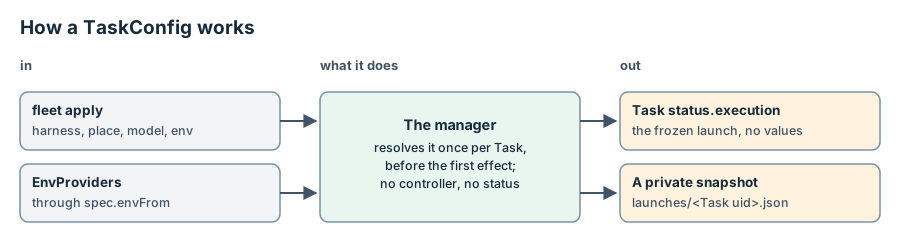
A TaskConfig holds execution defaults that many Tasks share: the harness, the place, the model, the environment, the idle pause and the agent's own telemetry. It is passive data. It has no controller and no status.
When you write one #
Write a TaskConfig when several Tasks run the same way. Each Task then names
it in spec.configRef, and keeps only its own brief, workspace and outputs.
The default TaskConfig #
A Task with no configRef takes its defaults from the TaskConfig named
default, when the store holds one. fleet init writes it:
{
  "apiVersion": "fleet/v1alpha1",
  "kind": "TaskConfig",
  "metadata": {"name": "default"},
  "spec": {"pauseAfterMs": 1800000}
}
So an idle session pauses after 30 minutes (pausing an idle session).
- A Task's own field overrides it, as for any TaskConfig.
- A Task with a
configReftakes that TaskConfig instead, and nothing fromdefault. - A repeated
fleet initkeepsdefaultas it is, and writes it again when it is gone. To never pause, applydefaultwith nopauseAfterMs. - A Task takes
defaultwhen it first launches. A Task launched beforedefaultexisted keeps its launch. defaultdoes not setagentTelemetry. So when Fleet exports telemetry, each agent exports its own to the same collector. To turn that off for every Task, applydefaultwith"agentTelemetry": false.
Example #
{
  "apiVersion": "fleet/v1alpha1",
  "kind": "TaskConfig",
  "metadata": {"name": "reviewer"},
  "spec": {
    "harness": "claude-code",
    "host": "local",
    "envFrom": [{"name": "project-env"}],
    "env": {"REVIEW_MODE": "careful"}
  }
}
A Task that uses it:
{
  "apiVersion": "fleet/v1alpha1",
  "kind": "Task",
  "metadata": {"name": "review"},
  "spec": {
    "configRef": {"name": "reviewer"},
    "env": {"REVIEW_MODE": "focused"},
    "workspace": ["file:///work/project"],
    "brief": "Review the current change.",
    "dispatch": false
  }
}
fleet apply accepts a reference to a TaskConfig or an EnvProvider that
does not exist yet. The manager checks every reference when it resolves the
launch.
Spec #
You write the spec with fleet apply. You can change it at any time. A
change applies to Tasks that resolve their launch after it.
| Field | Type | Required | Meaning |
|---|---|---|---|
harness |
string | no | The default harness. The Task or this TaskConfig must give one. |
host |
string | no | The default place: <runtime>/<place>, or local. Without one, a Task runs on local. |
model |
string | no | The default model. A runtime under [runtimes] passes no model to its harness, and refuses a Task that has one. |
envFrom |
array of {name} |
no | EnvProviders, in merge order. |
env |
object of strings | no | Environment values. They override every EnvProvider value. |
agentTelemetry |
boolean | no | false: the agent exports no telemetry of its own, also when Fleet exports. Absent: on. See coding agents. |
pauseAfterMs |
integer, at least 1 | no | Pause a Task's session once its agent was idle this long. Absent: never. A session on a runtime that cannot pause, of a harness Fleet cannot resume, or whose hooks report no activity never pauses either. See pausing an idle session. |
harness, host and model may not be empty, contain NUL or start with
-. Any other field is refused.
A Task overrides a default when it gives the field itself. A Task with
"model": null drops an inherited model. A Task with "host": "local"
overrides another default place. The environment merges in this order, and
a later value wins, case variants included:
EnvProvider data -> EnvProvider sources -> TaskConfig envFrom (in order)
  -> TaskConfig env -> Task env
env is visible to anyone who reads the resource. It is not a place for
secrets: use an EnvProvider file or command source.
Status #
None. Nobody writes the status of a TaskConfig.
Lifecycle #
A TaskConfig has no phases. Deletion removes it at once. A Task that has not
resolved its launch then blocks with an error in fleet reconcile. A Task
that already resolved it continues.
Resolution and freezing #
Task with configRef, env or a default TaskConfig, dispatch: true
  -> check every TaskConfig and EnvProvider reference
  -> resolve the sources through the store and the runtime port
  -> write a private snapshot, launches/<Task uid>.json, under the lease
  -> write status.execution: harness, place, model, pauseAfterMs and the
     kind, name, uid and generation of each source, without values
     (the snapshot also keeps agentTelemetry)
  -> spawn and brief as usual
The first resolution that succeeds is frozen. Retries and manager restarts
reuse the snapshot. A later edit, deletion or recreation of a TaskConfig or
an EnvProvider never changes a Task that resolved its launch. A missing,
deleting or invalid reference blocks the launch with an error in
fleet reconcile. Fleet never starts a session with a partial launch.
The snapshot is plaintext. On Unix its directory and files are 0700 and
0600. On Windows it inherits the store's ACL. The store removes it when it
deletes the Task. A Task whose snapshot is missing after its launch was
frozen blocks: restore the snapshot from a protected backup, or delete and
recreate the Task. The environment reaches the session in the runtime's
start request on stdin. It never enters a status, an intent, an error or
an argument list.
Related kinds #
- A Task names a TaskConfig in
spec.configRef. - A TaskConfig names EnvProviders in
spec.envFrom. - A TaskConfig is a resource, separate from
fleet.toml. A Task with noconfigReftakes the default TaskConfig.
Commands #
fleet apply -f task-config.json
fleet get taskconfig reviewer
fleet list taskconfigs --json
fleet delete taskconfig reviewer